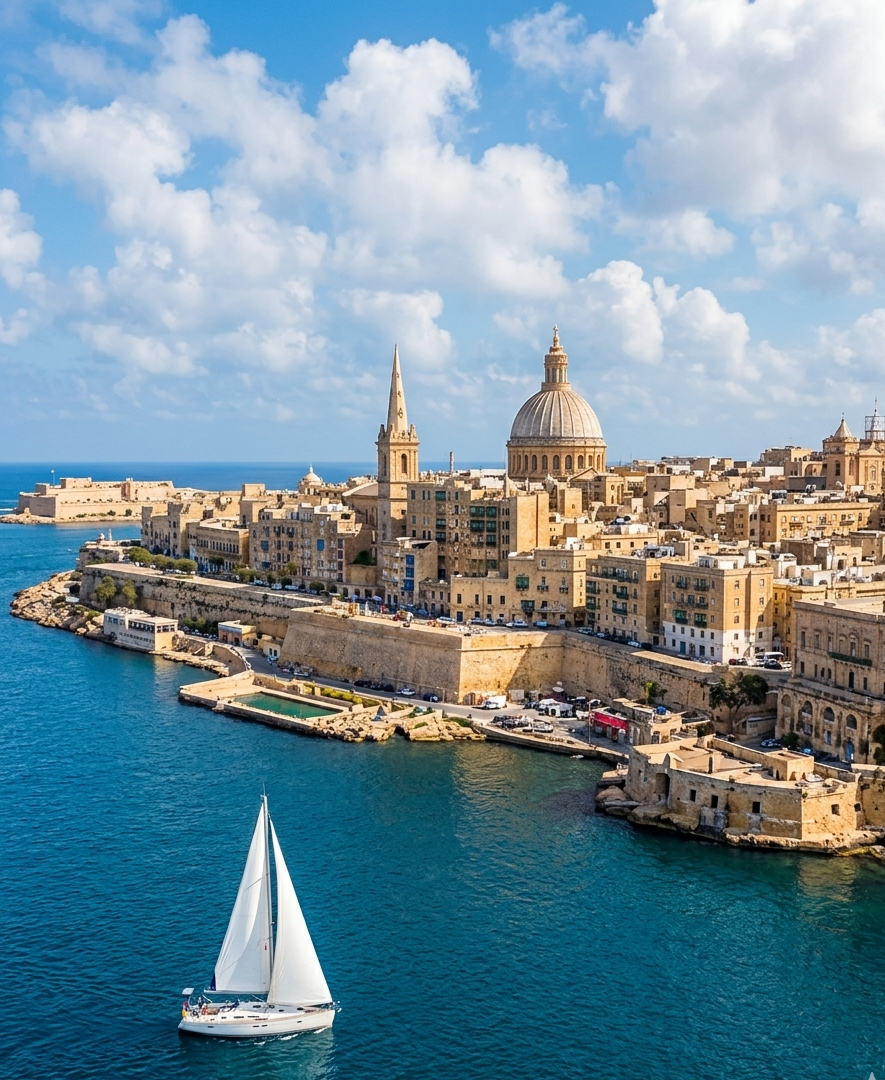
Most Valletta guides tell you it’s a UNESCO World Heritage Site with baroque architecture and harbour views. True, but that description fits half the old towns in the Mediterranean. What actually makes Valletta different is more specific: it was built in fifteen years flat, entirely on purpose, by an order of warrior monks who had just survived an invasion and wanted to make absolutely sure it never happened again. Every straight street, every thick wall, every narrow entrance was a decision, not an accident of centuries. This guide covers that story properly, plus the practical layer most articles skip: which cannon fires when, where the Caravaggio actually hangs, which restaurant claim in half the “best of Valletta” lists is simply wrong, and how to park without losing an hour to it.
Why Valletta exists, and why it looks the way it does
In 1565, the Knights of St John, a military and hospitaller order that had already been driven out of Rhodes once, held Malta against a massive Ottoman invasion. The Great Siege very nearly ended the Order for good. It didn’t, and the man who led the defence, Grand Master Jean Parisot de Valette, drew an immediate lesson from how close it had been: the Knights needed a capital that could never be besieged that way again.
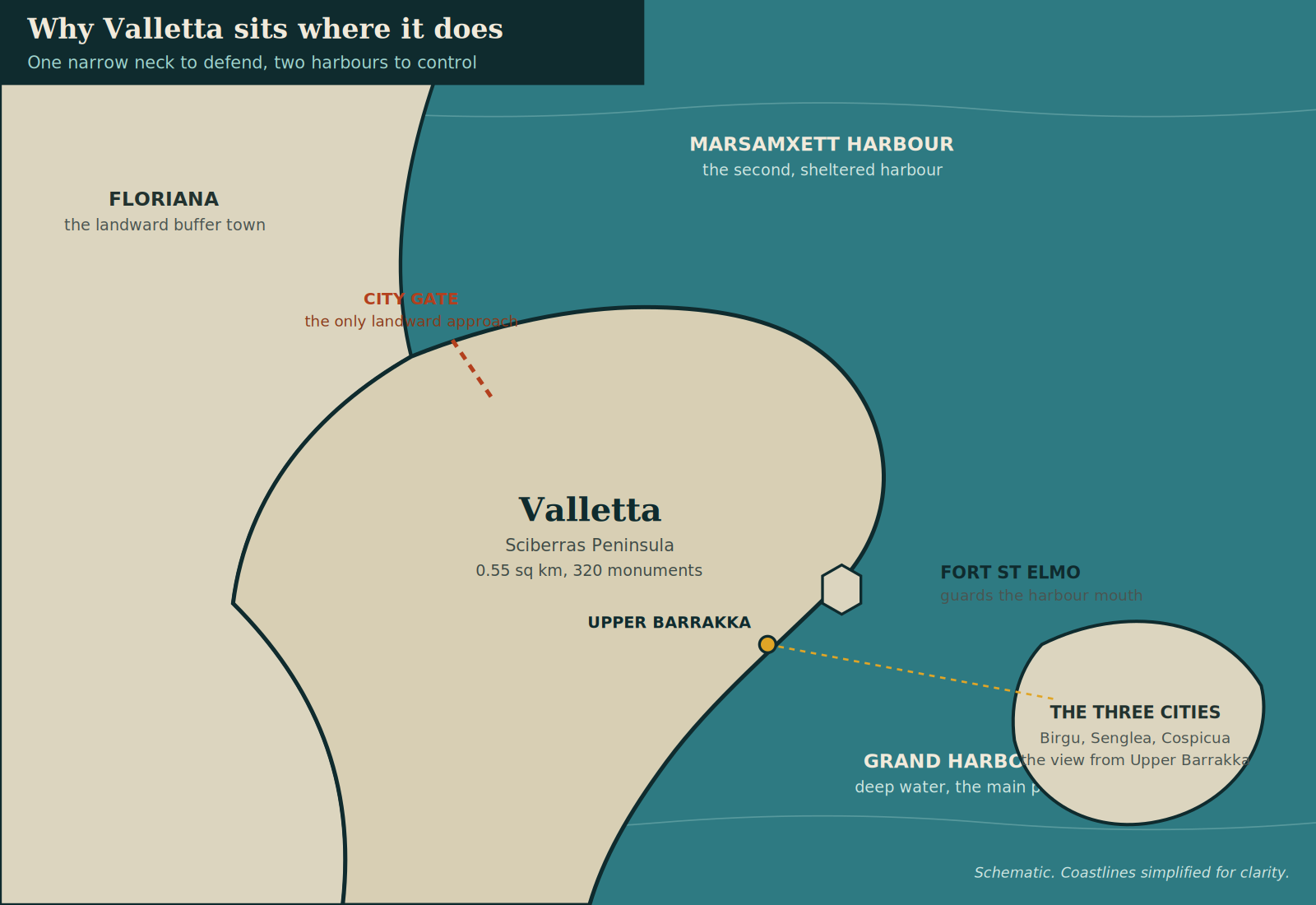
The site he chose explains almost everything about how the city looks today. The Sciberras Peninsula sits between two natural harbours, the Grand Harbour on one side and Marsamxett Harbour on the other, with only a narrow neck of land connecting it to the rest of Malta. Control that neck and you control both harbours. De Valette laid the foundation stone on 28 March 1566, and the new city was named Valletta in his honour. The Order brought in Francesco Laparelli, an Italian military engineer who had trained under Michelangelo, to design it. Laparelli made a choice that was genuinely radical for the period: rather than let the city grow organically the way every other Maltese town had, he laid it out on a strict grid plan, wide straight streets running from the City Gate down to Fort St Elmo at the tip, built for defence and for moving troops and supplies quickly. When Laparelli left in 1570, his Maltese assistant Girolamo Cassar took over and effectively finished the job, also designing many of the city’s most important buildings himself. The whole thing, walls included, went up in roughly fifteen years, an extraordinary pace funded by donations from European monarchs who saw the Knights as Christendom’s front line against Ottoman expansion. Valletta has functioned as Malta’s capital ever since, and UNESCO inscribed the entire city as a World Heritage Site in 1980, recognising what is still one of the most concentrated collections of historic architecture anywhere in the world: 320 monuments packed into just 0.55 square kilometres.
What Valletta actually feels like
Unlike Mdina, which emptied out once it lost its role as capital, Valletta never stopped being used. It’s still where Malta’s Parliament, courts and government ministries sit, and that gives it a completely different rhythm: people walking with purpose, cafés doing real trade, the city working rather than being preserved behind glass. Walk in through City Gate and the first thing that registers is the stone itself. Valletta is built almost entirely from local limestone, and in direct sun it turns a warm, consistent gold that ties the whole city together visually, arguably more than any single building does. The main streets are wide and easy, a direct legacy of Laparelli’s grid, but the side streets are where the texture is: enclosed wooden balconies painted in faded greens and blues, narrow stone stairways, doors that have clearly been repainted many times over centuries rather than replaced. Move a couple of streets off Republic Street, the main spine, and the crowds drop away fast. Quiet residential corners, small courtyards, empty alleys where laundry hangs between buildings, that’s genuinely just as much Valletta as the main tourist run, and most visitors never see it.
What to actually see
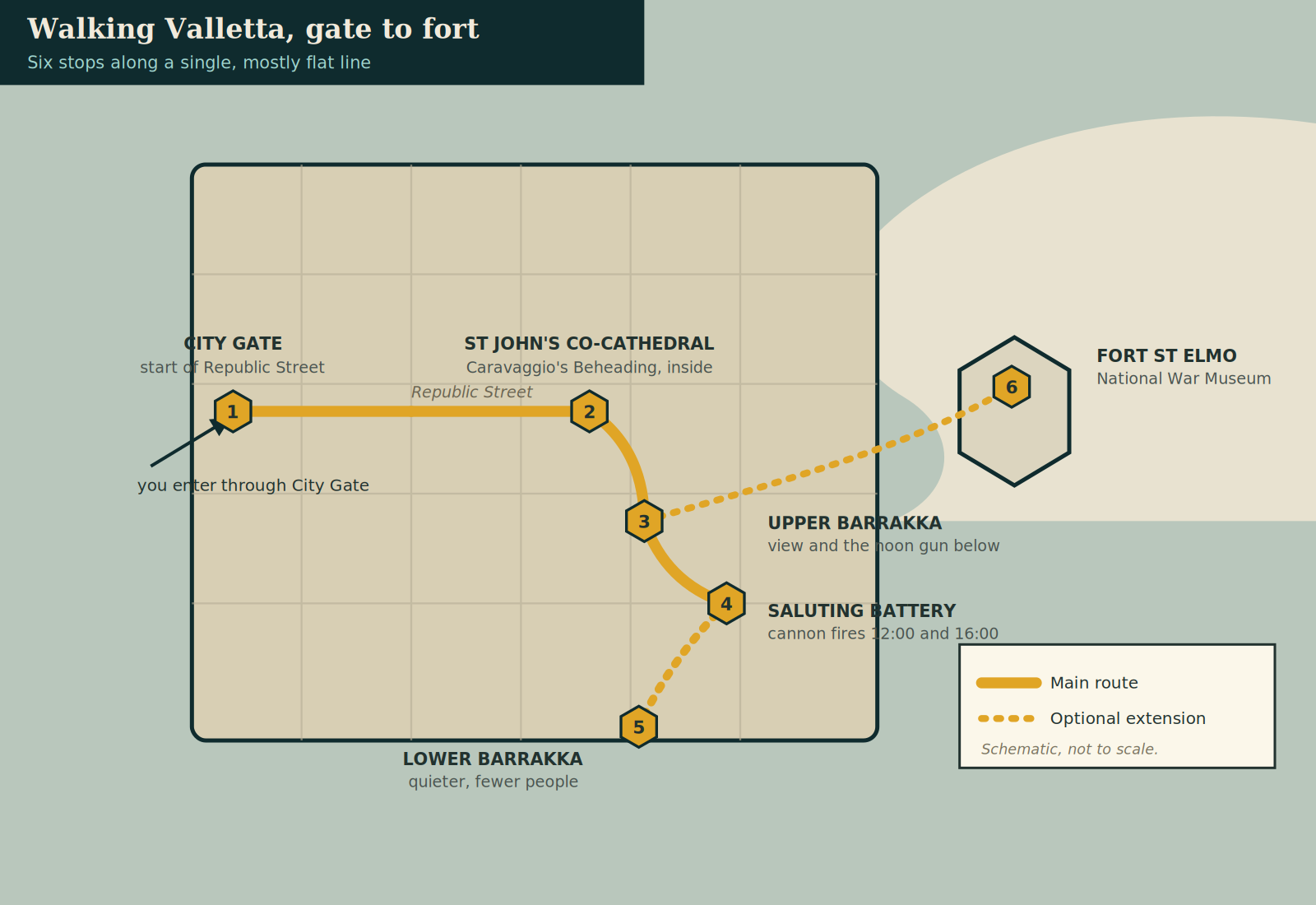
St John’s Co-Cathedral looks deliberately plain from the outside, almost military. Walk in and the contrast is the whole point: gold leaf, marble, and an interior that ranks among the most extravagant Baroque spaces in Europe. The cathedral floor itself is remarkable on its own, made up of roughly 400 inlaid marble tombstones, each marking a Knight of the Order. The reason most people actually come, though, is in the attached Oratory: Caravaggio’s The Beheading of Saint John the Baptist, painted in 1608. It’s the largest painting Caravaggio ever produced and, more strikingly, the only work he ever signed, his name written into the blood flowing from the saint’s severed neck. The same Oratory holds a second Caravaggio, St Jerome Writing. Caravaggio painted both while a member of the Order himself, not long before he was expelled and imprisoned in Malta for a separate violent incident. Upper Barrakka Gardens sit on the bastions above the Grand Harbour and give you the single best panorama in the city: the water, and directly across it, the Three Cities of Birgu, Senglea and Cospicua, the fortified towns the Knights defended before Valletta existed. Directly below the gardens is the Saluting Battery, where a cannon fires daily at noon and again at 4pm, a tradition that runs back to the Knights themselves and continued under British rule. It’s genuinely loud and worth timing your visit around; arrive a little early, since a short commentary usually runs before the noon firing and the terrace above fills up fast. The battery is generally closed on Christmas, New Year, Good Friday and Easter. Lower Barrakka Gardens, a short walk further along the fortifications, gets a fraction of the visitors Upper Barrakka does, despite having its own harbour views and a small neoclassical monument. It’s the better stop if what you actually want is somewhere to sit down quietly. Walking the city walls and bastions more generally is worth doing on its own terms, not just as a route between two gardens. The angle on the harbour changes constantly, and it’s the clearest way to feel the scale of what Laparelli and Cassar actually built. Fort St Elmo, at the very tip of the peninsula where Laparelli’s grid terminates, guards the mouth of both harbours and now houses the National War Museum, covering Malta’s military history from the Knights through to the Second World War siege of Malta.
The quieter side
Step away from Republic Street and Merchants Street and the character shifts fast. Empty alleys, residential balconies, small unmarked courtyards, corners that see almost no tourist traffic even at the height of summer. This isn’t a separate itinerary so much as a five-minute detour from wherever you already are, and it’s consistently where the city feels most like an actual place rather than a stage set.
Eating in Valletta
For a city this size, the food scene punches well above its weight. Sotto Pinsa Romana, at 32 South Street, is the name that comes up constantly, and deserves it: Roman-style pinsa, a lighter, more digestible relative of pizza, in a cosy stone-walled basement space that’s easy to walk straight past if you’re not looking for it. It gets busy, so book ahead if you can. Along and around Republic Street you’ll find the highest concentration of cafés, ideal for a coffee or a quick bite between sights, and there’s also a McDonald’s on Republic Street itself, useful to know if you’re travelling with kids who need a reliable option. Beyond that, Valletta’s small footprint holds a genuinely wide spread of restaurants, from traditional Maltese and fresh seafood to modern international menus, particularly around the waterfront.
Parking in Valletta
Parking inside the city itself is limited and mostly reserved for residents, so plan to park just outside and walk in. The most straightforward option is the MCP underground car park, just outside the city, which connects directly to the Valletta Waterfront through a tunnel. It’s paid, with rates that run noticeably higher than the alternative below, but it’s reliable and well signposted. The better value option for most visitors is the Floriana Park & Ride, immediately next to Valletta, with over 750 spaces and a free shuttle running every 5 to 10 minutes into the city centre. At around €0.40 to €1 for the day, it’s dramatically cheaper than the MCP car park. It operates daily from 6am to 9pm, though the shuttle service typically doesn’t run on Sundays and public holidays, so on those days plan to walk the roughly 15 to 20 minutes into the city instead. Cars entering Valletta itself are also subject to a Controlled Vehicular Access charge, which is a further reason most visitors are better off parking outside and walking in rather than driving into the city directly.
Getting to Valletta
If you’re staying in Sliema or St Julian’s, Valletta is close and easy, by taxi, rideshare, or the regular ferry that crosses the harbour, which is genuinely one of the more scenic ways to arrive. From elsewhere on the island, buses run frequently into the Valletta terminus just outside City Gate from all major towns, since the national bus network is largely built around routes converging on the capital.
Malta International Fireworks Festival
This isn’t a rare stroke of luck, it’s an annual fixture, held over several nights each spring, typically in April, with the Grand Harbour hosting the competition nights and grand finale. Dozens of local and international fireworks teams compete in a judged pyro-musical format, choreographing displays precisely to music. Public viewing areas along the bastions and waterfront are free, and displays generally start around 8:30pm. If you want a harbourside table with a direct view, book well in advance through the Valletta Waterfront restaurants, since tables disappear fast on festival nights and last-minute reservations rarely work. Upper Barrakka Gardens, the Valletta Waterfront itself, and the Three Cities across the harbour are the three classic vantage points, each giving a genuinely different angle on the same show.
Valletta versus Mdina
They’re often paired in the same day, and the contrast is exactly the point. Mdina is the city that emptied out: quiet, residential, frozen in scale since the 1500s. Valletta is the city that replaced it and never stopped working: busier, louder, still functioning as the seat of government eight generations later. Seeing both in the same trip gives you a genuinely fuller picture of Malta than either one alone.
Best time to visit
Morning brings cooler temperatures and thinner crowds, particularly useful in summer before the stone genuinely starts radiating heat. Evening is when the city is at its best for walking, photography and food, as the light softens and the day-trip crowds thin out. Spring and autumn are the most comfortable seasons overall, and even summer is manageable thanks to the sea breeze, though the shadeless stretches along Republic Street get genuinely hot by early afternoon.
How much time to allow
Half a day covers the core sights at a reasonable pace: City Gate, Republic Street, St John’s Co-Cathedral, and the Upper Barrakka view. A full day lets you add the museums, a proper sit-down meal, and time to just wander the quieter streets without a schedule, which is genuinely where a lot of the city’s character lives.
Frequently asked questions
When was Valletta built?
Construction began in 1566, with the foundation stone laid by Grand Master Jean Parisot de Valette on 28 March 1566, following the Great Siege of Malta in 1565. The bulk of the city was completed within about fifteen years.
Why is Valletta a UNESCO World Heritage Site?
Valletta was inscribed as a UNESCO World Heritage Site in 1980 for its exceptional concentration of historic architecture: 320 monuments within just 0.55 square kilometres, built as a single, unified Renaissance-era plan rather than growing organically over time.
Where is the Caravaggio painting in Valletta?
The Beheading of Saint John the Baptist, Caravaggio’s largest work and the only painting he ever signed, hangs in the Oratory of St John’s Co-Cathedral. The same room holds a second Caravaggio, St Jerome Writing.
What time does the cannon fire in Valletta?
The Saluting Battery, below Upper Barrakka Gardens, fires its cannon daily at noon and again at 4pm. Arrive a little early, since a short commentary usually precedes the noon firing and the viewing terrace fills up quickly.
Is Rainforest Cafe in Valletta?
No. Rainforest Cafe is located on Bay Street in St Julian’s, roughly 3 kilometres from Valletta. It’s a genuine and popular restaurant, but it’s not inside the capital, despite appearing on some Valletta restaurant lists.
Where should I park to visit Valletta?
The Floriana Park & Ride, immediately next to Valletta, offers the best value with over 750 spaces, a free shuttle every 5 to 10 minutes, and a daily rate of around €0.40 to €1. The MCP underground car park is a paid alternative with a direct tunnel to the Valletta Waterfront, at a noticeably higher rate. Driving directly into Valletta itself incurs a Controlled Vehicular Access charge.
How do I get from Sliema or St Julian’s to Valletta?
The passenger ferry across the harbour is the fastest and most scenic option. Taxis and rideshare apps are also quick. Buses run frequently from both towns into the Valletta terminus as well.
When is the Malta International Fireworks Festival?
It’s held annually over several nights in spring, typically in April, with competition nights and a grand finale over the Grand Harbour. Displays usually start around 8:30pm, and public viewing areas are free, though harbourside restaurant tables should be booked well in advance.
How long do you need in Valletta?
Half a day covers the main sights at a comfortable pace. A full day allows time for the museums, a proper meal, and wandering the quieter side streets away from Republic Street.
What is the best time of day to visit Valletta?
Morning offers cooler temperatures and fewer crowds, particularly valuable in summer. Evening brings softer light for photography and a livelier café atmosphere as day-trippers leave. Midday in summer is the hottest and busiest stretch, with little shade along the main streets. Valletta rewards a slower pace than most visitors give it. See the Caravaggio, time the cannon, eat well on South Street, and then just walk, since the fifteen years the Knights spent building this city on purpose are still doing all the work centuries later.