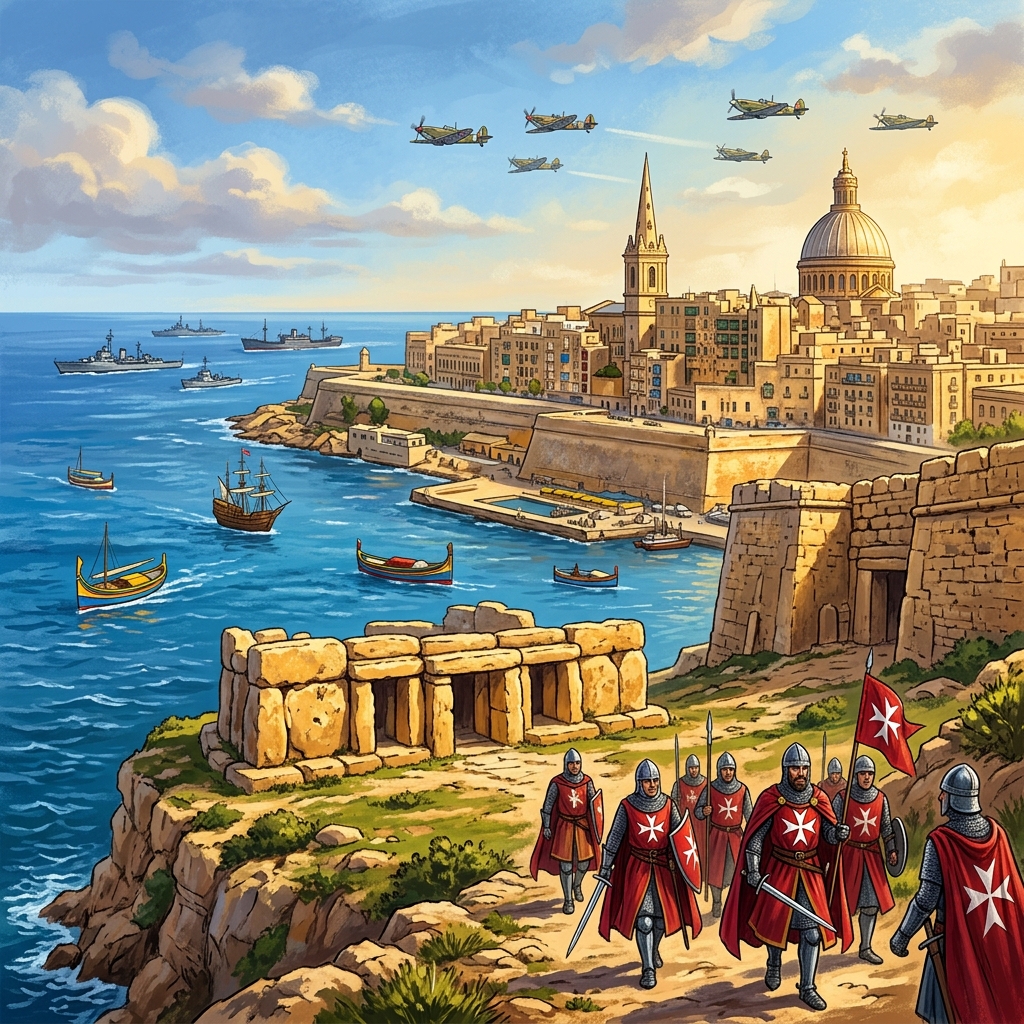
Mediterranean Island Nation
Malta
A living museum at the heart of the Mediterranean – where ancient temples, epic sieges, and modern Europe share the same shoreline.
Where Is Malta Located?
Malta is a small island country located in the central Mediterranean Sea, in Southern Europe. It sits just south of Sicily (Italy) – about 80 to 100 km across the water – and to its south lies North Africa, including Libya. This places Malta at a unique geographic crossroads between Europe and Africa.
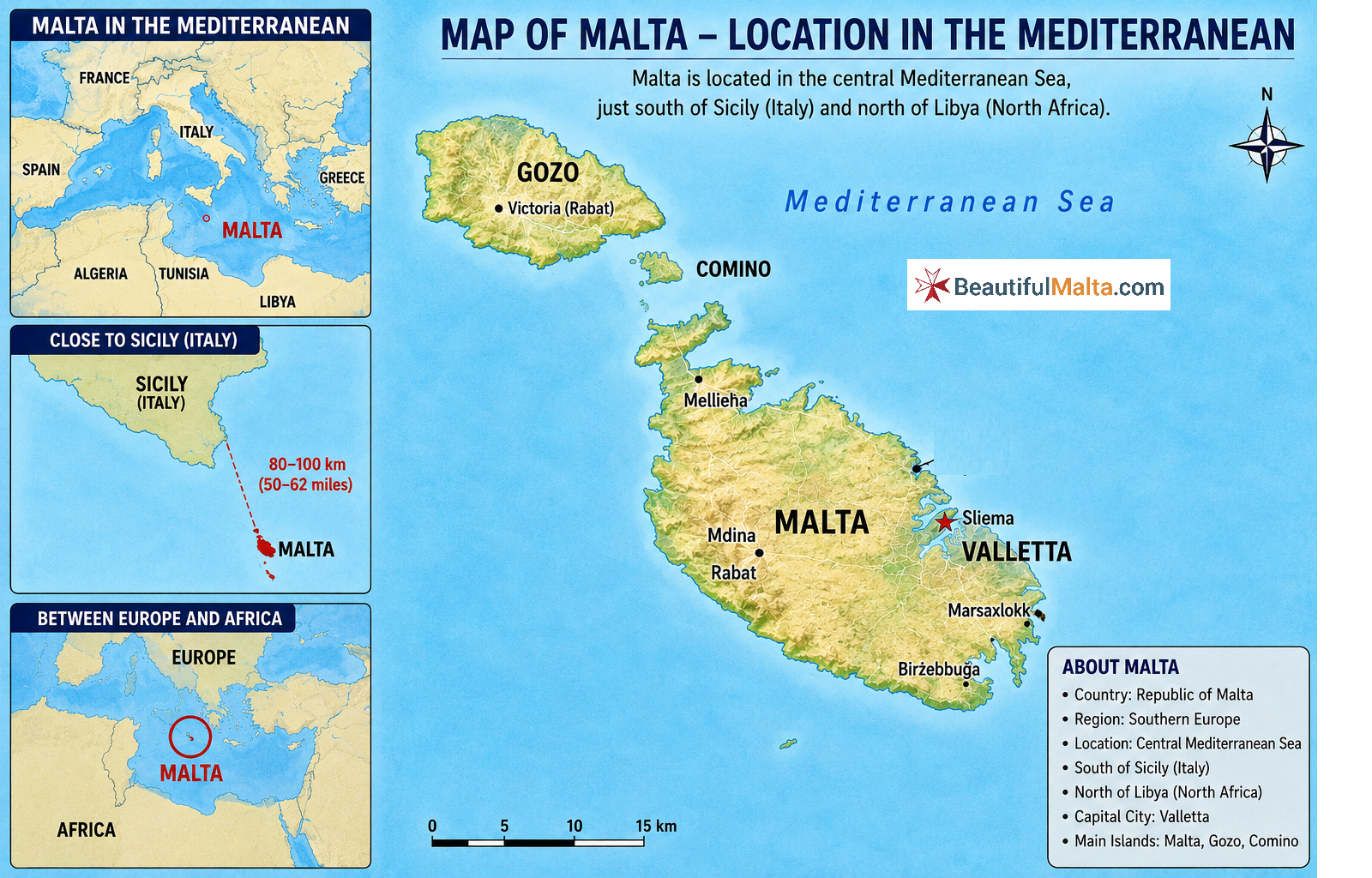
Because of this central position, Malta has always been an important hub for trade, travel, and military control. Today it is known for its strong historical and cultural ties with nearby countries like Italy and Tunisia, and its deep blue Mediterranean waters make it easy to spot on any map – a tiny archipelago punching far above its size in history and influence.
Why Is Malta a Famous Destination?
Malta sits at the heart of the Mediterranean and is widely recognised as one of the region’s most beautiful and historic island destinations. With its blue waters, ancient cities, and thriving tourism scene, it attracts travellers from around the world.
Yet beyond its scenic charm lies a story stretching back thousands of years. Because of its strategic location, every major empire wanted to control its natural harbours – conquerors, traders, and knights all left their mark on these shores. For anyone fascinated by Mediterranean culture, old civilisations, and European heritage, Malta offers a remarkable journey through time.
Malta averages over 300 days of sunshine and more than 3,000 hours of sunlight annually – one of the highest figures in all of Europe. While the Schengen zone’s sunniest cities are mostly large urban centres in Spain and Italy, Malta stands out as the sunniest small island nation in the area. Mild winters (rarely below 15°C), warm summers, and a sea you can swim in from May to October make it a genuine year-round destination – not just a summer one.
The Dawn of Civilisation: Neolithic Temples
Human activity in Malta began long before recorded history. The story stretches back to around 5000 BC – nearly 7,000 years ago – when early settlers arrived, most likely from nearby Sicily. These ancient communities laid the foundations of one of the Mediterranean’s earliest civilisations and built some of the world’s oldest free-standing temples, older than Egypt’s pyramids.
Ħaġar Qim, Mnajdra, and Ġgantija
These limestone temples were constructed before the Egyptian Pyramids and Stonehenge, using massive stone blocks weighing several tons – without metal tools or the wheel. The builders aligned their temples with solar solstices, created intricate pottery, and carved stone figures of full-figured deities. All three sites are now UNESCO World Heritage Sites.
Then, around 2500 BCE, this entire civilisation vanished. Historians still debate why – climate change and resource depletion are the most likely causes. Their ruins remain Malta’s proudest ancient monuments.
Crossroads of the Mediterranean: Early Conquerors
Malta’s central position in the Mediterranean made it an important trading and military centre, prized by the great seafaring powers of the ancient world. Each wave of arrivals added another layer to Malta’s identity.
The Knights of St. John: A Golden Age
In 1530, Holy Roman Emperor Charles V granted Malta to the Order of the Knights of St. John – also known as the Knights Hospitaller – for the symbolic annual rent of a single Maltese falcon. The Knights were an elite Catholic military order made up of noblemen from across Europe, and they transformed Malta from a quiet island outpost into a major military, religious, and cultural centre.
They built strong forts, grand churches, hospitals, palaces, and impressive cities – many of which still attract visitors today. This period is widely seen as Malta’s golden age.
The Great Siege of 1565
The Ottoman Empire sent an armada of 40,000 soldiers to conquer the island. The defending force consisted of just 700 knights and around 8,000 Maltese militia. Under Grand Master Jean Parisot de Valette, the defenders held out against massive bombardment for nearly four months – and the Ottomans retreated.
This victory is one of the most celebrated in European history. To protect against future attacks, the Knights built a new heavily fortified capital city and named it Valletta in honour of their heroic Grand Master. The Knights ruled for over 250 years, funding magnificent baroque churches, opulent palaces, and masterpieces – including works by Caravaggio.
The British Empire & World War II
The Knights’ era ended when Napoleon captured Malta in 1798. French rule was short-lived – they plundered churches and quickly lost local support. The Maltese rebelled, sought British help, and by 1800 the French had surrendered. In 1814, Malta formally became part of the British Empire, developing into a vital naval base in the Mediterranean.
British rule introduced new administrative systems, the English language, and modernised naval dockyards. Malta became headquarters for the British Mediterranean Fleet – which made it a primary target during World War II.
The Bombing of Malta (1940-1942)
Between 1940 and 1942, Italian and German air forces carried out thousands of raids on Malta, aiming to break its resistance and cut off supplies.
~7,000 tons – extremely concentrated
~18,000 tons – spread across entire country
Despite far less total tonnage, Malta’s small size meant it suffered one of the highest bomb densities per square kilometre of any place in the war.
Maltese civilians sheltered in rock-hewn underground tunnels and refused to give in. In recognition of this extraordinary courage, King George VI awarded Malta the George Cross in 1942 – the highest civilian gallantry honour, still proudly displayed on the Maltese national flag today.
After the war, Malta moved steadily toward self-government, gained independence in 1964, and became a republic in 1974.
Modern Malta: A Tapestry of Cultures
Today, Malta is a proud, independent nation within the European Union and one of Europe’s most popular tourist destinations. Walking its streets, you can see the physical evidence of its layered history everywhere – in the architecture, the food, the language, and the way its people celebrate.
🏛️ Architecture
Red British telephone boxes beside baroque churches built by the Knights, near Arab-style city walls and Roman ruins
🍽️ Cuisine
Pastizzi pastries and rabbit stews reflect a blend of Sicilian, British, and North African flavours
🎆 Festas
Village festivals combining intense Catholic devotion with explosive fireworks traditions dating back centuries
A Fast-Growing Economy & Europe’s iGaming Capital
Modern Malta is not just a tourist destination – it is one of the EU’s fastest-growing economies. Driven by tourism, financial services, technology, and a booming digital sector, Malta recorded one of the strongest GDP growth rates in the entire eurozone in recent years.
Malta was the first EU member state to regulate online gambling back in 2004, giving it a two-decade head start over rival jurisdictions. Today, hundreds of EU-licensed iGaming companies are headquartered here – from major operators to software developers, payment providers, and legal firms that serve the global industry. The Malta Gaming Authority (MGA) is widely regarded as one of the most respected gambling regulators in the world, making a Malta licence the gold standard for operators targeting European markets.
Beyond iGaming, Malta has attracted fintech firms, blockchain companies, and esports organisations – with €60 million in new gaming and esports investment confirmed by 2026, bringing around 1,300 new high-skilled jobs to the islands.
Malta in the European Union
Famous places like Valletta, Mdina, Fort St. Elmo, the Blue Grotto, and the island of Gozo continue to showcase the unique charm that makes modern Malta so appealing to visitors from around the world.
What Languages Are Spoken in Malta?
Malta has two official languages, both widely used in everyday life.
Malta is much more than a sunny Mediterranean holiday destination. It is a living, breathing museum where the ancient world meets modern European life. From the stone temples of prehistoric builders to the battered walls of World War II shelters, every corner tells a story of survival and adaptation.
The story of Malta is, in many ways, the story of the Mediterranean itself.
Explore further: discover Valletta’s baroque architecture or find the best historical walking tours in Mdina.