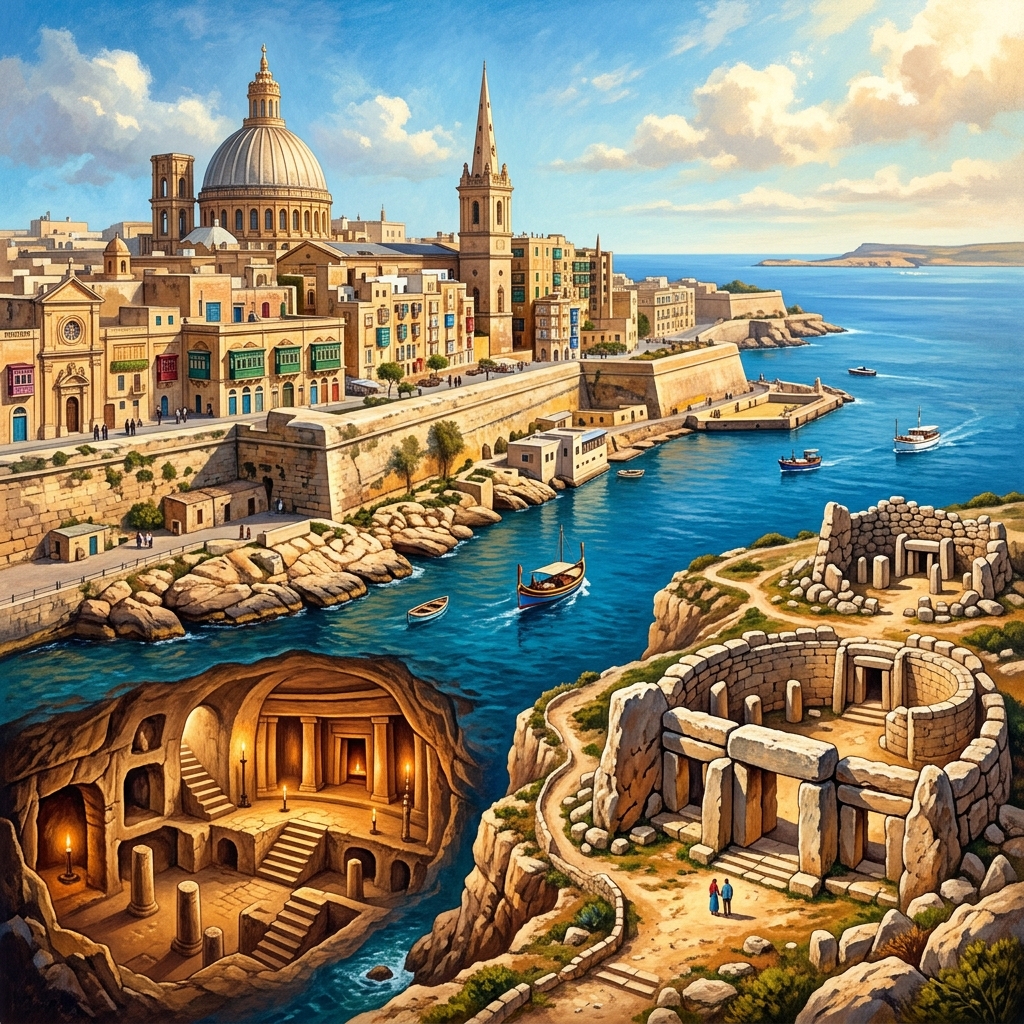
Malta might be one of the smallest countries in the world, but it holds some of the most extraordinary historical treasures you will ever experience. Sitting right in the heart of the Mediterranean Sea, this tiny archipelago has served as a crossroads for empires, knights, and ancient civilizations. These diverse groups left behind magnificent structures that still stand proudly today.
If you love history and travel, exploring the Malta UNESCO World Heritage Sites offers a perfect adventure. UNESCO recognizes these specific locations for their outstanding universal value to humanity. They give us a rare glimpse into how ancient people lived, worshipped, and defended their homes.
In this guide, we will explore the three official UNESCO World Heritage Sites in Malta and Gozo: 1. Valletta, 2. Ħal Saflieni Hypogeum, 3. Megalithic Temples of Malta. Together, these remarkable landmarks reveal the rich history, architecture, and cultural heritage that make Malta and Gozo so special.
1. Valletta: The Fortress City
UNESCO recognized Malta’s capital city, Valletta, as a World Heritage Site in 1980. People often describe Valletta as an open-air museum because it contains 320 monuments within an incredibly compact area. Walking through its grid-like streets feels like stepping straight into the 16th century.
The Historical Context of Valletta
The story of Valletta begins with the Knights of St. John. After surviving the devastating Great Siege of 1565 against the Ottoman Empire, the Knights realized they needed a stronger fortress. Grand Master Jean Parisot de Valette laid the foundation stone for the new city in 1566.
The Knights built Valletta on the barren Mount Sceberras peninsula, entirely by hand. They designed it as a formidable fortress to protect the island’s two deep natural harbors. European nobility poured money into the project, allowing the best military engineers and architects of the time to create a masterpiece of urban planning.
Unique Features and Significance
Valletta features a brilliant grid system designed to let the sea breeze cool the streets during hot summer months. The city boasts towering bastion walls, grand palaces, and stunning baroque architecture. Traditional wooden balconies, painted in vibrant colors, line the narrow streets and create picture-perfect views at every turn.
One of the most significant landmarks within the city is St. John’s Co-Cathedral. From the outside, it looks like a simple, austere fortress. However, stepping inside reveals one of the most dazzling baroque interiors in all of Europe. The cathedral houses intricate gold leaf decorations, marble tombstone floors, and the famous painting “The Beheading of Saint John the Baptist” by Caravaggio.
Valletta represents a perfect blend of military architecture and artistic brilliance. It stands as a testament to the power, wealth, and strategic importance of the Knights of St. John. Plan your visit with our Valletta guide, and don’t miss Fort St Elmo and the National War Museum at the tip of the city.
2. Ħal Saflieni Hypogeum: An Underground Marvel
Also securing its UNESCO status in 1980, the Ħal Saflieni Hypogeum is arguably the most mysterious site on the island. Located in the town of Paola, this site is a massive underground sanctuary and burial complex carved entirely out of solid limestone rock.
Prehistoric Origins
Ancient builders constructed the Hypogeum between 4000 BC and 2500 BC. They worked in near darkness, using only crude tools made from bone, antlers, and harder stones like chert and obsidian. Over centuries, they excavated deeper and deeper into the earth, creating a three-level labyrinth of interconnected chambers, halls, and passages.
Construction workers accidentally discovered the Hypogeum in 1902 while digging a cistern for a new housing development. Archaeologists later found the remains of roughly 7,000 individuals inside, along with pottery, amulets, and stone carved figures.
Mysteries and Architectural Brilliance
The Hypogeum mimics the architecture of Malta’s above-ground megalithic temples. The builders carved false doors, pillars, and lintels directly into the cave walls. Many of the walls feature ancient red ochre paintings, consisting of intricate spiral and honeycomb designs that still baffle historians today.
One of the most fascinating features of the Hypogeum is the “Oracle Chamber.” This specific room possesses incredible acoustic properties. If someone speaks in a low, resonant voice inside this chamber, the sound amplifies and echoes throughout the entire underground complex.
Because the microclimate inside the Hypogeum is incredibly fragile, Heritage Malta strictly limits the number of daily visitors. If you want to experience this eerie, subterranean masterpiece, you must book your tickets several months in advance.
3. The Megalithic Temples of Malta and Gozo
The third UNESCO World Heritage Site actually consists of seven distinct temples spread across the islands of Malta and Gozo. In 1980, UNESCO initially listed the Ġgantija temples. In 1992, they expanded the list to include five other major temple complexes. These structures rank among the oldest free-standing stone buildings in the world, predating the Egyptian pyramids by more than a thousand years.
Ġgantija Temples (Gozo)
Located on the sister island of Gozo, the Ġgantija Temples date back to approximately 3600 BC. The name “Ġgantija” translates to “Giant’s Tower” in the Maltese language. For centuries, local legends claimed that actual giants built these massive structures because the limestone blocks weigh up to 50 tons each.
The complex consists of two separate temples enclosed by a massive boundary wall. The ancient builders used rough, coralline limestone for the exterior walls to withstand the elements, while using softer globigerina limestone for the detailed interior doorways and altars. The sheer scale of Ġgantija makes it a magnificent engineering triumph of the prehistoric world. Read our full Ġgantija Temples visitor guide for tickets and tips.
Ħaġar Qim and Mnajdra Temples
You will find the Ħaġar Qim and Mnajdra temples sitting on a rugged cliffside on the southern coast of Malta. These temples overlook the vast Mediterranean Sea and the small, uninhabited islet of Filfla.
Ħaġar Qim features a massive main facade with towering stone slabs. Archaeologists found several “fat lady” statues here, which likely represent fertility goddesses or ancient deities.
Just a short walk down the hill lies the Mnajdra temple complex. Mnajdra is famous for its astonishing astronomical alignment. During the Spring and Autumn Equinoxes, the rising sun shines perfectly through the main doorway, illuminating the central axis of the temple. During the Summer and Winter Solstices, the sunlight perfectly strikes the edges of specific megaliths left and right of the entrance. This proves that these ancient builders possessed a deep understanding of astronomy and changing seasons. Our Ħaġar Qim and Mnajdra guide explains how to visit both temples.
Tarxien Temples
The Tarxien Temples sit in a highly residential area, making them a unique contrast of ancient and modern life. Discovered in 1913 by local farmers, this site represents the most complex and artistically advanced phase of Malta’s temple-building era (around 3100 BC to 2500 BC).
Tarxien stands out because of its intricate stone carvings. You can find beautifully preserved relief carvings of domestic animals, such as bulls and pigs, which suggests the site hosted animal sacrifices. The site also features elaborate spiral decorations that demonstrate the refined artistic skills of this mysterious, vanished civilization.
Plan Your Historical Adventure
Malta’s UNESCO World Heritage Sites offer a captivating journey through human history. From the genius prehistoric engineers who moved 50-ton stones to the valiant knights who built an impenetrable fortress city, the legacy of these islands is truly extraordinary.
Whether you wander the baroque streets of Valletta, descend into the eerie depths of the Hypogeum, or watch the sunrise at Mnajdra, these sites will leave you completely mesmerized. Explore the rest of our beautiful categories to plan the ultimate Mediterranean getaway and experience these historical wonders for yourself.
Most of these sites are cared for by Heritage Malta. For every museum, temple and fort on the islands, see our complete guide to Heritage Malta museums and sites, find out whether the Heritage Malta Multisite Pass is worth it for your trip, or browse all our heritage site guides.