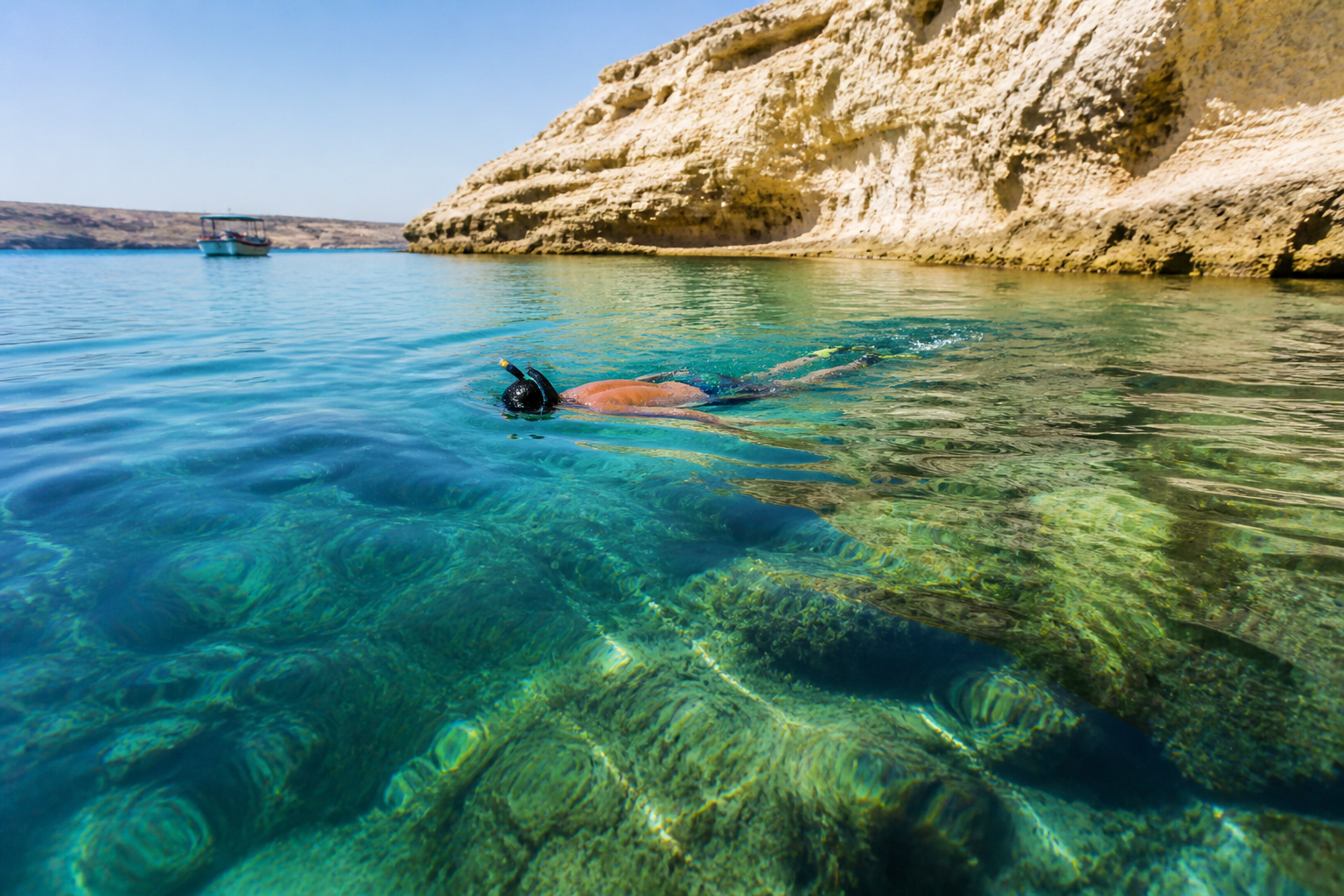
You do not need any experience to see Malta’s underwater side. A guided try dive takes a few hours, and snorkelling needs only a mask, a snorkel and a calm day. The islands are known for caves, arches, shore dives and wrecks rather than big fish, and the sea stays warm enough to enjoy for much of the year. This guide covers when to go, what a first dive costs, which sites suit beginners and the safety rules worth knowing. Prices and rules change, so check the official site or your dive centre before you go.
The quick answer
- First time underwater? Book a try dive (often called Discover Scuba Diving) with a licensed dive centre. Recent price lists I checked put it at roughly 50 to 100 euros, with equipment included.
- Just want to look at fish? Snorkelling is free at many rocky bays and is most comfortable from May to October.
- Visiting in winter? Diving still runs. Visit Gozo says the sea never drops below 14°C, so you will simply wear a thicker suit than in summer.
- Not sure where to start? Gozo and Comino have the gentlest beginner sites, and dive centres on both islands supply all the gear.
Why Malta works for beginners
The Malta Tourism Authority’s diving brochure counts more than 100 dive sites and over 50 dive centres across Malta, Gozo and Comino. Dive centres must be licensed by the Malta Tourism Authority, and English is widely spoken, so briefings are easy to follow. The islands are small, so if the wind spoils one coast, a centre can usually move you to a sheltered site on the other side.
One honest note: a Maltese diving information site points out that fish life is not the main reason people dive here. The real draw is the scenery, with limestone walls, caves, swim-throughs, arches and wrecks in very clear water. Go for the landscape and treat the fish as a bonus.
When to go: sea temperature by month
Long-term averages for Valletta from weather2travel show how the sea changes through the year. Use them as a guide, because a windy week can feel colder than the number suggests.
- January to April: about 15 to 16°C. Diving only, in a thick suit. Snorkelling is for the very hardy.
- May: about 18°C. Still cool, but the diving season is in full swing.
- June: about 22°C. Comfortable for most people.
- July to September: about 25 to 26°C. The warmest and busiest months.
- October: about 24°C. Often the sweet spot, with warm water and fewer people.
- November and December: about 21°C, falling to 18°C.
The live sea temperature and wind are on our Malta This Week page, which is worth checking the day before you book. For the wider picture of weather and crowds, see our best time to visit Malta guide, and if you are coming in the cold months, read about swimming in Malta in winter.
Your first dive: what to expect
A try dive starts with a short briefing and a few basic skills in shallow water. Then you dive with an instructor beside you, usually only a few metres down. You will fill in a medical questionnaire first, so be honest about any health conditions. Visit Gozo notes that centres teach to SSI, CMAS and PADI standards and provide all the equipment, so you only need swimwear and a towel.
Some centres accept children from about 8, but age limits vary, so ask before you book. Our Malta with kids guide has other family ideas for days when the sea is rough.
What it costs
Prices vary by centre and season. Recent price lists from several centres show a rough pattern:
- Try dive: about 50 to 100 euros, with extra dives costing more.
- Open Water Diver course (the standard first certificate): about 420 to 550 euros, depending on the centre and training agency.
Always ask what is included. Equipment, insurance, transport to the site and certification fees are not always bundled. If you want the full course, many centres let you complete the online theory at home, which saves holiday time.
Best beginner dive sites
Gozo
Visit Gozo rates several shore sites as beginner level. Mġarr ix-Xini is popular for night dives, Ħondoq Bay is a sandy bay with seagrass meadows and an average depth of about 5 metres, and Xlendi Cave and Reef has a shallow tunnel through the headland at 6 to 10 metres. Gozo is easy to add to a Malta trip: see our guide to things to do in Gozo and our Gozo day trip guide for the ferry basics.
Comino and the north of Malta
The Santa Maria Caves off Comino are rated beginner level, at 7 to 10 metres deep, with gullies, caverns and swim-throughs. The P31, a former Armed Forces of Malta patrol boat scuttled in 2009, lies upright near Comino at a maximum depth of about 20 metres, which Visit Gozo describes as ideal for Open Water divers. After a dive, you can swim at the Blue Lagoon or read more about Comino.
Ċirkewwa, near the Gozo ferry terminal, is another well-known area, with wrecks that include the tugboat Rozi and the patrol boat P29. Ask your centre which sites match your certification and the day’s conditions.
Advanced sites to build up to
Um El Faroud is Malta’s most famous wreck dive. The Libyan tanker was scuttled off Wied iż-Żurrieq on 2 September 1998 after an explosion at the Malta Drydocks killed nine workers, and it now serves as an artificial reef and a memorial. It is about 115 metres long and sits upright on the sand, with a maximum depth of around 34 to 36 metres, so it is a dive for experienced divers with a local guide.
The Blue Hole at Dwejra, Gozo is a natural limestone shaft with a sheltered entry. Visit Gozo rates it advanced, with an average depth of 15 metres and a maximum of 25. The famous Azure Window next to it collapsed in a storm on 8 March 2017, and its fallen blocks are now a dive site of their own. This is an exposed coast, so it is only for calm weather.
Best snorkelling spots
You will see octopus, cuttlefish, starfish and shoals of small fish in most rocky bays, and the odd turtle is reported now and then. Good places to start:
- Blue Lagoon, Comino: clear, shallow and very popular. Go early or late in summer to avoid the boat crowds.
- St Peter’s Pool, Marsaxlokk: deep, clear water beside flat rocks, best on calm days.
- Fomm ir-Riħ: a remote bay on the west coast where the effort of getting there keeps it quiet.
- Exiles Beach, Sliema: an easy, urban option with snorkellers and families in the water.
- Ħondoq ir-Rummien, Gozo: caves at water level that make it popular for both diving and snorkelling.
Wear reef shoes for rocky entries, use sun protection, never snorkel alone and stay close to shore. For more places to swim, browse our Malta beaches guide.
Safety and rules that matter
- Check the wind first. Rough water closes some coasts while others stay calm. Our Malta This Week page shows wind and sea conditions, and a good dive centre will move you to a sheltered site.
- Respect diver flags. A blue and white Alpha flag means divers are in the water. Transport Malta’s Notice 069 of 2024 asks boats to keep a safe distance and speed, and recommends about 100 metres clear of diver flags and surface marker buoys. Never snorkel near boat traffic, and a bright towed float makes you easier to see.
- Use swimming zones. Transport Malta marks swimming areas with buoys to keep boats out, including at places like the Blue Lagoon. Zones can change, so check the current notices.
- Obey beach flags. A red flag means dangerous conditions and swimming is not recommended.
- Do not fly too soon. Dive organisations such as DAN and PADI suggest waiting at least 12 hours after a single dive and 18 hours after multiple dives or several days of diving. Many people wait 24 hours. Ask your instructor and plan your last dive well before your flight home.
Frequently asked questions
Can beginners scuba dive in Malta?
Yes. Licensed dive centres run try dives for people with no experience, with an instructor beside you and all equipment provided. If you enjoy it, you can continue to a full Open Water course.
Can you dive in Malta in winter?
Yes. Visit Gozo says the sea never drops below 14°C, so diving is possible almost all year round. Expect a thicker suit and cooler surface conditions than in summer.
Do I need my own equipment?
Not for a try dive or a course, because centres supply it. For snorkelling you can bring your own mask and snorkel or buy or rent them locally.
Which island is better for diving, Malta or Gozo?
Both are excellent. Gozo has easy shore dives for beginners and the Dwejra sites, while Malta has Um El Faroud and the wrecks at Ċirkewwa. Many visitors dive on both.
In short
Malta is a very good place to try diving for the first time: short distances, licensed centres, clear water and plenty of gentle sites in Gozo and Comino. Snorkelling is best from May to October, while diving runs through the year. Check the wind, respect diver flags and ask your instructor about flying after diving. Prices and conditions change, so check each centre’s official site before you book.
Planning further ahead? See our Malta beaches guide and our Gozo day trip guide.