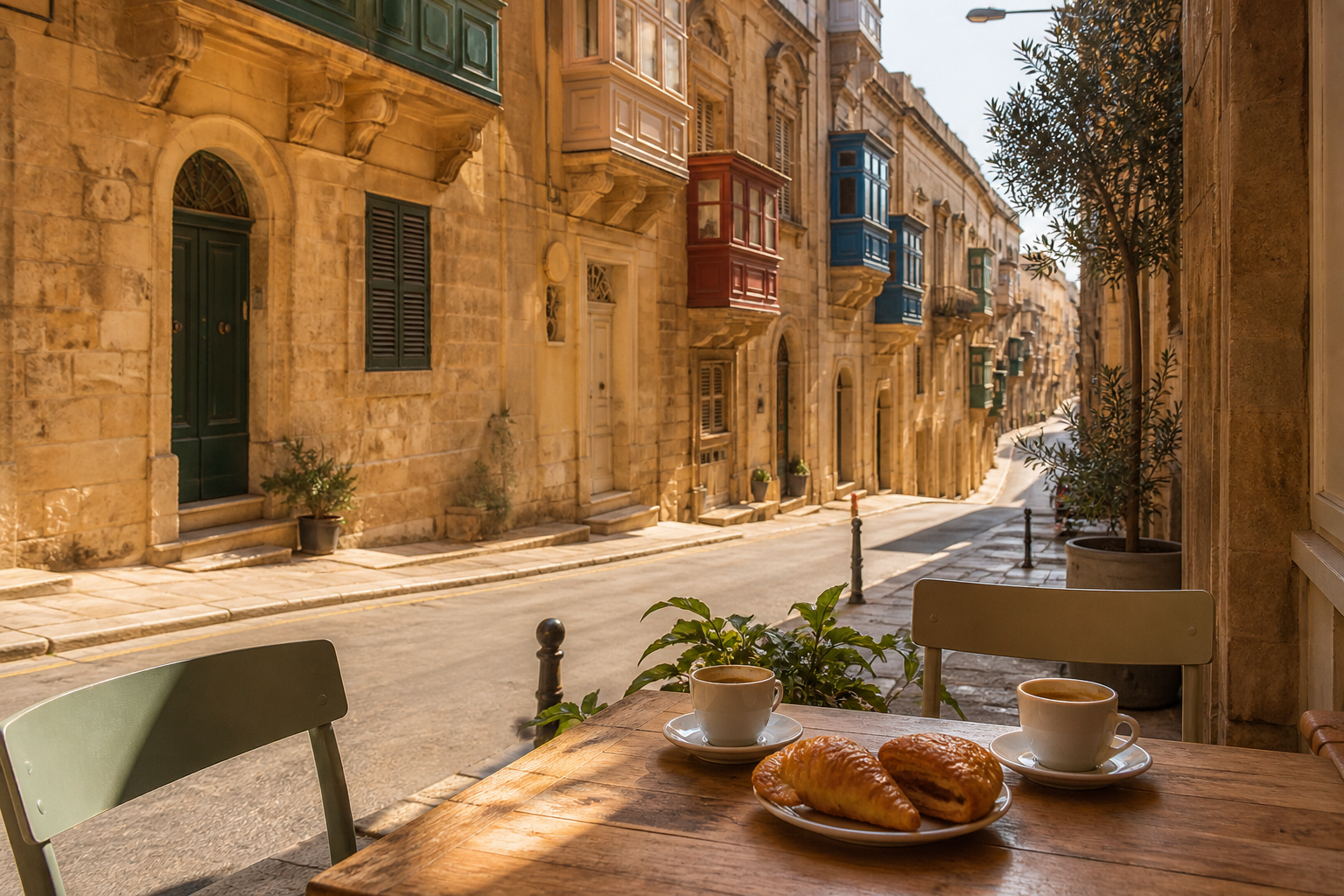
You do not need Maltese to enjoy Malta. English is an official language, and almost everyone in hotels, shops and restaurants speaks it well. But a few words of Maltese, said with a smile, bring a warm reaction almost every time. This guide gives you the words worth learning, how to say them, and when to use them. Start with bonġu, grazzi and jekk jogħġbok and you are already ahead of most visitors.
Do you need to speak Maltese in Malta?
No. Malta has two official languages, Maltese and English, and Maltese is the national language. English is widely and fluently spoken, and Italian is also widely understood. So Maltese phrases are a courtesy, not a survival tool. Locals will often answer you in English as soon as they hear an accent. Do not take that as a rejection. Keep trying, because most people enjoy the effort.
If you are still planning the practical side of your trip, our Malta travel basics guide covers the everyday questions that visitors ask before they arrive.
A quick look at the language
Maltese is a Semitic language that grew out of Arabic spoken in Sicily in the Middle Ages. It is the only Semitic language that is an official language of the European Union, and the only one written in the Latin alphabet. Over the centuries it absorbed a lot of Sicilian, Italian and English. A rough rule of thumb is that about half the vocabulary comes from Italian and Sicilian and about a fifth from English. That is why some words will feel familiar, such as kafè (coffee) and ajruport (airport).
You can also see the Arabic roots on the map. The town of Rabat takes its name from an Arabic word for suburb, and Mdina comes from the Arabic word for city. Our Mdina guide tells that story in more detail.
Pronunciation: the letters that look strange
The Maltese alphabet has 30 letters. Most look normal, but a few have dots or double letters. You do not need to be perfect. These rough guides are enough to be understood.
- ċ sounds like “ch” in “church”.
- ġ sounds like “j” in “jam”. That is why bonġu is said “bon-ju”.
- ħ is a strong, breathy “h”, made a little further back in the throat than an English h. A normal “h” will still be understood.
- għ is the tricky one. It is often almost silent and mostly changes the sound of the vowel next to it. If you are unsure, say the word as it sounds in the guides below.
- x sounds like “sh”.
- ż is the normal “z” sound, as in “zoo”, while a plain z sounds like “ts”. So grazzi is “grat-see”.
- q is a tiny catch in the throat, like the pause in the middle of “uh-oh”.
Greetings and polite words to learn first
If you only learn a handful of words, learn these. Spellings and pronunciations vary a little between sources, so treat the sound guides as approximate.
- Bonġu (bon-ju): good morning, and a general daytime hello.
- Il-lejla t-tajba (il-LAY-la t-TIE-ba): good evening. You may also hear bonswa.
- Ċaw (chow): bye, borrowed from Italian “ciao”.
- Merħba (MER-ha-ba): welcome. You may hear it when you walk into a shop or restaurant.
- Kif int? (kiff int): how are you?
- Saħħa (SAH-ha): a friendly goodbye and also “cheers”. The word literally means “health”.
- Grazzi (GRAT-see): thank you. Grazzi ħafna means thank you very much.
- Jekk jogħġbok (yek YOH-jbok): please. In daily life many locals just say “please” in English, so using the Maltese version is a nice surprise.
- Skużani (skoo-ZAH-nee): excuse me, or sorry. Skużi is the shorter, more casual form.
- Iva (EE-va) means yes, le (leh) means no, and ma nafx (ma NAFSH) means “I do not know”.
Phrases for cafes and restaurants
Eating is where most visitors use Maltese first. Staff will be pleased if you add jekk jogħġbok to every request.
- Il-menu, jekk jogħġbok. The menu, please.
- Mejda għal tnejn, jekk jogħġbok. A table for two, please.
- Għandi riżervazzjoni. I have a reservation.
- Nixtieq dan. I would like this.
- Ilma, jekk jogħġbok. Water, please.
- X’tirrakkomanda? What do you recommend?
- Il-kont, jekk jogħġbok. The bill, please.
At a busy pastizzi counter, simply pointing and saying dan, jekk jogħġbok (“this one, please”) works well. To find out what to order, read our Maltese food guide. When your glass is full, say saħħa.
Phrases for getting around and shopping
Most bus drivers, taxi drivers and shop staff will use English with you. A few Maltese phrases still help, especially for asking for directions politely.
- Kif immur il-Belt Valletta, jekk jogħġbok? How do I get to Valletta, please? Locals often call Valletta simply il-Belt, “the city”.
- Kemm jiswa? How much does it cost?
- Jekk jogħġbok, tkellem iktar bil-mod. Please speak more slowly.
- Kif tgħid … bil-Malti? How do you say … in Maltese?
The word for bus is tal-linja, which is where the name of the Tallinja travel card comes from. Our Malta bus and Tallinja card guide explains tickets and routes, and our Valletta guide is a good first stop once you arrive.
Words you will see on signs and maps
Reading a few common words makes maps and road signs much easier.
- Triq means street. You will see it on almost every road sign.
- Pjazza means square.
- Il-Belt is Valletta, the capital.
- Għawdex is Gozo, and Kemmuna is Comino.
- Tal-linja marks bus services.
“Għawdex” is a good test of the pronunciation rules above. If you are planning a trip across the water, our Gozo day trip guide has the practical details.
Festival greetings
At Easter you can say L-Għid it-tajjeb, which means “a good Easter”. Village feasts are the best place to hear Maltese in a lively setting, with brass bands, fireworks and long street processions. Our guide to Maltese festas explains what is happening and how to join in.
Tips for sounding natural
- Start with five words. Bonġu, grazzi, jekk jogħġbok, skużani and saħħa are enough to make a good impression.
- Speak slowly and smile. Maltese people tend to be friendly and appreciate even a clumsy try.
- Expect mixing. Many locals blend Maltese and English in one sentence, so you may hear both together.
- Ask for help. If you want to learn a word, ask “Kif tgħid … bil-Malti?” People are usually happy to teach you.
- Do not worry about mistakes. Nobody expects visitors to get the throaty sounds right.
FAQ: Maltese phrases for visitors
Do I need to speak Maltese when visiting Malta?
No. English is an official language and is widely spoken, so you can manage the whole trip in English. Maltese phrases are a friendly extra that locals tend to appreciate.
Is Maltese the same as Arabic?
No, but it has Arabic roots. Maltese developed from a medieval Arabic dialect, then took in large amounts of Italian, Sicilian and English. It is written in the Latin alphabet, so it looks very different from Arabic on the page.
How do you say hello in Maltese?
In the morning and during the day, say “bonġu”. In the evening, say “il-lejla t-tajba”. A casual “ċaw” works as a hello or goodbye with friendly people.
How do you say cheers in Maltese?
Say “saħħa”, pronounced “SAH-ha”. It also works as a friendly goodbye, and it literally means “health”.
In short
You can visit Malta without a word of Maltese, but a few phrases make every interaction warmer. Learn greetings, please and thank you, and one or two restaurant lines, and practise the odd-looking letters slowly. Spelling and pronunciation guides differ slightly between sources, so treat the sound guides here as a friendly starting point.
Planning further ahead? Read our Malta itinerary for 3, 5 and 7 days and our complete Malta travel guide for first-time visitors.