If you are trying to figure out how schooling works in Malta, whether you are Maltese, from the EU, or moving here from outside the EU, this guide walks you through it in plain language. No confusing jargon, just what actually happens, what documents you need, and where you need to go.
First, the Basics: Three Types of Schools
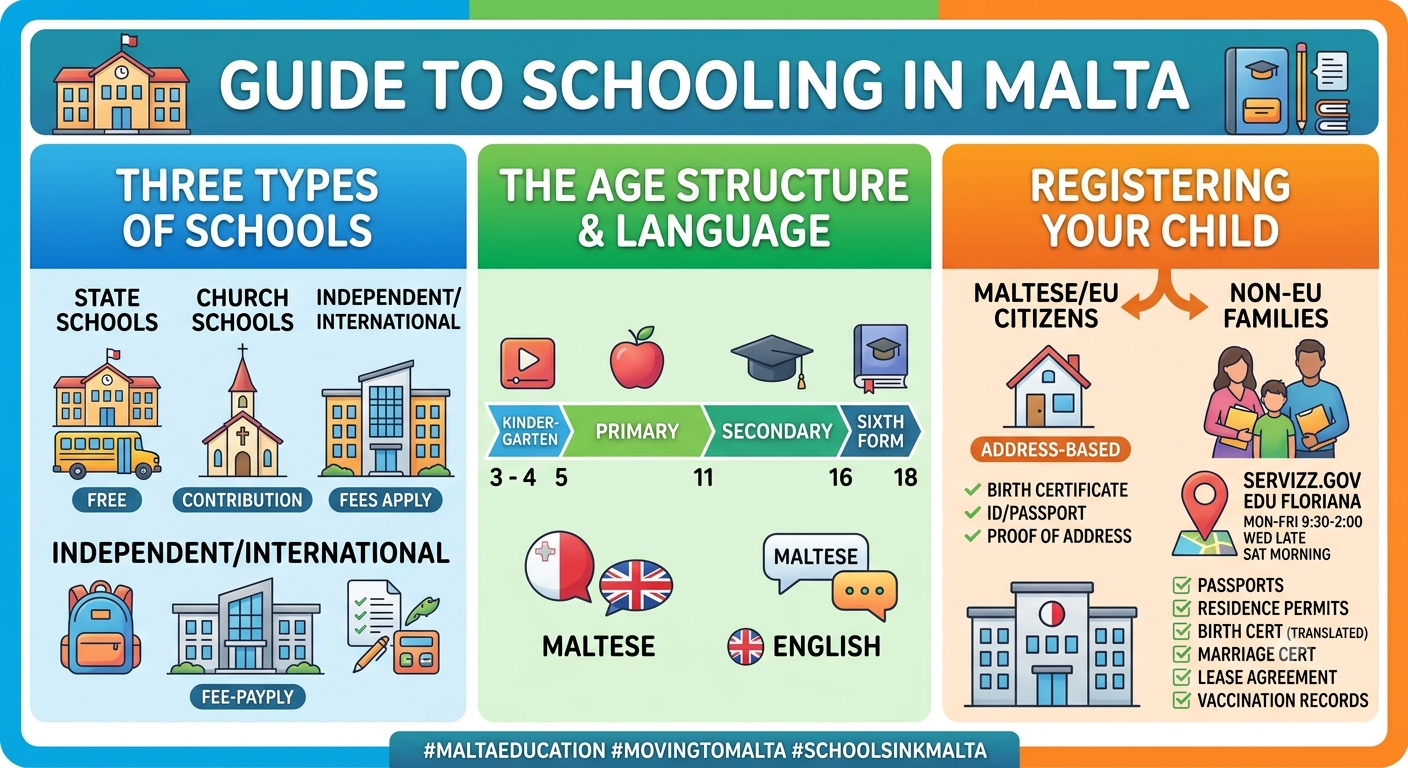
Malta’s education system mainly consists of three types of schools, and most families choose between these options regardless of their nationality.
State schools Completely free, run by the government. Books and learning materials are provided at no cost, and school transport is available subject to eligibility and arrangements, though it is not automatically guaranteed for every child. You only pay for the uniform. These schools are found in every town and village across Malta and Gozo.
Church schools Run by the Catholic Church, these do not charge tuition fees, but parents are usually expected to contribute towards school-related expenses. Because they are popular, places are usually given out through a lottery. You do not have to be Catholic to attend one.
Independent and international schools Private, fee paying schools. Costs vary widely depending on the school, year group and curriculum, but many private and international schools fall within the range of several thousand euros per year. These are a common choice for families who plan a shorter stay in Malta or want their child to continue with a British, American or International Baccalaureate curriculum.
The Age Structure
Schooling in Malta is compulsory from age 5 to 16, and it follows a British style structure:
- Kindergarten: ages 3 to 4
- Primary school: ages 5 to 11
- Secondary school: ages 11 to 16
- Sixth Form / post-secondary education: usually ages 16 to 18, for students continuing towards university or further qualifications
One thing worth knowing early on: Maltese and English are both official languages, and both are taught throughout compulsory schooling. The balance between the two varies depending on the school, the subject, and the year group. In many state schools, Maltese tends to take on a stronger role once children move past the early years, but English remains widely used, particularly for certain subjects. Every child, no matter their nationality or how long they plan to stay, studies both languages.
Registering a Maltese or EU Citizen’s Child
If your child is Maltese, or you are an EU, EEA or Swiss national, the process is fairly simple.
- Your home address decides which state primary school your child is assigned to.
- Secondary school is handled through the College Principal’s office, and children usually move up to the secondary school linked to their primary school’s College.
- You will need your child’s birth certificate, ID documents, proof of address, and vaccination records, plus school records if transferring schools.
EU, EEA and Swiss citizens are entitled to the same free education as Maltese citizens, up to age 16.
Registering a Non-EU Child: What Actually Happens
This is the part that confuses a lot of families, so here is exactly how it works based on real experience going through it.
Where to go
Non-EU families register their children in person at:
Servizz.gov EDU (Ministry for Education, Sport, Youth, Research and Innovation) Great Siege Road, Floriana, VLT 2000
For many non-EU families, this Floriana office is the first point of contact for school registration. The department responsible for non-EU and migrant learners is officially called the International Learners Directorate, and it has its own separate premises in Ħamrun, which supports migrant learner services and language support. Many families, though, only ever deal with the Floriana office directly for the registration itself, so do not be surprised if you never need to visit Ħamrun at all. Procedures can vary from case to case, so it is worth confirming your specific situation directly with the Ministry rather than assuming one office handles every part of the process.
Opening hours
- Monday to Friday: 9:30am to 2:00pm
- Wednesday: also open later, until 6:00pm
- Saturday: 8:00am to 12:00pm
The Saturday morning slot is genuinely useful if both parents work during the week, since it means you do not have to take time off to get this done.
Documents to bring
Bring both originals and photocopies of everything. Officials need to see the originals to verify them, but they will generally keep the copies.
- Both parents’ passports
- Both parents’ Maltese residence permits
- Each child’s passport
- Each child’s Maltese residence permit
- Each child’s birth certificate (if it is not in English, it must be officially translated)
- Marriage certificate
- Lease agreement or proof of your address in Malta
- Vaccination records for each child
- School leaving certificate or previous school reports, if the child is transferring from a school in another country
A few practical tips
- If possible, attend together with both parents and the child, as it can reduce delays if questions arise about documents or guardianship.
- Bring physical copies, not just digital ones. There is not a lot of information about this process available online, so it is best to prepare thoroughly and bring paper copies of everything rather than assuming you can show documents on your phone.
- Ask about school transport during registration. Eligibility depends on the current transport scheme and your child’s individual circumstances. A distance of around 1 kilometre or more from the assigned school is usually the general guide people mention, but it is best to double check the exact rule at the time of your appointment rather than assume it applies automatically.
- Confirm details directly before you go. Because this process is handled in person and not really documented step by step online, it is worth calling ahead or checking directly with the Floriana office to confirm current requirements before your visit, since procedures can be updated from time to time.
Is Schooling Free for Non-EU Children
It depends on the parents’ residence status rather than nationality alone. Many non-EU families with valid residence status, including those holding employment based permits, can access free state education for their children. The exact entitlement depends on the family’s specific residence category, so it is worth asking about your particular situation when you register rather than assuming a single rule applies to everyone.
Born in Malta Does Not Mean Maltese Citizenship
A common mix up: having a baby in Malta does not automatically make that child a Maltese citizen. A child’s nationality follows the parents’ home country nationality laws, not the country of birth. So even a child born in Malta to non-EU parents is still registered for school the same way as any other non-EU child, generally through the Floriana office, using documents similar to those listed above.
If your child was born in Malta, there are a few practical steps to take before school registration becomes relevant:
- Register the birth first at the Public Registry to obtain the child’s birth certificate.
- Apply for the child’s residence documents, if these are required based on your family’s status.
- Keep copies of all documents from the very start, since schools and government offices frequently ask to see them again later, sometimes more than once.
Do Parents Get to Choose the School Based on Where They Work
Usually not by default. Your home address is generally what determines which school and College your child is assigned to, rather than where either parent works. That said, if a parent’s workplace is in a different area, it may be possible in some cases to request a school closer to work instead of home. This tends to be treated as an exception rather than a right, and it would need approval from the relevant College Principal, so it is worth asking about it directly rather than assuming it will be automatically granted.
Support for Children Who Do Not Speak Maltese or English
If your child is joining a Maltese school without much English or Maltese, the International Learners Directorate runs dedicated language support and induction programmes to help them settle in and catch up. Their teachers work in schools across Malta and Gozo. Younger children generally pick up the languages fast, often becoming conversational within a year, while older children may take a bit longer. Importantly, children who arrive in Malta without any Maltese or English are not refused a place in school because of the language barrier. Schools and the support programmes are there specifically to help these children integrate into the classroom over time.
Quick Recap: What to Bring for Non-EU Registration
- Both parents’ passports
- Both parents’ Maltese residence permits
- Children’s passports
- Children’s Maltese residence permits
- Children’s birth certificates, translated into English if needed
- Marriage certificate
- Lease agreement
- Vaccination records
- School leaving certificate or previous school reports, if transferring from abroad
- Both original documents and photocopies of everything
- Both parents and the child present, if possible
Go to Servizz.gov EDU, Great Siege Road, Floriana, open Monday to Friday, with extended hours on Wednesday, and Saturday mornings until noon, and ask about school transport eligibility for your specific circumstances.
Choosing the Right Type of School for Your Family
There is no single right answer here, it really depends on how long you are staying and how old your children are. Families here for a short period, or with older children needing to continue an international curriculum, often go for international schools despite the cost. Families settling in longer term, especially with younger kids, often find state schools work out well since they are completely free and help children genuinely integrate into Maltese life. Church schools sit somewhere in the middle, offering strong results at low cost, though spots can be competitive.
Whichever route you take, the process itself comes down to your family’s residence and citizenship status more than anything else, so it is worth confirming your specific category directly with the Ministry before you gather your documents.