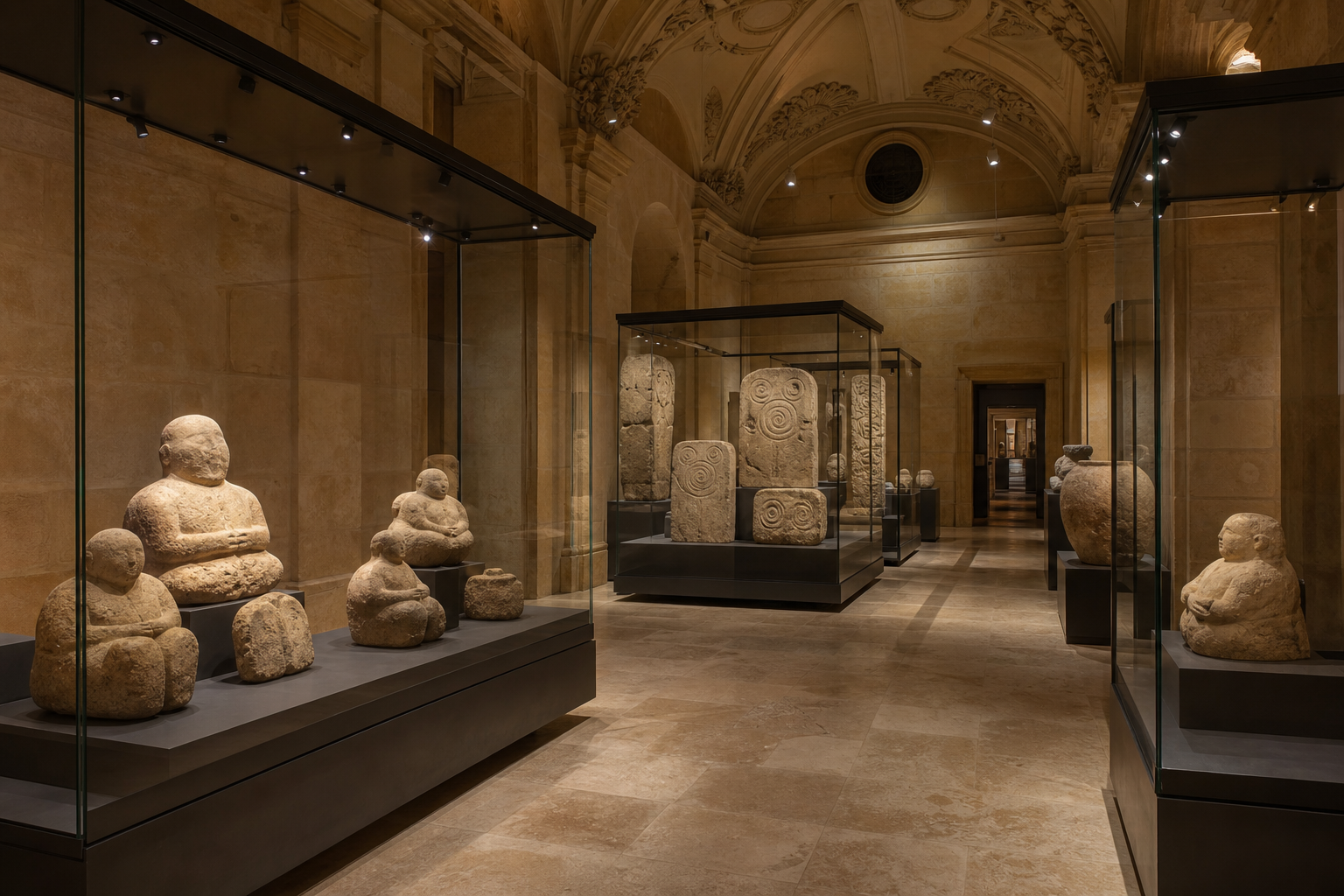
If you only have time for one museum in Malta, make it this one. And if you’re planning to visit the temples, come here first.
The National Museum of Archaeology on Republic Street is where Malta keeps the treasures found at its prehistoric sites. The Sleeping Lady from the Ħal Saflieni Hypogeum. The Venus of Malta from Ħaġar Qim. The giant stone figure from the Tarxien Temples. Standing in front of these objects, the temples stop being piles of old stone and start feeling like places where real people lived, worshipped and buried their dead.
This guide covers what’s inside, the pieces you shouldn’t miss, tickets and how to fit the museum into your Malta plans.
A museum inside a Knights’ palace
The museum is housed in the Auberge de Provence, one of the “inns” built in the 16th century for the Knights of St John. Each auberge was the headquarters of knights from a different part of Europe, and this one belonged to the knights from Provence in southern France.
It’s one of Valletta’s finest early Baroque buildings, and it has been home to the national archaeology collection since 1958. Even if archaeology isn’t your thing, the building alone makes it worth stepping inside, especially the grand painted hall upstairs.
You’ll find it on Republic Street, Valletta’s main street, only about 200 metres from City Gate. That makes it one of the easiest museums in Malta to visit, and a perfect first stop on a day in the capital. Our Valletta guide has ideas for the rest of your day.
The ground floor: Malta before history
The ground floor takes you through Malta’s Neolithic and Temple periods, from the first farmers who arrived around 5900 BC to the end of the temple culture around 2500 BC.
It starts simply, with the tools, pottery and everyday objects of the island’s earliest people. Then the story builds through the different phases archaeologists use to describe Maltese prehistory, each named after the site where it was first identified, such as Għar Dalam, Skorba, Mġarr, Ġgantija and Tarxien. There’s also a reconstruction of the rock-cut tombs used in the early Neolithic period.
By the time you reach the Temple period rooms, you’re in the heart of the collection.
The pieces you shouldn’t miss
The Sleeping Lady
Found in the Ħal Saflieni Hypogeum, this small clay figure of a woman lying asleep on her side, on what looks like a low bed, is probably the most famous object in Malta. Nobody knows exactly what she represents. Some think she shows death, others sleep or dreaming, and others link her to rituals where people slept in a sacred place hoping for visions. Whatever the answer, she’s beautifully made and surprisingly moving to see in person. If you can’t get a ticket to the Hypogeum itself, seeing her here is the next best thing.
The Venus of Malta
This small clay figure, found at Ħaġar Qim, shows a female form with remarkable detail and realism for its age. It’s one of the finest pieces of prehistoric art found in the islands.
The “fat ladies”
You’ll see several of the rounded, seated stone figures often nicknamed the “fat ladies” of Malta. They’re among the most distinctive images of the temple culture. They’re often described as fertility or mother goddess figures, but that remains a theory, and some of the figures may not be female at all.
The colossal statue from Tarxien
Only the lower half survives, a pair of huge legs and a pleated skirt, but it’s enough to show that the original statue stood well over two metres tall. Imagine it standing inside the temple, and you start to understand how impressive these places must once have been.
The Tarxien altars and decorated stones
Look out for the stone blocks carved with spirals and animals from the Tarxien Temples, along with altars that were probably used for offerings. Many of the pieces you see at the temple sites today are replicas, with the originals kept safely here.
The cart ruts
There’s even a reproduction of Malta’s mysterious cart ruts, the deep grooves cut into rock all over the islands. If you’re curious, read our story on the cart ruts nobody can explain.
Upstairs: the Bronze Age and the Phoenicians
The upper floor moves forward in time, through the Bronze Age and into the Phoenician period, when Malta became an important stop for traders sailing across the Mediterranean.
Highlights include Phoenician glass and gold jewellery, amulets that show the strong influence of Egyptian beliefs about the afterlife, and a large terracotta sarcophagus shaped like a human figure, which takes pride of place in this section.
The upper floor is also home to the Gran Salon, a huge hall with painted decorations from the early 1800s. It’s one of the most beautiful rooms in Valletta and often hosts temporary exhibitions.
Speaking of which, the museum regularly runs temporary exhibitions on topics like recent research, underwater archaeology and the history of archaeology in Malta. Check what’s on before your visit, as some can be just as interesting as the permanent collection.
Ticket prices
The National Museum of Archaeology is one of the more affordable Heritage Malta museums, with adult tickets at around €5. Reduced prices apply for youths, seniors, students and children, and infants go free. Prices are updated from time to time, so check the current rates on the official Heritage Malta website before you go.
The museum is included in the Heritage Malta Multisite Pass. If you’re planning to see several sites, our guide to whether the Multisite Pass is worth it will help you decide.
Opening hours
The museum is usually open daily, but hours can change with the seasons and for special events. Like all Heritage Malta sites, it’s closed on 24, 25 and 31 December, 1 January and Good Friday. Check the current times on the Heritage Malta website before visiting.
How long you need
Around one to one and a half hours is enough for most visitors. History lovers who read every panel can easily spend two hours here.
Tips for your visit
- Visit before the temples. Seeing the objects first makes Ħaġar Qim, Tarxien and Ġgantija far more meaningful.
- Take the audio guide if offered. It adds useful background to the main pieces.
- Go early or late. Republic Street gets busy, and the main Temple period rooms fill up when tour groups arrive.
- Don’t skip upstairs. Many visitors see the famous figures and leave, missing the Phoenician gold and the Gran Salon.
- Combine it with a Valletta museum day. The Grand Master’s Palace, St John’s Co-Cathedral and Fort St Elmo are all within walking distance.
A Valletta heritage day
- Morning: National Museum of Archaeology, as soon as it opens.
- Late morning: walk down Republic Street to the Grand Master’s Palace.
- Lunch: grab a quick bite in one of Valletta’s side streets.
- Afternoon: Fort St Elmo and the National War Museum at the tip of the city.
- Before sunset: the Upper Barrakka Gardens, for the view over the Grand Harbour.
Frequently asked questions
Is the Sleeping Lady at the National Museum of Archaeology? Yes. The original Sleeping Lady, found in the Ħal Saflieni Hypogeum, is on display here.
Where is the Venus of Malta? Also here, in the Temple period galleries on the ground floor.
How much is the ticket? Around €5 for adults, with reduced prices for youths, seniors, students and children. Check the Heritage Malta website for current prices.
How long do you need? One to one and a half hours, or up to two if you love history.
Is it included in the Heritage Malta Multisite Pass? Yes.
Should I visit the museum before or after the temples? Before, if you can. It gives you the background that makes the temple sites come alive.
Where is it? In the Auberge de Provence on Republic Street, Valletta, about 200 metres from City Gate.
Plan your visit
Museum: National Museum of Archaeology, Auberge de Provence, Republic Street, Valletta Managed by: Heritage Malta Duration: 1 to 1.5 hours Highlights: Sleeping Lady, Venus of Malta, Tarxien colossal statue, Phoenician gold, Gran Salon Tickets: Around €5 for adults, included in the Multisite Pass Closed: 24, 25 and 31 December, 1 January, Good Friday Nearby: Grand Master’s Palace, St John’s Co-Cathedral, Fort St Elmo, Upper Barrakka Gardens
Beautiful Malta is an independent travel guide and is not affiliated with Heritage Malta. Always check opening hours and prices on the official Heritage Malta website before visiting.