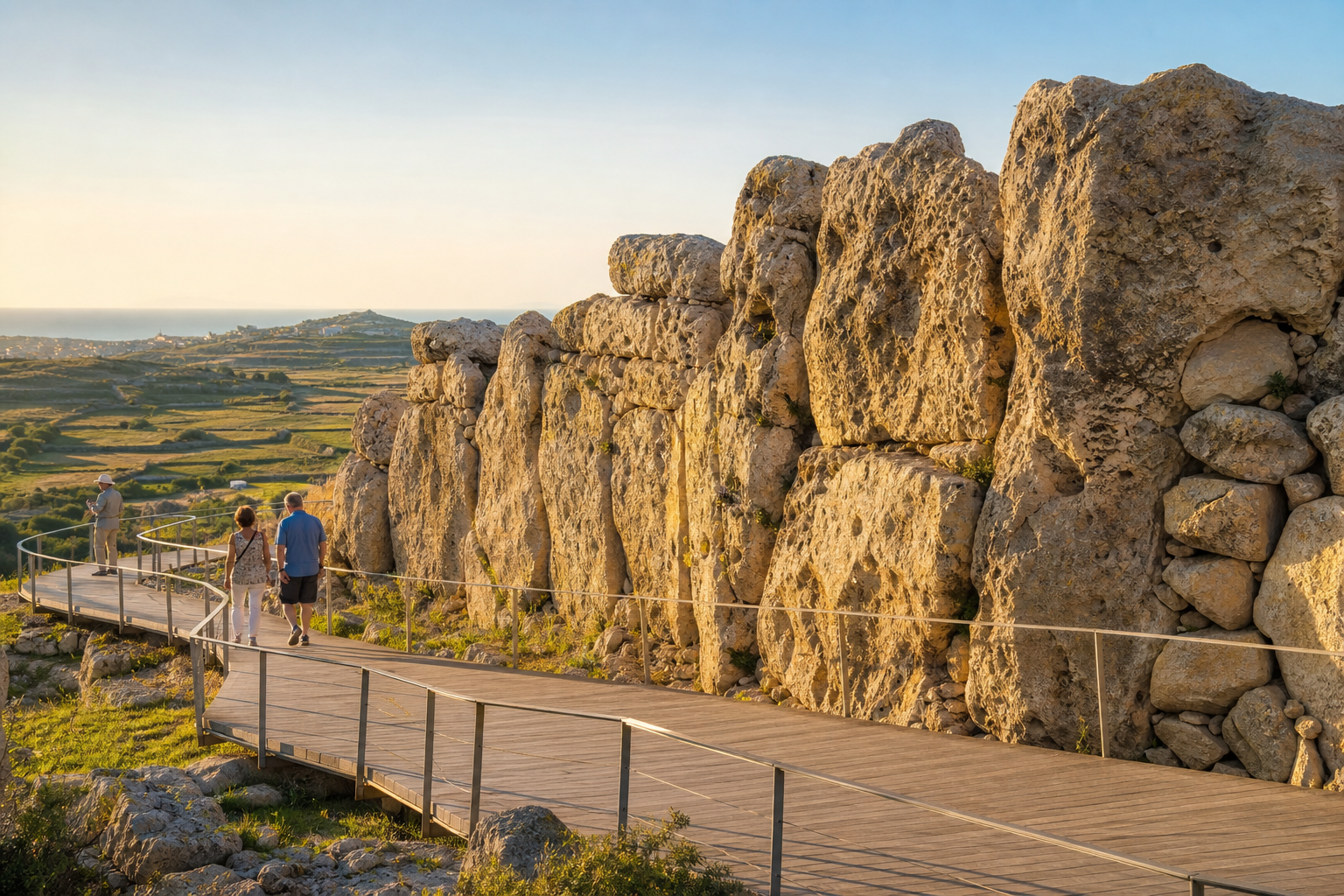
Stand in front of Ġgantija and try to picture the year it was finished. No Stonehenge yet. No pyramids at Giza. No writing anywhere on Earth, and certainly no metal tools. Just a community of farmers on a small island, dragging limestone blocks heavier than a lorry up onto a plateau and stacking them into walls that are still standing more than five thousand years later.
Ġgantija, in the village of Xagħra on Gozo, is one of the oldest free-standing stone structures in the world. It is also one of the easiest of Malta’s great prehistoric sites to actually visit: no ticket lottery, no months of planning, no queue at dawn. You just turn up.
This guide covers what you are looking at, why it matters, and the practical side of getting there, including the combo ticket most visitors don’t realise they already have.
What Ġgantija actually is
Ġgantija is a pair of megalithic temples built side by side on the edge of the Xagħra plateau, facing south-east. Heritage Malta dates their construction to roughly 3600 to 3200 BC, during what archaeologists now call the Ġgantija phase of Maltese prehistory, a period named after this very site.
The two temples are enclosed by a single massive outer wall. Inside, each one follows the same basic plan you’ll later recognise at Ħaġar Qim, Mnajdra and Tarxien: a central corridor opening into rounded side chambers, so the floor plan looks a little like a clover leaf. The southern temple is the older and larger of the two, with five of these rounded chambers. The northern one, added later, is smaller and simpler.
The scale is what stays with you. Some of the upright stones in the outer wall are more than five metres tall, and the heaviest blocks are estimated at up to fifty tonnes. The builders used two kinds of local stone: hard coralline limestone for the outer walls, which had to take the weather, and softer, easier to shape globigerina limestone for the doorways and the finer work inside.
The giantess who built it, according to Gozo
Ġgantija means “giant’s tower” in Maltese, and the name comes from a story locals have told for centuries. According to the legend, a giantess called Sansuna built the temples in a single day and a single night, carrying the stones on her head while nursing a baby on her hip.
It’s a lovely story, and you can see why people needed one. When you look at those blocks and remember there were no wheels, no draught animals strong enough and no metal, a giantess starts to sound like the most reasonable explanation.
The less magical answer is still impressive. Stone spheres found around the Maltese temples are thought to have been used as rollers, moving blocks over the ground like ball bearings, with ropes, levers and a lot of people doing the pulling. It was a community project on a scale that tells you a great deal about how organised these early Gozitans were.
What the temples were used for
Nobody knows for certain, and any guide claiming otherwise is guessing. What the evidence does show is that Ġgantija was a place of ritual. Archaeologists found hearths, stone altars, niches, libation holes in the floor and the remains of animal bones, which point to offerings and possibly sacrifices.
Fragments of red ochre plaster survive too, a reminder that the interior was once painted rather than the bare grey stone you see today. The temple culture also left behind the curvy stone figures often linked with fertility, which is why you’ll often hear these sites described as places connected with a mother goddess. That idea is popular, but it remains a theory rather than a fact.
What is certain is that around 2500 BC the temple culture across Malta and Gozo came to an end, for reasons still debated, and the sites were eventually abandoned.
A World Heritage Site since 1980
Ġgantija was added to UNESCO’s World Heritage List in 1980, among Malta’s very first entries alongside the Ħal Saflieni Hypogeum. In 1992 the listing was extended to include five more temple sites on Malta, and the whole group became known as the Megalithic Temples of Malta. Our guide to UNESCO sites in Malta covers the rest.
What the visit is like
Your visit starts at the Interpretation Centre, opened as part of the Ġgantija Heritage Park in 2013. Don’t skip it. It’s a modern, well designed museum that explains who the temple builders were, how they farmed, what they ate and how they lived, and it displays objects found at Ġgantija and around Xagħra, including figures and pottery. Fifteen minutes here makes the temples themselves far more meaningful.
From the centre, a pathway leads up through the landscaped park to the temples. You walk around the outside of the great wall first, which is where the size really hits you, then into the temples on raised walkways. Some inner areas are closed off to protect the stone, so you’ll be looking into certain chambers rather than walking through them.
Heritage Malta says a typical visit takes about an hour, but you’re welcome to stay as long as you like. Late afternoon is the best time for photos, when the low sun turns the limestone gold and the views over the Gozitan countryside open up.
Ticket prices
Your ticket to Ġgantija is a combo ticket that also includes the Ta’ Kola Windmill, a few minutes’ walk away in Xagħra. Many visitors never realise this and leave without seeing the windmill.
| Ticket | Price |
|---|---|
| Adults (18+) | €10 |
| Youths (12-17) | €8 |
| Senior citizens (60+) | €8 |
| Concessions and students | €8 |
| Children (6-11) | €6 |
| Infants (1-5) | Free |
| Heritage Malta members and Passport holders | Free |
Prices as currently listed by Heritage Malta for the Ġgantija and Ta’ Kola Windmill combo ticket. Prices can change, so check the official Ġgantija page on the Heritage Malta website before you go.
If you’re planning several Heritage Malta sites during your trip, the Multisite Pass also covers Ġgantija and can work out cheaper. We explain how it works in our complete guide to Heritage Malta museums and sites.
Opening hours
Opening hours change between the summer and winter seasons, so always check the current times on the Heritage Malta website before travelling, especially since you’ll be catching a ferry to get there. Like all Heritage Malta sites, Ġgantija is closed on 24, 25 and 31 December, 1 January and Good Friday.
Don’t miss Ta’ Kola Windmill
Since it’s already included in your ticket, make the short walk to Ta’ Kola Windmill. It’s one of the few traditional windmills left in the Maltese islands, dating back to the time of the Knights. Inside you’ll see the miller’s living quarters, his tools and the original milling machinery, which give a real picture of rural Gozitan life a few centuries ago. It’s a nice contrast after Ġgantija: one site five thousand years old, the other only a few hundred, both in the same village.
How to get there
From Malta: take the Gozo Channel ferry from Ċirkewwa to Mġarr. The crossing takes around 25 minutes, and you only pay on the way back from Gozo.
From Mġarr harbour: Xagħra is about a 15 minute drive. Public buses run from Mġarr to Victoria, the main town, where you can change for a bus to Xagħra. A taxi or hire car saves a lot of time if you want to see more of Gozo in one day.
Address: Triq John Otto Bayer, Xagħra, Gozo.
The temples sit just off Xagħra’s main square, so once you’re in the village they’re easy to find.
Make a day of it in Gozo
Ġgantija fits perfectly into a full Gozo day. A route that works well:
- Morning: ferry across, then straight to Ġgantija before the tour groups arrive.
- Late morning: Ta’ Kola Windmill, then a coffee in Xagħra’s square, facing the parish church.
- Lunch: head down to Ramla Bay, just below Xagħra, for its famous red sand. In warm months, bring your swimwear. Our guide to the best beaches for swimming in October includes it.
- Afternoon: drive to Victoria and explore the Citadel, where several more Heritage Malta museums sit inside the old walls, including the Gozo Museum of Archaeology.
- Evening: sunset at Xlendi or Dwejra before the ferry home.
Tips before you go
- Wear comfortable shoes. The paths are good, but there’s some walking uphill from the Interpretation Centre to the temples.
- Bring a hat and water in summer. There’s very little shade around the temples themselves.
- Visit Tarxien or the Archaeology Museum too. Seeing the decorated stones at Tarxien, or the temple figures at the National Museum of Archaeology in Valletta, helps everything at Ġgantija make sense.
- Accessibility: Heritage Malta has added ramped pathways from the Interpretation Centre to the temples, though some inner areas remain off limits to protect the site.
- Combine it with the Hypogeum trip. If you couldn’t get a Hypogeum ticket, Ġgantija is the best way to experience Malta’s temple culture without any booking stress.
Frequently asked questions
How old is Ġgantija? Heritage Malta dates the temples to around 3600 to 3200 BC, making them older than Stonehenge and the pyramids of Egypt.
Is Ġgantija worth visiting? Yes. It’s one of the oldest free-standing structures in the world, the Interpretation Centre is excellent, and unlike the Hypogeum you don’t need to book months ahead.
How much is the ticket? €10 for adults, €8 for youths, seniors and students, €6 for children aged 6 to 11, and free for infants. The ticket also includes Ta’ Kola Windmill.
How long do you need? About an hour for Ġgantija, plus 20 to 30 minutes for Ta’ Kola Windmill.
Is Ġgantija included in the Heritage Malta Multisite Pass? Yes.
Where is Ġgantija? In Xagħra, on the island of Gozo, about 15 minutes’ drive from Mġarr ferry harbour.
What does Ġgantija mean? “Giant’s tower” in Maltese, from the legend that a giantess built it.
Plan your visit
Site: Ġgantija Archaeological Park, Triq John Otto Bayer, Xagħra, Gozo Phone: 21553194 Managed by: Heritage Malta Ticket includes: Ta’ Kola Windmill Duration: About 1 hour Booking: Online through the Heritage Malta store or at the entrance Closed: 24, 25 and 31 December, 1 January, Good Friday Nearby: Ta’ Kola Windmill, Ramla Bay, the Citadel in Victoria Best time: Early morning or late afternoon
Beautiful Malta is an independent travel guide and is not affiliated with Heritage Malta. Always check opening hours and prices on the official Heritage Malta website before visiting.