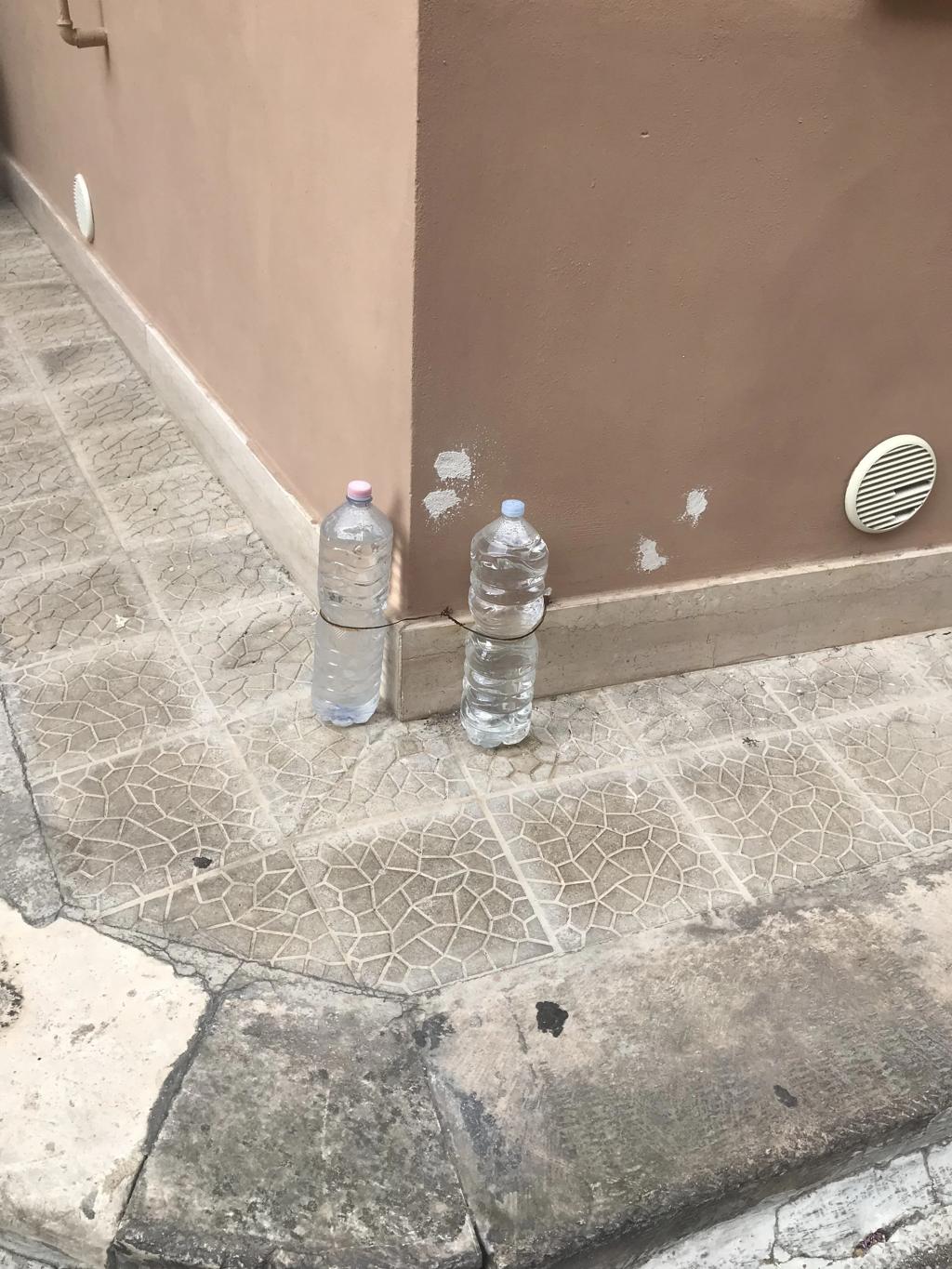
The Water Bottles Outside Maltese Homes – And the Strange Reason They’re There
Not recycling. Not decoration. Just one of Malta’s most quietly fascinating little habits.
You’re walking through a narrow street in Valletta or wandering through one of the older village corners of Rabat. The walls are honey-colored limestone. Balconies hang heavy with potted plants. And then you notice something sitting beside a doorstep that doesn’t quite fit the picture.
A plastic bottle. Filled with water. Just sitting there.
You walk a little further. There’s another one. Then two more lined up near a garage entrance. Then a larger container placed carefully along a stone wall.
You start wondering if you’re missing something obvious. Are people leaving water out for stray cats? Is it some kind of recycling system? Did someone just forget to bring their shopping inside?
Then you ask a local – and suddenly a whole little world opens up.
The story behind the bottles
Those water-filled bottles are there to stop dogs – and sometimes cats – from urinating outside people’s homes.
The idea is surprisingly simple. Animals are supposedly confused or discouraged by the way light reflects off the water. They sense something unfamiliar, feel uneasy, and move on. The area stays clean. The homeowner stays happy.
That’s the theory, at least.
Some Maltese residents swear by it completely. Others laugh when you ask about it and admit it’s probably just an old habit that nobody bothered to question. But walk through almost any older residential neighborhood in Malta – Valletta, Rabat, Zejtun, Siggiewi, the quieter backstreets of almost any village – and the bottles are there. They’ve been there for years. Possibly decades.
Once you see them, you notice them absolutely everywhere.
Does it actually work?
Honestly – probably not in any scientifically proven way.
Animal behavior experts generally agree there’s no strong evidence that water bottles reliably stop dogs or cats from marking a spot. The reflection theory sounds logical, but animals are adaptable and the effect, if it exists at all, likely fades quickly.
And yet the belief persists – not just in Malta, but across parts of Italy, Spain, and other Mediterranean countries where the same habit quietly exists in older neighborhoods.
In Malta, though, it became something more than just a trick. It became part of how people manage street life.
Older stone houses are genuinely difficult to clean. Narrow streets trap heat in summer, and unpleasant smells can linger for days in the kind of tight alleyways that make Maltese villages so beautiful to photograph. For many residents, placing a cheap bottle outside costs nothing, takes thirty seconds, and feels like it helps – even if only a little.
So the logic becomes: it costs almost nothing, it harms no one, and it works well enough. Why stop?
Why the tradition survived
The bottles say something deeper about how life works in Malta.
Nobody sat down and formally decided this was the solution. Nobody wrote it in a guidebook or announced it as official neighborhood advice. Someone did it. A neighbor noticed. The neighbor copied them. And slowly, quietly, the habit spread across streets and generations without anyone needing to explain it.
That’s very Maltese.
Malta is full of small unwritten customs that outsiders rarely pick up on immediately – little habits and local shortcuts that pass from one generation to the next simply through observation. You see it done, you do it too, and eventually you stop thinking about where it came from.
Which is exactly what makes these details so fascinating to visitors. The bottles aren’t a tourist attraction. They won’t appear in any official travel guide. They’re just one of those tiny background details of daily life that reveal something honest about how a place actually works.
A very Maltese mix of practicality and superstition
Malta has always sat comfortably at the crossing point between practical thinking and old belief. You’ll find religious statues tucked into street corners to protect the neighborhood. Old symbols carved quietly into doorways. Fishermen who still follow weather patterns passed down through families for generations.
The water bottle tradition fits right into that world – half logic, half local myth, entirely Maltese.
And that’s part of what makes it charming. Because the most interesting things about any country are rarely the famous landmarks or the beaches in the travel brochures. They’re the small strange habits that locals stop noticing and visitors can’t quite explain.
So next time you spot a water-filled bottle sitting outside a Maltese doorstep, you’ll know exactly why it’s there.
Even if nobody can fully prove whether it actually works.