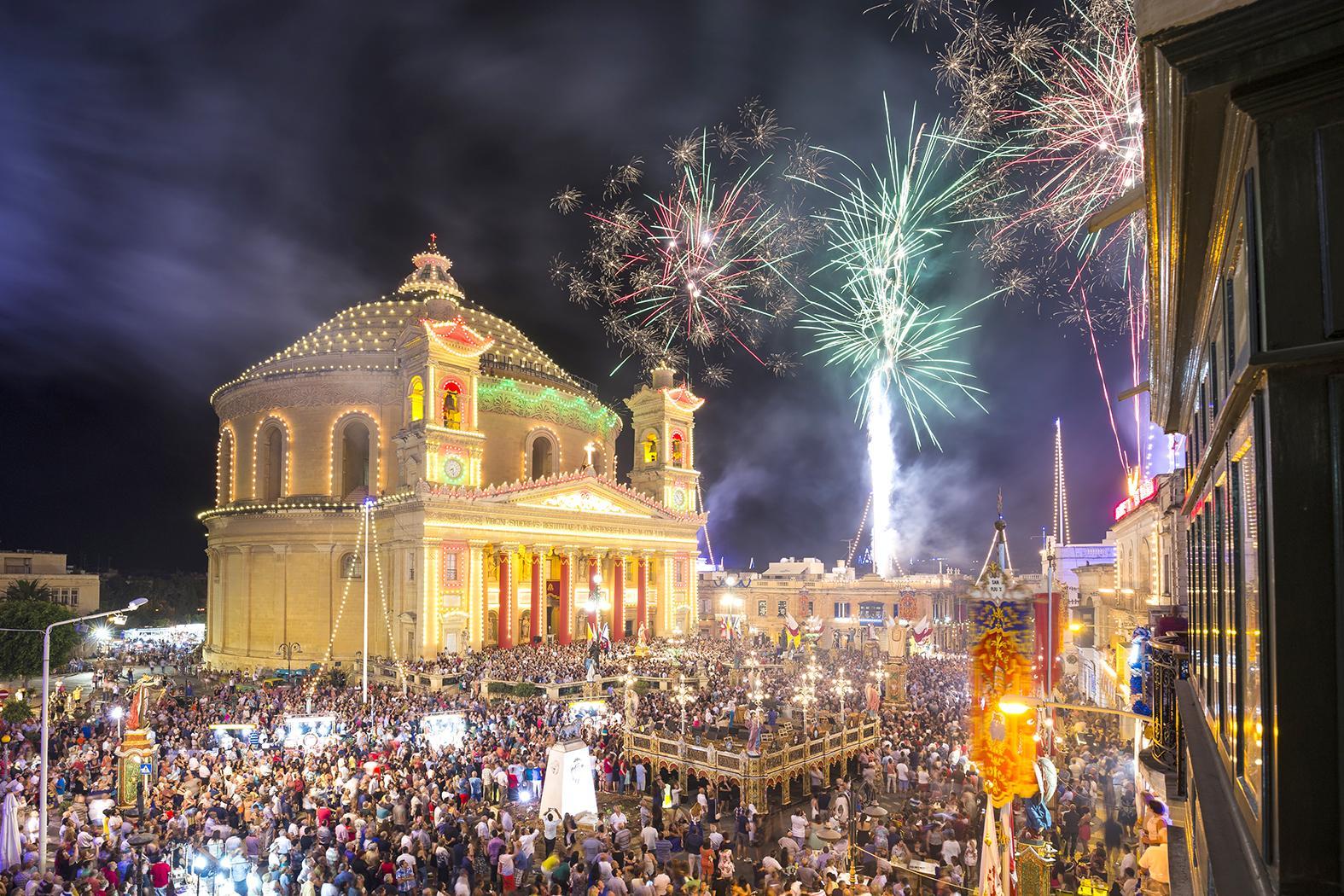
The Reason Malta Sounds Like New Year’s Eve All Summer
No, it’s not New Year’s Eve. No, nothing is wrong. Welcome to festa season.
You’re sitting outside somewhere in Malta. Maybe having dinner on a terrace. Maybe just walking through a quiet village street, enjoying the evening air and the smell of old limestone.
And then – BOOM.
A massive firework goes off somewhere nearby. Then another. Then a deep, thundering explosion that rolls across the rooftops and fades into the summer sky.
You look around. Nobody else reacts. A couple keeps eating. An old man on a bench doesn’t even look up. A cat stretches and goes back to sleep.
You check your phone. It’s a Wednesday. It’s July. There’s no national holiday. No football final. Nothing in the news.
And yet the fireworks keep going.
If this has happened to you, you’ve just had your first proper introduction to one of Malta’s most beloved and most misunderstood traditions.
It’s all about the festa
One word explains almost everything: festa.
A festa is the annual feast celebration dedicated to a village’s patron saint. But calling it a festival feels far too small. In Malta, a festa is part religious ceremony, part community reunion, part intense village pride – and part competition that the whole neighborhood takes extremely seriously.
For many Maltese villages, the festa is the single biggest event of the entire year. Not Christmas. Not New Year. The festa.
And fireworks are not a side detail. They are one of the main events.
Weeks before the actual feast day, the whole village shifts into a different gear. Streets fill with elaborate decorations. Giant banners hang between buildings. Churches get covered in hundreds of lights. Marching bands rehearse late into the night. And fireworks – day and night – begin announcing to anyone within earshot that something important is coming.
Yes, daytime fireworks are completely normal
One of the first things visitors discover – usually with some alarm – is that Malta’s fireworks tradition doesn’t wait for darkness.
The island has a long history of loud daytime fireworks called petards – explosive shells designed almost entirely for sound rather than visuals. On a festa day, you might hear enormous thunder-like booms rolling across entire towns in bright afternoon sunshine, with nothing visible in the sky at all.
For locals, that sound means celebration. It means the feast is near. It means the village is alive.
For anyone visiting for the first time, it can sound a lot like construction work crossed with artillery fire.
And somehow, everyone just accepts it as completely normal.
Villages actually compete with each other
This is where things get very Maltese.
Festas are inseparable from village pride. And because every village wants its festa to feel bigger, louder, and more memorable than the neighboring town’s, the fireworks became an unofficial but deeply felt competition.
Villages invest serious time, money, and community effort into larger displays, more elaborate pyrotechnics, louder explosions, and longer celebrations. In places like Mosta, Zebbug, Naxxar, and Qormi, entire communities spend months organizing their festa – and the fireworks committee is never short of volunteers.
Nobody wants their village to be outdone.
The fireworks are actually handmade
Here’s something most visitors never find out: Malta has a deep pyrotechnic tradition, and many fireworks are still produced by local volunteer enthusiasts connected directly to village feast associations.
For some families, working on fireworks is a craft passed down through generations. Fathers teach sons. Neighbors work together in small workshops. The knowledge, the techniques, the specific character of each village’s display – all of it gets carried forward as a point of genuine pride.
Despite being one of the smallest countries in Europe, Malta became internationally recognized for its pyrotechnic craftsmanship. Locals know this, and they feel it. These displays aren’t just entertainment – they represent real heritage and real community effort packed into every explosion.
Not everyone loves it
Modern Malta is honestly divided on the tradition.
Many residents love it completely and would defend it without hesitation. But others – especially in densely populated areas – talk about sleepless nights, frightened pets, noise that starts before dawn and doesn’t stop until late, and the general exhaustion of living through festa season in a small country where the celebrations seem to follow you from village to village all summer long.
There are also serious safety concerns. Malta has experienced a number of fireworks factory accidents over the years, sparking wider debates about regulation, modernization, and how much risk a tradition is worth.
But despite all of it, festas remain deeply emotional events for most Maltese families. For many people, the fireworks aren’t just noise – they’re memory, identity, and belonging all rolled into one very loud package.
Why it catches every visitor off guard
In most countries, fireworks are saved for one or two nights a year. A national holiday. New Year’s Eve. Something officially marked on the calendar.
Malta doesn’t work that way.
Here, fireworks happen because a saint’s feast is approaching, because a procession is passing through the street, because the marching band is celebrating, or simply because the festa week has officially begun and the village needs everyone to know it.
Which is why newcomers always feel that same confused jolt – that sense of expecting a quiet Mediterranean evening and getting something that sounds like a celebration refusing to end.
A tradition that refuses to stay quiet
After a while in Malta, something shifts. The explosions stop surprising you. The bells, the bands, the lights strung between balconies, the smell of gunpowder drifting through warm summer air – it all starts feeling like the normal texture of an evening.
And then one night, the festa ends. The village goes quiet. The streets go dark.
And somehow, without quite expecting it, the silence feels completely wrong.