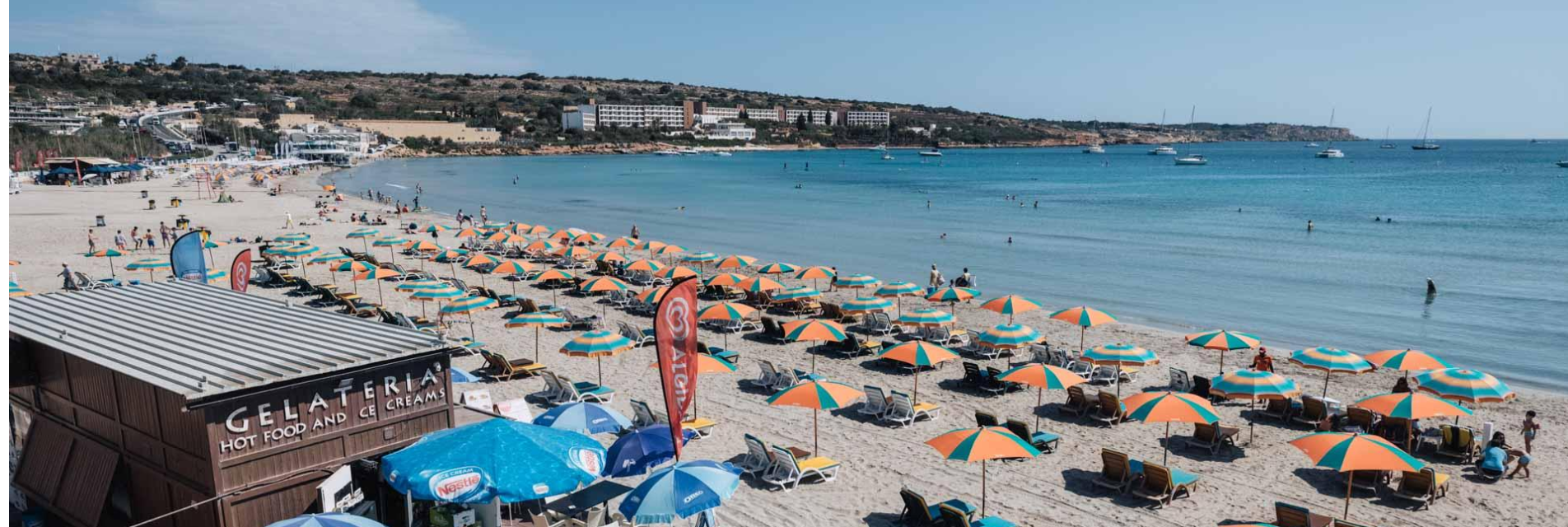
Golden Bay gets the sunset photos. Blue Lagoon gets the Instagram grid. But ask a Maltese family with young kids where they actually go on a Sunday, and the answer is more often Għadira Bay, also known as Mellieħa Bay, the largest stretch of sand on the island and the closest thing Malta has to an easy beach day. This guide covers what actually matters: the story behind the name, the real BBQ rules, the nature reserve most visitors walk straight past, and the exact bus routes rather than a vague “it’s easy to get to.”
Where the name comes from, and why it matters
Għadira is Maltese for a small body of water, a pond, l
ake or marsh, from the Arabic ghadir. It’s not a decorative name. Directly behind the beach sits a shallow coastal lagoon that formed naturally inside the bay, and sixteenth-century maps actually label the site Saline Vecchie, old saltpans, suggesting the area was once used for salt extraction. For centuries after that it lay mostly unused, until a coastal road built in the nineteenth century stabilised the shoreline and separated the beach from the pool behind it. That pool still exists. Today it’s the Għadira Nature Reserve, managed by BirdLife Malta volunteers, and it’s the reason the beach carries this name at all.
The largest sandy beach in Malta
Most of Malta’s coastline is rock, so an 800-metre stretch of genuine soft sand stands out immediately. Għadira Bay is consistently cited as the island’s largest and most popular sandy beach, made up of three connected sections that together form the long curve of shoreline below Mellieħa town. Even on a packed August weekend, the sheer length of it means you can usually still find room. The water stays shallow for a genuinely long way out, sloping so gently that you can wade 50 metres or more and still be no deeper than waist height. That single fact does more for the beach’s reputation with families than anything else on this list.
Why families choose Għadira Bay
Built for kids
Small waves, a sandy seabed rather than rock, and water that stays shallow for a long stretch out from shore. Parents can genuinely relax here in a way that’s harder at Malta’s steeper or rockier beaches, and the soft bottom makes walking in and out of the water far more comfortable underfoot.
Calm evenings, and a proper night beach
Once the day-trip crowd thins out, Għadira turns noticeably quieter than beaches closer to Sliema or St Julian’s. Evening walks along the sand are genuinely peaceful, and on a full moon night the light on the water is worth staying out for.
A view that comes free with the beach
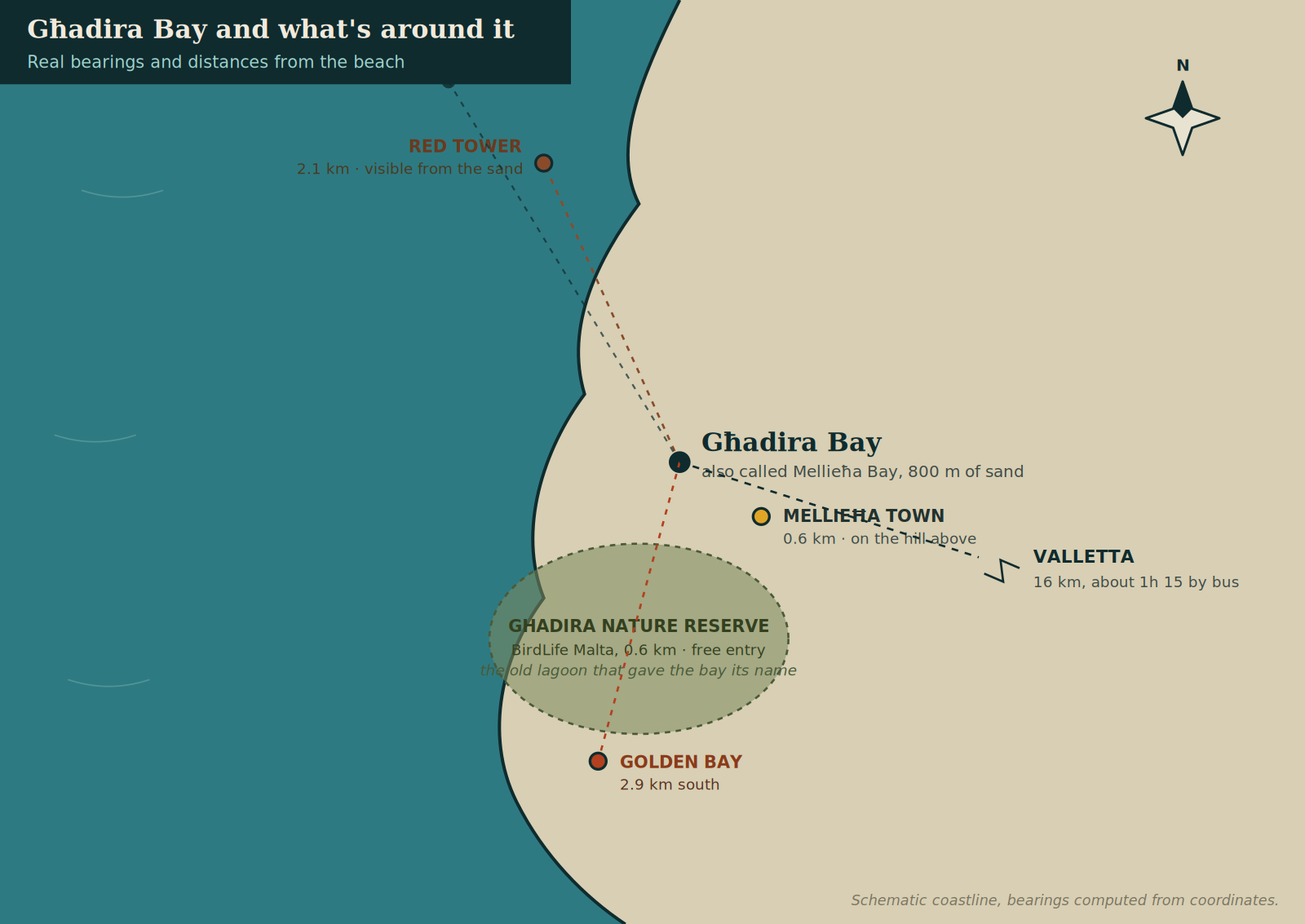
Look north-west from the sand and you’ll see the Red Tower (St Agatha’s Tower) on high ground roughly two kilometres away, built by the Knights of St John between 1647 and 1649 as one of the Lascaris watchtowers guarding Malta’s northern coast. Sunset and early evening are when it looks best against the sky, and it’s a genuinely striking backdrop that most other Maltese beaches simply don’t have.
Things to do
Water sports
In season, expect the full range: jet skiing, banana boat rides, paddleboarding, kayaking, water skiing, windsurfing and pedal boats. Operators are set up directly on the beach, so there’s rarely much waiting around to get started.
Sunbeds and umbrellas
Rentals are available right on the sand, a straightforward option if you’d rather not carry your own gear for a full beach day.
Kiosks and food
The beachfront has a solid run of kiosks and snack bars: ice cream, pizza, fries, burgers, sandwiches, cocktails, coffee and cold drinks. On summer evenings this stretch turns genuinely lively, with families and groups eating together as the light fades.
Facilities
Free public showers, public toilets and changing areas are all available along the beach, with some nearby hotels also offering shower access to non-guests for a fee. For a beach this size, it’s well equipped.
BBQ rules, precisely
This is where a lot of visitors get caught out, so it’s worth being exact rather than vague. According to the Malta Ranger Unit, which manages outdoor activity guidance for protected areas, only gas barbecues are permitted at Għadira, and only within the designated zones on the beach itself. Charcoal is not allowed. A permit is required from the Mellieħa Local Council regardless of group size, not just for larger gatherings. Inside the nature reserve itself, the rules are stricter still: no barbecues, no open fires, and no loud noise are permitted there under any circumstances, and fines are enforced. The reserve sits immediately behind the main beach, so this matters if you’re setting up further back from the sand rather than on it. Check current permit requirements with the Mellieħa Local Council before you plan anything, since local by-laws here have changed before and can change again.
Parking and getting there
Parking
Free parking is available close to the beach, though it fills up fast on summer weekends. Arrive early if you want to park near the sand rather than walk from further back.
By bus
Malta Public Transport connects Għadira Bay well:
- From Valletta: routes 41 and 42 run direct, taking roughly 1 hour to 1 hour 15 minutes depending on traffic.
- From the Cirkewwa ferry terminal: route 101 takes about 20 minutes, useful if you’re coming from or heading to Gozo.
- From Buġibba, Qawra and St Paul’s Bay: routes 221 and 222 cover the roughly 30-minute journey.
- From Sliema and St Julian’s: route 222 runs direct, taking around an hour.
Buses stop close to the beach itself, so this genuinely is one of the more convenient beaches on the island if you’d rather skip the parking search entirely. Check the Tallinja app for current timetables, since routes and schedules do shift.
By taxi
Bolt and eCabs both operate reliably from every major tourist area on the island.
Best time to visit
Summer (June to August) is the busiest and most energetic stretch, warm water, full water sports, a lively beach atmosphere from morning through evening. Spring and autumn suit anyone who wants the same warm-enough water with a noticeably quieter beach and more comfortable temperatures for sitting out all day. Night visits work here in a way they don’t at every beach. Għadira stays genuinely pleasant after dark, whether you’re after a quiet walk, some distance from the noise of the towns further south, or simply somewhere to sit by the water.
Frequently asked questions
Is Għadira Bay the largest beach in Malta?
Yes. At roughly 800 metres of sand across three connected sections, it’s consistently cited as Malta’s largest and most popular sandy beach.
What does Għadira mean?
Għadira is Maltese for a small body of water, a pond or marsh, from the Arabic ghadir. It refers to the coastal lagoon that once sat directly behind the beach and still exists today as the Għadira Nature Reserve.
Are BBQs allowed at Għadira Bay?
Only gas barbecues, within designated zones on the beach, and only with a permit from the Mellieħa Local Council regardless of group size. Charcoal is not permitted, and no barbecues or open fires of any kind are allowed inside the adjacent nature reserve.
How do you get to Għadira Bay by bus?
Routes 41 and 42 run direct from Valletta, taking around 1 hour to 1 hour 15 minutes. Route 101 connects from the Cirkewwa ferry terminal in about 20 minutes. Routes 221 and 222 serve Buġibba, Qawra and St Paul’s Bay, and route 222 also runs from Sliema and St Julian’s.
Can you see the Red Tower from Għadira Bay?
Yes. St Agatha’s Tower, known locally as the Red Tower, stands on high ground about 2 kilometres north-west of the beach and is visible from the sand, particularly striking at sunset.
Is there a nature reserve at Għadira Bay?
Yes. The Għadira Nature Reserve, managed by BirdLife Malta, sits directly behind the beach and protects a rare wetland habitat that’s an important stopover for migratory birds. Entry is free, with guided tours typically available from November to May.
Is Għadira Bay good for young children?
Yes, it’s widely considered one of the best beaches in Malta for families with young kids. The water stays shallow for a long distance from shore, waves are usually small, and the sandy seabed is easier underfoot than Malta’s rockier beaches. Għadira Bay doesn’t try to be the most photogenic beach in Malta, and it doesn’t need to be. It’s the one that actually works for a full day with kids, a proper evening swim, and a nature reserve worth the ten-minute detour once you’ve had enough sun.