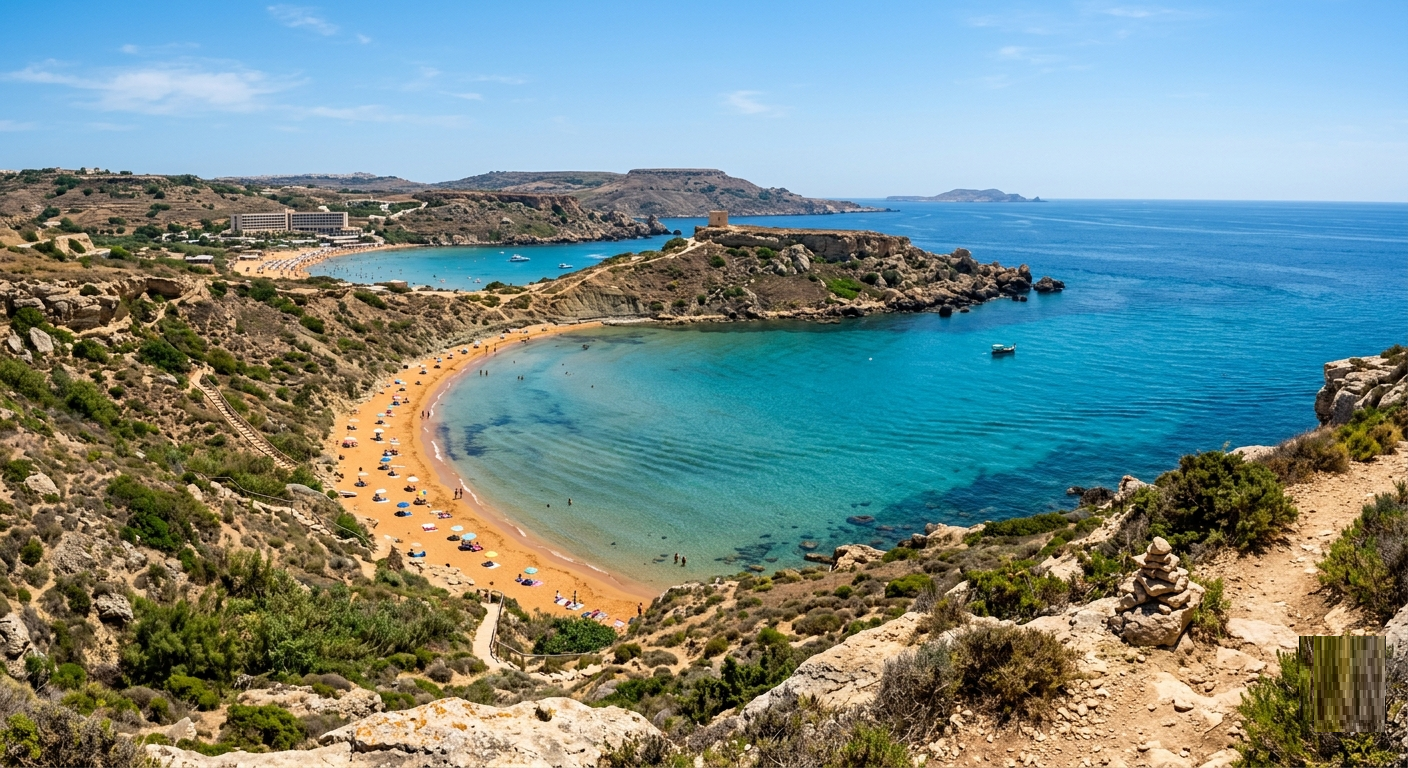
Golden Bay is the beach everyone photographs. Għajn Tuffieħa, one bay south and separated from it by nothing more than a headland and 200 steps, is the one locals actually prefer. Same coastline, same clay slopes and limestone cliffs, but red-orange sand instead of gold, a fraction of the crowd, and a name most visitors mispronounce without ever learning what it means. This guide covers what that name actually says, the tower on the cliff and why part of it is currently roped off, the real walking times to Golden Bay and Ġnejna, and the practical details that make or break a visit here: the steps, the bus stop, and where to actually get a drink once you’re down on the sand.
What the name means, and why it’s called Riviera
Għajn Tuffieħa translates to “Apple’s Eye.” Għajn is the Maltese word that shows up all over the island in place names tied to springs or water sources; tuffieħa means apple. Nobody’s entirely certain the name ever had anything literally to do with apples, since it follows a naming pattern common to Maltese place names beginning with Għajn, but it’s stuck for centuries regardless. Locally, you’ll hear the beach called Riviera just as often, and the bus stop at the top of the steps is signed that way too. Some older references extend it further to Riviera Martinique.
The red-orange sand
Unlike Golden Bay’s pale gold or Għadira’s beige, this sand runs distinctly red-orange, the result of clay from the surrounding slopes washing down into the bay over thousands of years. It’s the same blue clay geology found up and down this stretch of coast, the layer responsible for the green, terraced slopes at Dingli and Selmun too, but here it’s the sand itself that carries the colour rather than just the hillside above it. The bay curves in deeply between clay slopes and limestone cliffs on both sides, which gives it a closed-in, sheltered feel that Golden Bay, more open and more built-up, doesn’t have. There’s no large hotel directly on this shoreline, which is a large part of why the atmosphere stays as quiet as it does.
The tower on the cliff
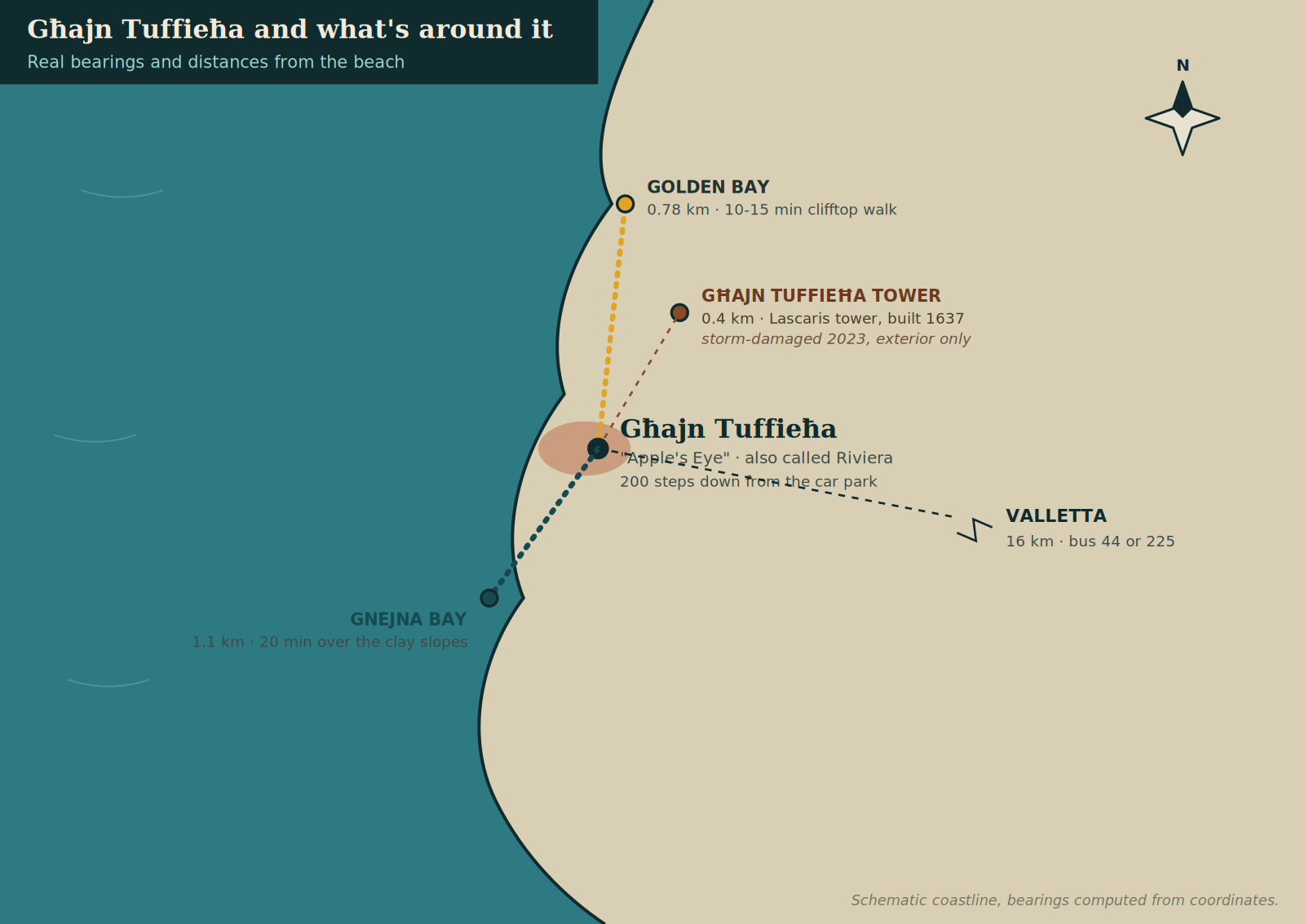
On the headland above the bay stands the Għajn Tuffieħa Tower, built in 1637 as the second of the Lascaris towers, a chain of coastal watchtowers commissioned by Grand Master Giovanni Paolo Lascaris and designed by the Italian architect Vincenzo Maculani. It replaced an earlier medieval watch post on the same site, was originally armed with a half-pounder gun, and was garrisoned by a captain and three men, paid by the Università of Mdina. The system worked as a relay: spot an approaching fleet, light a fire on the roof, and the next tower down the chain would see it and pass the warning on toward Mdina and eventually Valletta. Worth knowing before you go: the tower’s exterior can be visited on a short walk from the top of the steps, but you can’t go inside, and a storm in 2023 caused damage that’s left the structure further threatened by coastal erosion. Treat it as a viewpoint and a photo subject rather than a building to explore.
Best time to visit
May, June, September and October hit the balance most people are after: warm enough to swim comfortably, without the peak crowds of high summer. July and August are busier, though even then, noticeably quieter than Golden Bay just over the hill. November to April is too cold to swim for most people, but the clay slopes turn green after winter rain, which makes this the best stretch of the year for hiking and photography rather than sunbathing. Within the day, before 9am in summer gets you a still sea and an empty beach. Alternatively, arrive around 5pm for the sunset: the bay faces almost due west, so the sun drops directly into the water in front of you, and the cliffs pick up a deep amber glow as it goes down.
Things to do
Swim and snorkel
The water deepens gradually and stays clear well out from shore. Snorkelling is best around the rocky borders on either side of the bay rather than over the open sand in the middle; wrasse, sea bream and the occasional small octopus turn up in the crevices there.
Hike the clay slopes
A well-used trail heads south from the beach, climbing over the clay slopes with the sea on one side and open Maltese countryside on the other. It connects directly through to Ġnejna Bay, about 1.1 kilometres and 20 minutes away, and the two beaches together make a satisfying half-day loop for anyone who wants more than a straight beach day.
Photograph the bay
The curve of the bay from the top of the steps, the texture of the clay slopes, and the tower silhouetted against a sunset sky all make for genuinely strong compositions. The light in the last hour before sunset is the best it gets anywhere on this coast.
Nearby
Golden Bay is roughly 0.78 kilometres and a 10 to 15 minute walk north along the flat clifftop path. It’s bigger, busier, and backed by the Radisson Blu resort, restaurants and full water sports, a straightforward contrast if you want more energy after the quiet of Riviera Beach. Ġnejna Bay, on the other side of the clay slopes to the south, is known for the small, colourful boathouses built directly into the rock face above the sand, and tends to draw more Maltese families than tourists.
Practical tips
The 200 steps
The only way down to the sand is a flight of roughly 200 stone steps. Going down is easy; the climb back up in afternoon heat is the part that catches people out. Pace yourself, carry water, and know upfront that this beach is not accessible by wheelchair or pushchair.
Getting there
By bus, the stop is called Riviera, and it sits right at the top of the steps. Direct routes include 44 from Valletta, 225 from Sliema and St Julian’s, and 223 from Buġibba. Check the Tallinja app for current timetables, particularly the last bus back if you’re staying for sunset. By car, follow signs toward the north-west coast. A dirt car park sits at the top of the cliff near the bus stop; in summer, an informal attendant often manages it on a charity basis, and a tip of a euro or two is standard. On busy weekends this lot fills by mid-morning, so arriving early matters as much here as at Golden Bay next door.
Food and drink
Singita Miracle Beach, a cocktail bar and restaurant right on the sand, is the only real dining option at the beach itself. It’s good, but it gets busy and isn’t cheap, so bring your own water regardless, especially given the climb back up.
What to pack
Flip-flops are fine for the sand, but if you’re hiking the clay slopes or walking to the tower, switch to proper trainers with grip; the clay turns slippery fast after rain. There’s no natural shade anywhere on the beach, so sunscreen, a hat, and an early rental of an umbrella from the beach concession, before they sell out, are all worth planning for.
Frequently asked questions
What does Għajn Tuffieħa mean?
It translates to “Apple’s Eye,” from Għajn, a common element in Maltese place names tied to water sources, and tuffieħa, meaning apple. The beach is also widely known locally as Riviera or Riviera Beach.
Why is the sand red at Għajn Tuffieħa?
The red-orange colour comes from clay in the surrounding slopes, washed down into the bay over thousands of years. It’s the same blue clay found elsewhere on this stretch of Malta’s coast, but here it directly colours the sand rather than just the hillside.
How many steps are there down to Għajn Tuffieħa?
Roughly 200 stone steps, the only route to the beach. There’s no wheelchair or pushchair access, and the climb back up is noticeably harder than the walk down, especially in summer heat.
How do you get to Għajn Tuffieħa by bus?
The stop is called Riviera. Bus 44 runs direct from Valletta, bus 225 runs direct from Sliema and St Julian’s, and bus 223 connects from Buġibba. Check the Tallinja app for current timetables before you travel.
How far is Golden Bay from Għajn Tuffieħa?
About 0.78 kilometres, a 10 to 15 minute walk along the clifftop path connecting the two beaches.
Can you go inside the Għajn Tuffieħa Tower?
No. The exterior is accessible via a short walk from the top of the steps, but the interior is closed to visitors, and the tower has suffered storm damage as recently as 2023, with coastal erosion an ongoing threat to the structure.
Is there food available at Għajn Tuffieħa?
Yes, Singita Miracle Beach is a bar and restaurant on the sand, the only option directly at the beach. It gets busy and isn’t cheap, so most visitors also bring their own water and snacks.
Is Għajn Tuffieħa better than Golden Bay?
They suit different moods rather than one being objectively better. Għajn Tuffieħa is quieter, more natural, and requires more effort to reach; Golden Bay is larger, more developed, and easier to access. Many visitors combine both in the same day via the short clifftop walk between them. Għajn Tuffieħa asks a little more of you than the beach next door, 200 steps down and the same number back up, and that’s exactly the trade that keeps it this quiet. Go early or go for sunset, bring water for the climb, and take the short walk to the tower while you’re up there.