Most Marsaxlokk articles show you the same photo: rows of painted boats, a caption calling it “the most photographed harbour in the Mediterranean,” and a reminder to come on Sunday for the market. All true. What they skip is the reason those boats look the way they do, which authority to trust about swimming water further down the coast, and the one week in August when this quiet fishing village actually throws a party for its own fleet.
This guide covers Marsaxlokk properly: the harbour, the Sunday market, where the seafood is worth sitting down for, and the two places nearby worth the walk, with real distances rather than “just a short walk away.”
Where the name comes from
Marsaxlokk (pronounced roughly mar-sa-shlock) combines two words. Marsa is Arabic for harbour or port. Xlokk is the Maltese name for the sirocco, the dry, often fierce wind that blows up from the Sahara out of the south-east. Put together, the name simply means “south-east harbour,” describing both the bay’s orientation and the wind that defines it. The same root gives Sicilian scirocco, Catalan xaloc, and half a dozen other Mediterranean words for the same wind.
That wind has shaped more than the name. Phoenician traders anchored in this bay as early as the ninth century BC, and the Ottoman fleet used it as their first landing point during the 1565 Great Siege, before Napoleon’s forces landed here again in 1798. Even in living memory, the harbour has made history: in December 1989, Marsaxlokk hosted the Malta Summit, where George H. W. Bush and Mikhail Gorbachev met aboard ship and effectively declared the end of the Cold War. A quiet fishing village, twice over, has been where empires and superpowers chose to arrive.
The boats, and what the eyes actually mean
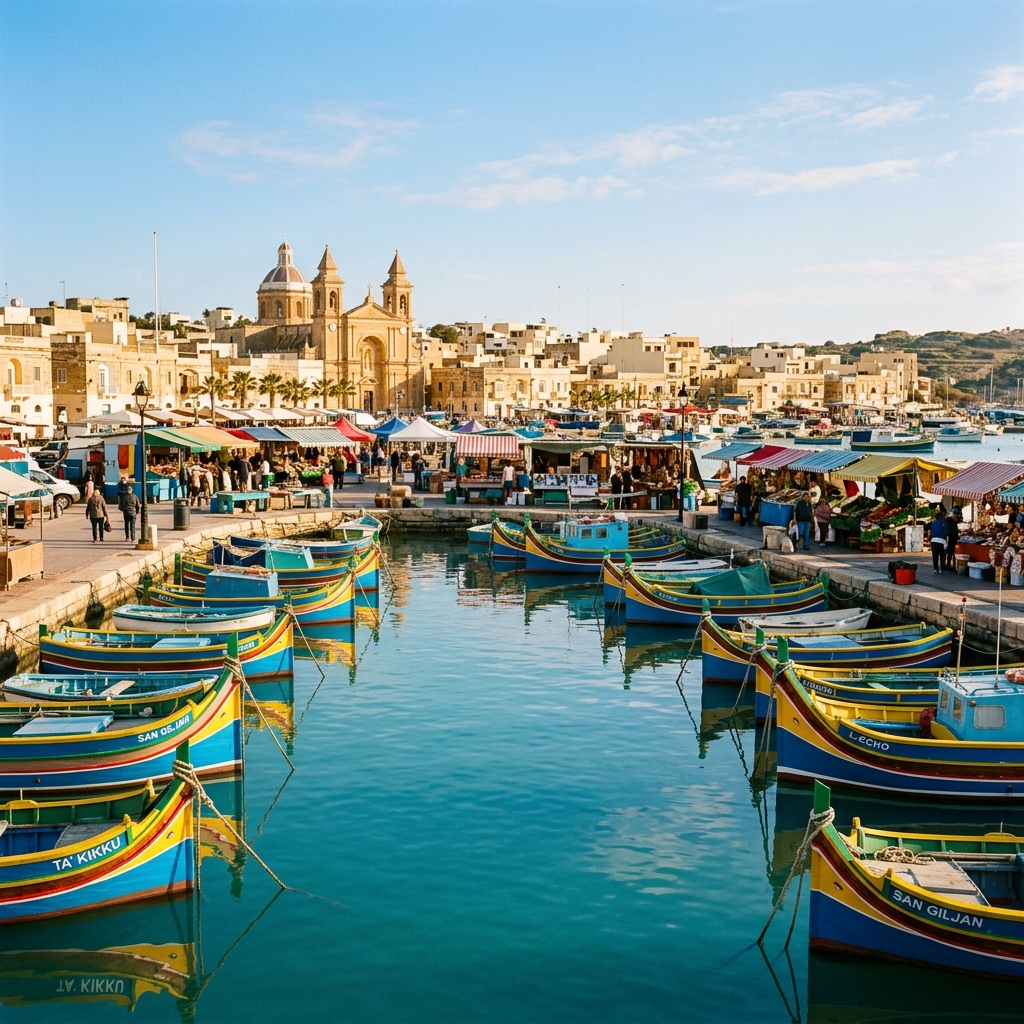
Walk onto the promenade and the harbour does the rest of the work. Hundreds of luzzu, the traditional double-ended fishing boats, sit in the water in blue, red, yellow and green, repainted by hand roughly twice a year in colours each family rarely changes.
Look at the bow of almost any boat and you’ll find a pair of painted eyes staring back, known as the Eye of Osiris or the Eye of Horus. The symbolism is genuinely ancient: an eye placed on a boat’s prow for protection is a tradition that traces back toward Phoenician and Egyptian maritime custom, and fishermen here will tell you the eyes watch for danger and guide the boat home.
Worth knowing, though: the luzzu as a specific boat design is not itself a direct, unbroken Phoenician relic, however often that claim gets repeated. Maltese maritime historians trace the modern luzzu’s hull to the Italian gozzo, a boat type that appeared around Malta in the late nineteenth century and was adapted into today’s form by the early twentieth. The eye is old. The boat carrying it is a more recent, and still very Maltese, invention. Look closer and you’ll also spot the mustaċċ, the moustache-shaped painted band near the bow, whose colour traditionally identified which village a boat called home; red, for instance, marked a boat from St Paul’s Bay.
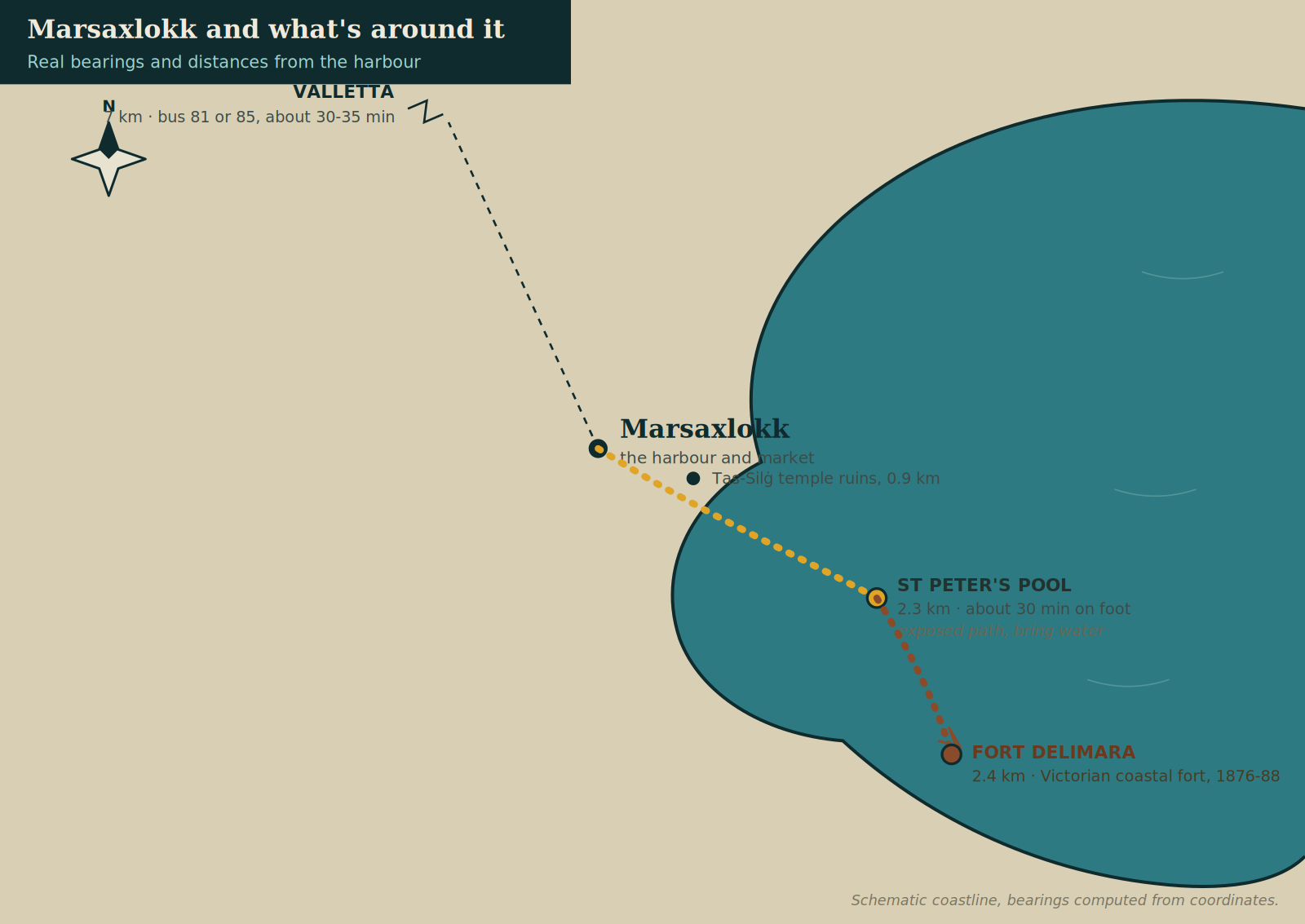
Marsaxlokk sits about 7 km from Valletta. St Peter’s Pool is 2.3 km away, roughly a 30 minute walk, with Fort Delimara a similar distance beyond it.
The Sunday market
Marsaxlokk is a working harbour every day, but Sunday is when it performs. The waterfront fills before dawn as fishermen bring their overnight catch straight to the tables lining the promenade: swordfish, octopus, sea bream, and the local favourite lampuki laid out on crushed ice, all while stallholders negotiate loudly in Maltese over the price.
Beyond the fish, the market runs deep into the village: seasonal fruit and vegetables, jars of raw Maltese honey, lace, and the smell of hot street food carried on the sea breeze.
Arrive before 9am. The fish selection is best early, and you’ll have the stalls to yourself before the coach tours arrive around mid-morning.
Lampuki season: the harbour’s own festival
If you’re here in mid-August, you’ve arrived for something most visitors never plan around. Every year on 15 August, the Feast of the Assumption, Marsaxlokk opens the lampuki (dolphin fish, or mahi-mahi) season with a blessing of the boats on the waterfront. A priest boards a small vessel and sails out into the bay to bless each luzzu and its crew before the fleet heads out that night, in a ceremony that’s been repeated for generations.
The technique itself is centuries old: fishermen weave palm fronds into floating rafts called kannizzati, anchored by slabs of limestone. Lampuki shelter in the shade beneath them, and once enough gather, the nets go out. The season runs from 15 August through to the end of December, with the best catches and the height of local demand in August and September. If you’re anywhere in Malta during those months, this is the fish to order.
Fresh seafood by the harbour
Marsaxlokk’s seafood reputation is earned. Dozens of restaurants line the water, serving fish that was in the sea hours earlier, cooked simply: grilled octopus with olive oil, lemon and parsley; lampuki pie, a flaky pastry filled with fish, spinach, capers and olives, at its best in autumn when the season peaks; whole sea bream baked with garlic, white wine and herbs; and aljotta, a garlicky fish soup thickened with rice and tomato that’s as comforting as Maltese cooking gets.
Meals here run slow by design. Take the table by the water, order the wine, and let it take the time it wants to.
What to see and do
Walk the waterfront
The whole promenade rewards an unhurried lap: fishermen mending nets on the dock, an ice cream stop, a bench facing the boats. Early morning, just after the fleet returns with the overnight catch, is the best light of the day, the sky turning warm colours against the dark water. Evenings are the opposite mood entirely, quiet and softly lit, good for a slow walk once the day’s visitors have gone.
St Peter’s Pool
This is where “just a short walk” undersells things. St Peter’s Pool sits about 2.3 kilometres east-south-east of the village, a genuinely turquoise natural swimming spot cut into flat limestone, and getting there on foot takes roughly 30 minutes, longer in midsummer heat. The path is exposed with almost no shade, so bring more water than feels necessary and start early or late in the day.
If you’d rather not walk, a taxi covers it in a few minutes for around €10, and several operators run boat trips from the harbour, weather permitting, which is arguably the best way to arrive: swimming in from open water rather than climbing down the rocks.
Fort Delimara
Beyond St Peter’s Pool, roughly the same distance again, sits Fort Delimara, a Victorian-era polygonal fort built by the British between 1876 and 1888 as part of a ring of fortifications defending Marsaxlokk Bay. Four of its original 38-ton rifled guns remain in place, among the last surviving examples anywhere still mounted on their original carriages. The fort passed to Heritage Malta in 2005; access has been limited while restoration continues, so check current opening status before making the trip, but the walk out along the headland is worthwhile on its own for the coastal views.
Practical tips for visiting
Best time to visit
Spring (March to May): warm without summer’s crowds, and good weather for walking the coastal paths toward St Peter’s Pool.
Summer (June to August): the village at its most energetic, hot enough for swimming, and genuinely busy on Sundays.
Autumn (September to November): the best stretch for seafood lovers, since lampuki season is in full swing and the sea stays warm enough to swim.
Winter (December to February): quiet and slow, too cool for swimming but atmospheric for a lunch by the water and unhurried photography.
How to get there
Marsaxlokk sits roughly 7 kilometres south-east of Valletta.
By bus: routes 81 and 85 run from the main Valletta bus terminus directly to Marsaxlokk, taking around 30 to 35 minutes. On Sundays, the TD10 direct route also operates. Check the Tallinja app for current timetables, since routes and schedules do shift.
By taxi or rideshare: Bolt and eCabs both operate reliably and take you straight to the waterfront.
By car: driving gives you the freedom to explore the wider south coast in a day, though parking on Sunday mornings takes patience. Arrive early.
Frequently asked questions
What does Marsaxlokk mean?
Marsaxlokk combines the Arabic word marsa, meaning harbour, with the Maltese xlokk, the name for the south-easterly sirocco wind. The name translates roughly to “south-east harbour,” describing both the bay’s orientation and the wind that regularly blows through it.
Is Marsaxlokk worth visiting?
Yes, particularly on a Sunday morning for the fish market, or any day for the harbour itself and the seafood restaurants along the water. It offers a slower, more traditional side of Malta than the resort towns further north.
What day is the Marsaxlokk market?
The main fish and produce market runs every Sunday, starting early with fishermen bringing the overnight catch straight to the promenade. Arrive before 9am for the best selection and to beat the coach tours.
How far is St Peter’s Pool from Marsaxlokk?
About 2.3 kilometres, roughly a 30-minute walk along an exposed coastal path. A taxi takes a few minutes and costs around €10, or you can arrange a short boat trip from the harbour.
What do the eyes on the boats mean?
The painted eyes, known as the Eye of Osiris or Eye of Horus, are believed to protect fishermen at sea, a tradition linked to ancient Phoenician and Egyptian maritime custom. The luzzu boat design itself is more recent, generally traced to the Italian gozzo of the late nineteenth century, though the eye motif it carries is considerably older.
How do you get to Marsaxlokk from Valletta?
Buses 81 and 85 run from the Valletta bus terminus to Marsaxlokk, taking around 30 to 35 minutes, with an additional TD10 direct service on Sundays. Taxis and rideshare apps also cover the roughly 7 kilometre journey directly.
What is the best time of year for seafood in Marsaxlokk?
Autumn, particularly September, when the lampuki season is at its peak. The season officially opens on 15 August with a blessing of the fishing boats, and runs through to the end of December.
Is Fort Delimara open to visitors?
Access has been limited while restoration work continues under Heritage Malta, which took ownership in 2005. Check current opening times before planning a visit, though the coastal walk out to the fort is worthwhile regardless.
Marsaxlokk doesn’t perform for visitors the way the resort towns do. The boats are painted for the fishermen who own them, the market runs on the rhythm of the catch, and the whole village still organises itself around the tides rather than the tour buses. Go on a Sunday morning, eat slowly by the water, and if you’re there in mid-August, watch for the priest boarding a boat to bless the fleet before the lampuki season begins.