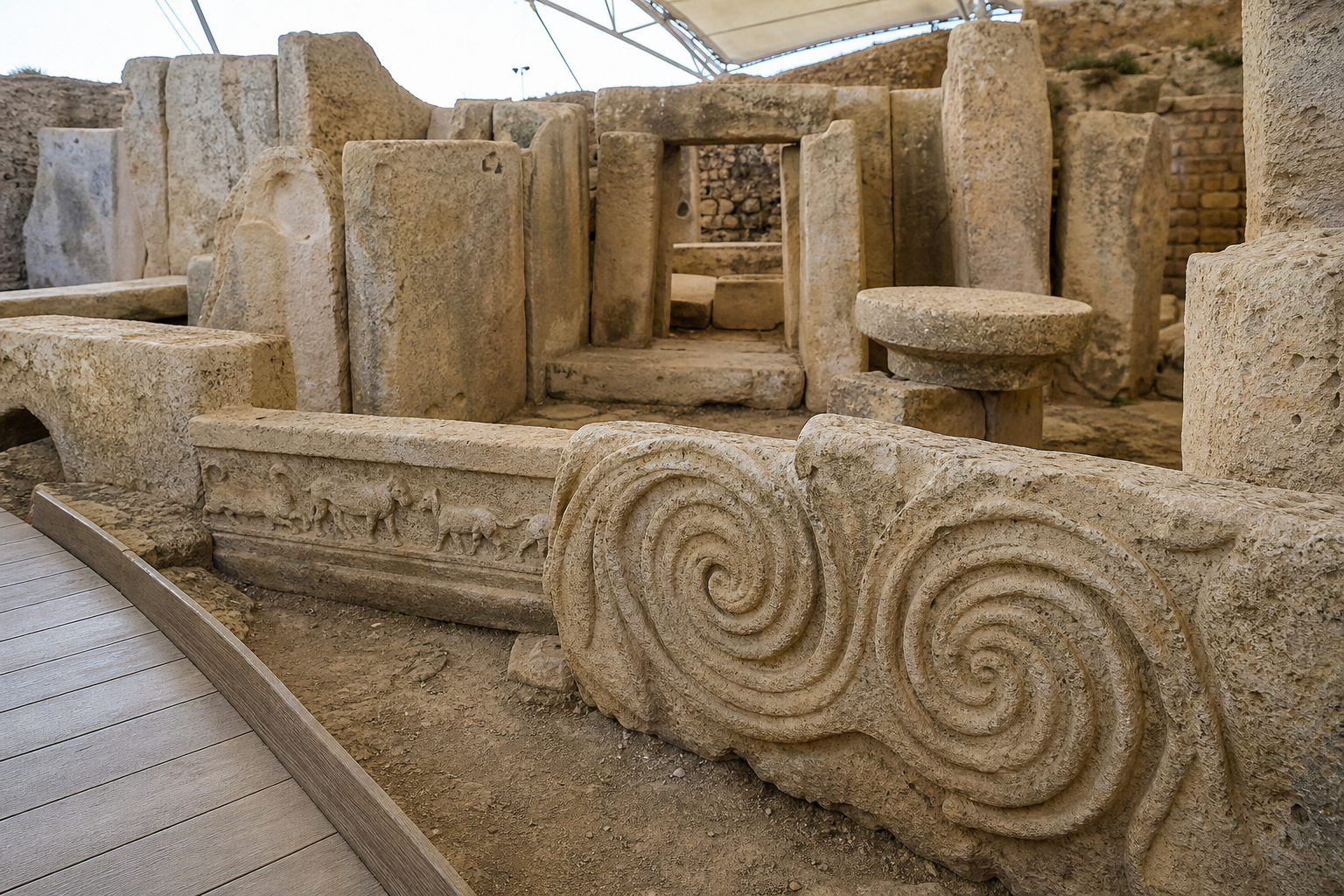
In 1913, a farmer in Tarxien kept hitting large stones while ploughing his field. Plenty of Maltese farmers had cleared stones from their land before. This time, when someone finally looked properly, the stones turned out to be the top of one of the most richly decorated prehistoric temple complexes in the world.
The Tarxien Temples sit today in the middle of a quiet residential neighbourhood, surrounded by houses and parked cars. It’s easy to drive past without noticing. But step inside and you’ll find carved spirals, rows of animals cut into stone, and the remains of a giant figure that once stood over the people who worshipped here.
It’s also just 800 metres from the Ħal Saflieni Hypogeum, so it fits perfectly into any visit to Malta’s prehistoric south.
Four temples, a thousand years of building
The Tarxien complex is made up of four connected structures, built over roughly a thousand years between about 3600 and 2500 BC, during the final and most sophisticated phase of Malta’s temple culture. In fact, archaeologists named that last great period the Tarxien phase, after this very site.
After the farmer’s discovery, the site was excavated between 1915 and 1919 by Sir Themistocles Zammit, the pioneering Maltese archaeologist who also worked on the Hypogeum. What he uncovered changed what the world knew about prehistoric Malta.
As you walk through, you’ll see:
- The Far East Temple: the oldest part, which survives mostly at ground level.
- The South Temple: the most richly decorated, with spiral-carved altars and the famous statue.
- The East Temple: built with large, finely shaped stone slabs.
- The Central Temple: unusual among Maltese temples for having six apses, or rounded chambers, instead of the usual four or five.
What makes Tarxien special: the decoration
Every Maltese temple is impressive for its size. Tarxien stands out for its art. It has more carved decoration than any other temple site in Malta.
The spirals
The most famous motifs are the carved spirals on altars and stone blocks, sometimes in pairs, flowing into each other like waves. Nobody knows exactly what they meant. Ideas range from eternity and the cycle of life to water or growing plants. Whatever their meaning, they show real artistic skill, carved with stone and bone tools, without any metal.
The animal friezes
Look closely and you’ll find rows of animals carved in relief: goats, sheep, pigs and a bull. They’re thought to show the animals offered at the temple, and they’re among the oldest animal carvings ever found in Malta.
The colossal statue
In the South Temple stands the lower half of a huge figure, a pair of legs and a pleated skirt. Complete, it would have been well over two metres tall, making it the largest known statue from Malta’s Neolithic period. Imagine it towering over the chamber in flickering lamplight, and you start to understand how powerful this place must have felt.
Originals and replicas
To protect them, many of the original carvings and the statue were moved to the National Museum of Archaeology in Valletta, and replicas now stand in their place at the site. Seeing both makes a great combination: the setting at Tarxien, and the fine detail of the originals in the museum.
What happened inside?
Archaeologists found animal bones, flint knives and stone altars with holes for tying animals, suggesting that sacrifices and offerings took place here. One altar even had a hidden compartment containing a flint knife and animal bones.
Large stone balls found around the site are believed to have been used as rollers, helping the builders move enormous blocks into place. It’s one of the best clues we have to how the temples were actually built. (If you like a good mystery, our story on the cart ruts nobody can explain covers another one.)
A second life as a cemetery
Around 2500 BC, the temple culture came to an end. But Tarxien didn’t stay empty. During the Bronze Age, people arrived and used the ruined South Temple as a cremation cemetery, burying the ashes of their dead in urns with weapons and ornaments. Archaeologists call this the Tarxien Cemetery phase. It’s a striking reminder that this site has been sacred to different people for thousands of years.
Part of a World Heritage Site
Tarxien is one of the Megalithic Temples of Malta, listed together on UNESCO’s World Heritage List alongside Ġgantija and Ħaġar Qim and Mnajdra. Read more in our guide to UNESCO sites in Malta.
The visit today
Since 2012, visitors follow an elevated walkway that winds through the complex, giving you a good view down into the chambers while protecting the fragile stone. In 2013, a protective shelter was added over the temples to shield them from rain and sun.
Information panels along the route explain what you’re looking at, and the site is compact enough to see in under an hour.
Tickets
Tarxien is one of the more affordable Heritage Malta sites, with adult tickets at around €6. Reduced prices apply for youths, seniors and students, and children under six go free. Prices are updated from time to time, so check the current rates on the official Heritage Malta website before you go.
The temples are included in the Heritage Malta Multisite Pass. If you’re planning several sites, see our guide to whether the Multisite Pass is worth it.
Opening hours
Tarxien is usually open daily, with seasonal changes and last admission shortly before closing. Like all Heritage Malta sites, it’s closed on 24, 25 and 31 December, 1 January and Good Friday. Always check the current hours on the Heritage Malta website before visiting, as times can change.
How long you need
Around 30 to 45 minutes for most visitors, or up to an hour if you love archaeology and want to read every panel.
Accessibility
Tarxien is one of the most accessible prehistoric sites in Malta. The walkway makes most of the complex reachable for wheelchair users and families with prams, although a few areas still have uneven ancient surfaces.
How to get there
Tarxien is about 6 km south of Valletta, in a residential area close to Paola. Several bus routes from Valletta stop nearby, and the journey takes around 15 to 20 minutes depending on traffic. Check the Malta Public Transport app for current routes. A taxi or ride-hailing app is quick and inexpensive.
The Ħal Saflieni Hypogeum is about a ten-minute walk away.
A prehistoric morning in the south
- Early morning: the Hypogeum, if you’ve managed to book a ticket.
- Mid-morning: walk ten minutes to the Tarxien Temples.
- Late morning: continue to Marsaxlokk for a fish lunch by the colourful boats.
- Afternoon: drive to Ħaġar Qim and Mnajdra on the southern cliffs, or explore Għar Dalam in Birżebbuġa.
Tips before you go
- Visit the museum too. The originals of the statue and carvings are in Valletta, and seeing them brings Tarxien to life.
- Combine it with the Hypogeum. They’re so close that it makes sense to see both on the same morning.
- Look for the details. Spirals, animals and the hidden altar compartment are easy to miss if you rush.
- Bring sun protection in summer. The shelter helps, but parts of the walkway are exposed.
Frequently asked questions
How old are the Tarxien Temples? They were built over roughly a thousand years, between about 3600 and 2500 BC.
When were they discovered? In 1913, by a farmer ploughing his field. They were excavated between 1915 and 1919.
How far is Tarxien from the Hypogeum? About 800 metres, around a ten-minute walk.
Is the statue at Tarxien the original? No. The original lower half of the colossal statue is in the National Museum of Archaeology in Valletta. A replica stands at the site.
How long does a visit take? Around 30 to 45 minutes.
Is it wheelchair accessible? Mostly, thanks to the elevated walkway. It’s one of Malta’s most accessible prehistoric sites.
Is it included in the Heritage Malta Multisite Pass? Yes.
Plan your visit
Site: Tarxien Temples, Tarxien Managed by: Heritage Malta Duration: 30 to 45 minutes Highlights: Spiral-carved altars, animal friezes, colossal statue, six-apsed Central Temple Tickets: Around €6 for adults, included in the Multisite Pass Closed: 24, 25 and 31 December, 1 January, Good Friday Nearby: Ħal Saflieni Hypogeum, Marsaxlokk, Għar Dalam
Beautiful Malta is an independent travel guide and is not affiliated with Heritage Malta. Always check opening hours and prices on the official Heritage Malta website before visiting.