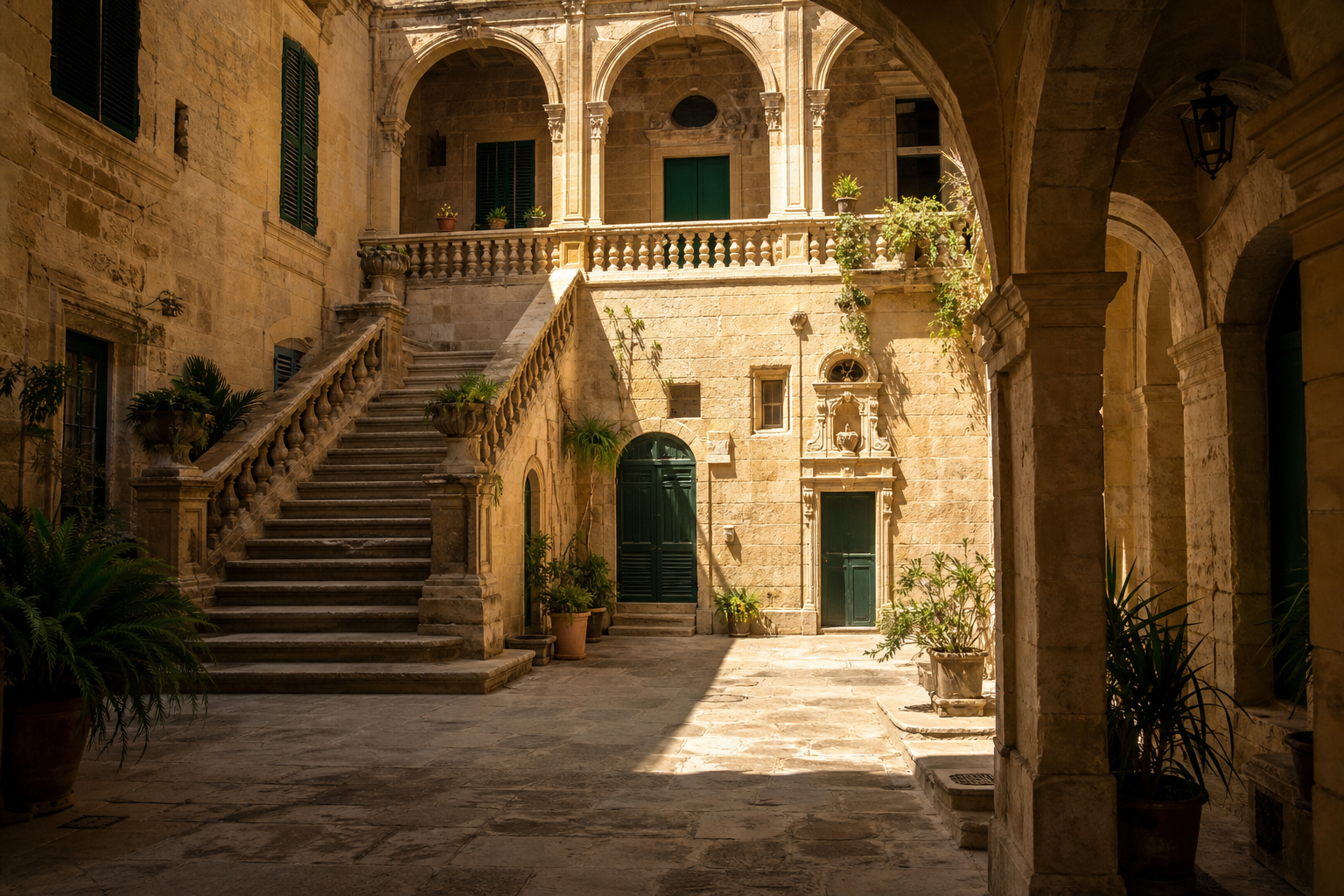
Walk down Main Gate Street in Birgu and you’ll pass a handsome but fairly quiet stone building. From the outside it looks like any other old palazzo. Inside, for more than two centuries, people were questioned, tried and locked up for what they believed, said or did.
This is the Inquisitor’s Palace, one of the very few buildings of its kind left anywhere in the world, and the only Inquisitor’s palace that’s open to the public. It’s a little eerie, surprisingly beautiful and one of the most fascinating museums in Malta.
This guide covers the palace’s story, what you’ll see inside, ticket prices and how to fit it into a day in Birgu.
From law courts to the Holy Office
The building started life in the 1530s as the law courts of the Knights of St John, who had just arrived in Malta and made Birgu their first home. When the Knights later moved their capital across the harbour to Valletta, the courts moved with them, and the building was left empty.
In 1574, a new tenant moved in. Monsignor Pietro Dusina arrived in Malta as the first Inquisitor, the Pope’s representative in charge of protecting Catholic faith on the island. He chose this building, which conveniently already had prison cells, and turned it into the Palazzo del Sant’Officio, the Palace of the Holy Office.
For the next two centuries, a long line of Inquisitors lived and worked here. Each one left his mark, adding rooms, changing staircases and decorating the palace in the Roman Baroque style of the day. That’s why the building today feels like a mix of periods rather than a single grand design.
What the Inquisition did in Malta
The Roman Inquisition’s job was to deal with anything seen as a threat to the Catholic faith. In Malta, that ranged from serious cases of heresy to things that seem small today: eating meat on fasting days, practising folk magic, saying the wrong thing in public or owning forbidden books.
People were brought here to be questioned, tried in the tribunal room and, if found guilty, held in the cells below. Punishments varied a lot, from public penance and prayers to time in prison. Torture was allowed under the rules of the time, but it was strictly regulated, and the records kept by the Inquisition show it was used far less often than popular stories suggest.
The Inquisition in Malta finally came to an end in 1798, when the French under Napoleon took control of the island and abolished it.
Two Inquisitors who became Popes
Here’s a detail many visitors don’t expect. Being Inquisitor of Malta was an important step in a Church career, and several men who held the post went on to great things. Two of them, Fabio Chigi and Antonio Pignatelli, later became Popes, as Alexander VII and Innocent XII. Walking through their private rooms, you’re literally following in the footsteps of future Popes.
The Inquisitors also had a country retreat, Girgenti Palace near Siġġiewi. It still stands today and is now the official summer residence of Malta’s Prime Minister.
What you’ll see inside
The tribunal room
The heart of the palace. This is where the Inquisitor sat in judgement and where cases were heard. It’s been carefully reconstructed, and standing there it’s easy to imagine how intimidating it must have felt to be brought before him.
The prison cells
Downstairs, the old cells are among the most moving parts of the visit. Look closely at the walls, where prisoners scratched graffiti into the stone: drawings, marks counting days, ships and names. These small scratches are some of the most personal records of the people who passed through the Inquisition.
The torture chamber
A reconstruction shows how interrogations could be carried out. It’s grim, but it’s presented as history rather than horror, and the information panels put it in proper context.
The Inquisitor’s private apartments
Upstairs, the mood changes completely. Elegant rooms, a private chapel, painted ceilings and a lovely garden show the comfortable life of the man at the top. The contrast with the cells below is the whole point, and it’s very powerful.
The National Museum of Ethnography
The palace is also home to Malta’s National Museum of Ethnography, which looks at the island’s popular religious traditions: devotions, festas, pilgrimages and the beliefs that shaped daily life for centuries. If you’ve ever wondered why Malta celebrates so many village festas, or why fireworks go off on a random Tuesday in July, this section helps explain where those traditions came from.
The palace as a museum
After the Inquisition ended, the building went through many lives, including as a military mess and a residence. It was restored and opened as a museum in 1966, and today it’s run by Heritage Malta.
The palace regularly hosts temporary exhibitions too, so check what’s on before your visit.
Ticket prices
| Ticket | Price |
|---|---|
| Adults (18-59) | €6.00 |
| Youths (12-17), seniors (60+) and students | €4.50 |
| Children (6-11) | €3.00 |
| Infants (1-5) | Free |
| Heritage Malta members and Passport holders | Free |
Heritage Malta notes that tickets bought online are valid for 30 days, so you don’t have to pick an exact date in advance. Prices can change, so check the official Heritage Malta website before your visit.
The palace is included in the Heritage Malta Multisite Pass. See our guide to whether the Multisite Pass is worth it if you’re planning several sites.
Special opening this week: on Saturday 10th October 2026, the palace and Fort St Angelo open by candlelight for Birgu Fest, with one combined ticket for just €3. Details in our Birgu Fest special opening guide.
Opening hours
The palace is usually open daily, with last admission 30 minutes before closing. Hours can change with the seasons, so check the current timetable on the Heritage Malta website. Like all Heritage Malta sites, it’s closed on 24, 25 and 31 December, 1 January and Good Friday.
How long you need
Plan on around one to one and a half hours. History lovers who read every panel will want closer to two.
Accessibility
Heritage Malta lists the palace as partially accessible. Expect uneven floors, low lighting and low doorways in the older parts of the building, especially around the prison cells.
How to get there
By ferry from Valletta: the Three Cities ferry crosses the Grand Harbour in a few minutes and is the nicest way to arrive. From the Birgu waterfront, it’s a short walk uphill into the old town.
By bus: several routes connect Valletta with Birgu, and Heritage Malta says the closest stop is about three minutes’ walk from the palace.
Address: Main Gate Street (Triq il-Mina l-Kbira), Birgu.
A day in Birgu
- Morning: ferry from Valletta, then Fort St Angelo while it’s cooler on the ramparts.
- Midday: lunch on the Birgu waterfront.
- Afternoon: the Inquisitor’s Palace, when the heat makes the cool stone rooms especially welcome.
- Late afternoon: get lost in Birgu’s narrow back streets, then cross to Senglea for sunset over Valletta.
Our Three Cities guide has more ideas for Birgu, Senglea and Cospicua.
Tips before you go
- Don’t rush the cells. The prisoners’ graffiti is easy to miss. Take your time and look closely at the walls.
- Visit Fort St Angelo the same day. They’re a few minutes apart and tell two sides of the Knights’ story in Birgu.
- Go in October if you can. During Birgu by Candlelight, the whole town glows and the palace opens in the evening.
- Bring older kids. Teenagers usually find the Inquisition fascinating. Younger children may find the cells and torture chamber a bit dark.
Frequently asked questions
Is the Inquisitor’s Palace worth visiting? Yes. It’s one of the very few Inquisitor’s palaces still standing anywhere, and the only one open to the public.
How much is the ticket? €6 for adults, €4.50 for youths, seniors and students, €3 for children aged 6 to 11, and free for infants.
How long do you need? One to one and a half hours.
When did the Inquisition end in Malta? In 1798, when the French took control of the islands.
Did any Inquisitors of Malta become Popes? Yes. Fabio Chigi became Pope Alexander VII and Antonio Pignatelli became Pope Innocent XII.
Is it included in the Heritage Malta Multisite Pass? Yes.
Is it suitable for children? Older children and teenagers usually love it. Younger kids may find some areas dark and a little scary.
Plan your visit
Site: Inquisitor’s Palace and National Museum of Ethnography, Main Gate Street, Birgu Managed by: Heritage Malta Duration: 1 to 1.5 hours Highlights: Tribunal room, prison cells and graffiti, Inquisitor’s apartments, Museum of Ethnography Tickets: €6 for adults, included in the Multisite Pass Closed: 24, 25 and 31 December, 1 January, Good Friday Nearby: Fort St Angelo, Birgu waterfront, Senglea
Beautiful Malta is an independent travel guide and is not affiliated with Heritage Malta. Always check opening hours and prices on the official Heritage Malta website before visiting.