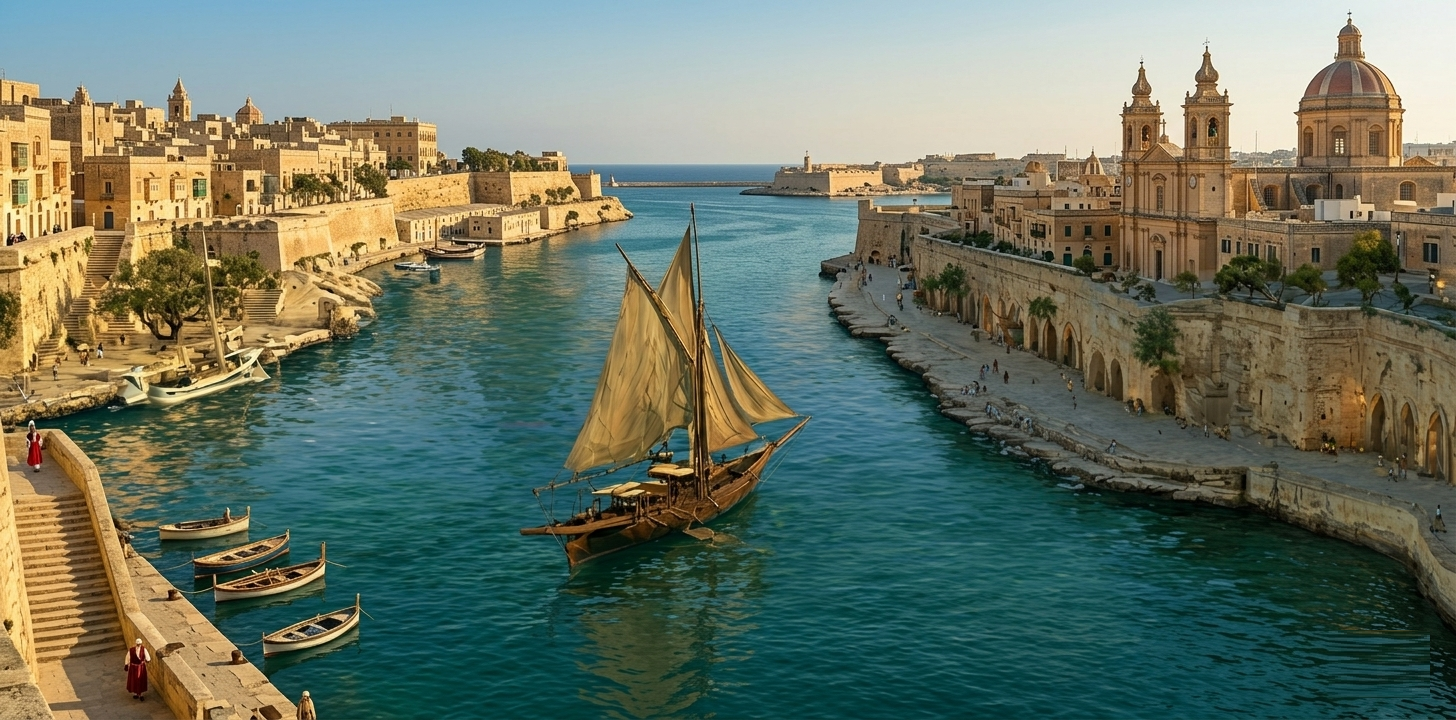
The Three Cities are Birgu, Senglea and Cospicua, three old fortified harbour towns that face Valletta across the Grand Harbour. The Knights of St John lived here for almost four decades before Valletta existed, and the towns took the full force of the Great Siege of 1565.
Today they are quieter than the capital and still very much lived in. You get a big fortress, a rare Inquisitor’s palace, waterfront walks lined with boats, and narrow streets where washing hangs over the alleys. It is one of the easiest and most rewarding half-day trips from Valletta.
The Three Cities at a glance
- Birgu: Maltese name Birgu, title Città Vittoriosa (the Victorious City), confirmed after the Great Siege. The oldest and busiest of the three, home to Fort St Angelo and the Inquisitor’s Palace.
- Senglea: Maltese name L-Isla, title Città Invicta (the Invincible City), granted after the Great Siege. A narrow peninsula with the famous Gardjola lookout.
- Cospicua: Maltese name Bormla, title Città Cospicua (the Conspicuous City), granted in 1722 by Grand Master Marc’Antonio Zondadari. The largest of the three, wrapped around the head of Dockyard Creek.
- Where: on the south side of the Grand Harbour, directly opposite Valletta. The area is also called Cottonera, after the outer ring of walls.
- How long you need: half a day covers the main sights of Birgu and the Gardjola in Senglea. Allow a full day if you want to go inside Fort St Angelo and the Inquisitor’s Palace at a relaxed pace and also walk Cospicua.
Birgu (Vittoriosa)
When the Knights arrived in 1530, Birgu was a small fishing town under an old castle. They made it their capital, and it stayed the centre of their rule until the move to Valletta. If you only have time for one of the three towns, choose Birgu.
Fort St Angelo
The fort sits at the tip of the Birgu peninsula. A castle stood here in the Middle Ages, known as the Castrum Maris, or castle by the sea. The Knights renamed it Fort St Angelo, made it their headquarters and rebuilt it for artillery. It was the heart of the defence in 1565.
Its story did not end with the Knights. The Royal Navy later used it as a base, and for a time it was even listed as a ship, first HMS Egmont and later HMS St Angelo. It was hit many times in the Second World War, and the last foreign forces left Malta in 1979.
Today Heritage Malta runs the fort, while the upper part, including the Magistral Palace and the Chapel of St Anne, is linked to the Sovereign Military Order of Malta. The views across to Valletta and out to the harbour mouth are some of the best in the country. Adult entry is about €10, with lower prices for children, students and seniors. Read our full guide to Fort St Angelo in Birgu before you go.
Inquisitor’s Palace
This building began life in the 1530s as the Knights’ civil law courts. From 1574 it became the home and tribunal of the Inquisitors sent from Rome, and it kept that role until the French ended the Inquisition in Malta in 1798.
Inside you can see the grand rooms where the Inquisitor lived, the tribunal room, the torture chamber and the prison cells. There is also a kitchen on the ground floor and a section on the national textiles collection. It is one of the few buildings of its kind to survive. Adult entry is about €6. For more detail, see our page on the Inquisitor’s Palace in Birgu.
Malta Maritime Museum
The large building on the Birgu waterfront was once the Royal Naval Bakery, built in the 1840s on the site of the Knights’ galley arsenal. It has housed the national maritime collection since 1992. At the time of writing, Heritage Malta lists the museum as temporarily closed for a major redevelopment, although parts of it have been used for special events. Check the Heritage Malta website before planning a visit.
If you plan to see several sites run by Heritage Malta during your trip, the Heritage Malta Multisite Pass can work out cheaper than separate tickets.
The Collacchio streets and the auberges
Behind Victory Square lies the old Collacchio, the quarter once reserved for the Knights. The streets are narrow, mostly car free and full of small details: brass door knockers, statues in wall niches, plants on every step.
Several of the first auberges, the houses where knights from each language group lived and ate, still stand here. The Auberge d’Angleterre, from the 1530s, is the best preserved. Most are now private or public buildings, so you will see them from the street, but a slow walk through this quarter is one of the best things to do in Birgu.
Birgu waterfront and marina
The wide promenade along Dockyard Creek runs from the foot of Fort St Angelo past the old naval buildings. Superyachts are moored next to small fishing boats, and the restaurants have tables right by the water. It is the natural place to end the day.
Birgu by Candlelight (October)
For one weekend each October, Birgu switches off its street lights and the town is lit by thousands of candles. It gets busy, but the atmosphere is special. Heritage Malta also runs a separate candlelit evening at its Birgu museums, usually in spring. See our guide to Birgu by Candlelight for dates and tips.
Senglea (Isla)
Senglea is named after Grand Master Claude de la Sengle, who fortified the peninsula in the 1550s. It is small, almost all residential and surrounded by water on three sides, so you are never more than a few minutes from a harbour view.
Gardjola Gardens and the watchtower
At the very tip of Senglea is a small public garden on the bastions, laid out from 1551. At its edge stands the Gardjola, a small stone lookout post. Carved on it are an eye, an ear and a crane, old symbols of watchfulness, meant to show that the guard here saw and heard everything coming into the harbour.
The view from here takes in Valletta, Fort St Angelo, the harbour entrance and the docks. It is especially good in the late afternoon, and it offers the classic photo of the harbour from the other side, the mirror of the view from the Upper Barrakka Gardens in Valletta.
Basilica of Our Lady of Victories
The main church of Senglea is dedicated to the Nativity of Our Lady and is widely known as the Basilica of Our Lady of Victories, in memory of the victory of 1565. The first church went up in the 1580s. It was destroyed by bombing during the Second World War and rebuilt in the 1950s, with the new church consecrated in 1957.
The church is famous for its wooden statue of Christ the Redeemer, dating from at least the early 1700s, which is the focus of strong devotion across Malta.
Senglea waterfront
A walk along the Senglea side of Dockyard Creek gives you views straight across to the Birgu marina, and it is far quieter than the other side.
Cospicua (Bormla)
Cospicua grew behind the other two towns at the head of the creek. It was the dockyard town for generations, and it suffered heavily in the Second World War. Fewer visitors come here, which is part of its appeal.
Dockyard Creek
The promenade at the inner end of the creek links Cospicua with both Birgu and Senglea. It is the landing point for the ferry from Valletta, so many visitors start their walk here. Look out for the old dry docks and the colourful traditional boats.
The Cottonera and Santa Margherita lines
Cospicua is ringed by two lines of walls. The inner Santa Margherita Lines were begun in 1638 to guard the high ground behind Birgu and Senglea. The much larger Cottonera Lines were started in 1670 under Grand Master Nicolas Cotoner and were never fully finished. St Helen’s Gate, from the 1730s, shows the scale of these works. You can walk parts of the lines, but there is little shade.
Church of the Immaculate Conception
The large parish church of Cospicua, the Collegiate Church of the Immaculate Conception, dates from the early 18th century and dominates the skyline above the creek. The interior is richly decorated. Opening times vary, so it is often easiest to visit just before or after a Mass.
How to get to the Three Cities
- Ferry from Valletta: Valletta Ferry Services runs a regular ferry between Valletta and Cospicua, in collaboration with Malta Public Transport. In Valletta, take the Barrakka Lift from the Upper Barrakka Gardens down to the quay, then walk across to the ferry landing. The crossing is short and drops you on Dockyard Creek, a few minutes’ walk from the Birgu waterfront. Times and fares change by season, so check the official timetable. Ferry users from Cospicua get a ticket for the lift back up.
- Dgħajsa water taxi: the traditional Maltese harbour boats work from the Valletta waterfront below the Barrakka Lift and can take you across to the Birgu waterfront. Agree the price before you set off.
- Bus: route 1 runs from Valletta through Cospicua to Senglea. Other routes reach Birgu, so use the Malta Public Transport journey planner for the best option on the day.
- Car and parking: the old centres have narrow streets and very limited parking. If you drive, use one of the car parks on the edge of the towns and walk in. The ferry is usually much easier.
Suggested walking routes
Half-day route (about 3 to 4 hours)
- Take the Barrakka Lift and the ferry from Valletta to Cospicua.
- Walk along Dockyard Creek to the Birgu waterfront.
- Visit Fort St Angelo (allow 1.5 to 2 hours).
- Walk up to Victory Square and wander the Collacchio streets.
- Cross to Senglea for the view from the Gardjola Gardens.
- Return to the creek for the ferry, or take a dgħajsa back.
Full-day route
- Morning: ferry to Cospicua and visit Fort St Angelo while it is cooler.
- Late morning: the Inquisitor’s Palace and the streets of the Collacchio.
- Lunch in Birgu.
- Afternoon: walk to Senglea, see the basilica and the Gardjola Gardens.
- Late afternoon: back through Cospicua, the Church of the Immaculate Conception and a short section of the lines.
- Evening: dinner on the Birgu waterfront, then the ferry or a boat back to Valletta. Next day, look back at the Three Cities from the Lower Barrakka Gardens in Valletta.
Where to eat
Birgu has the widest choice. The waterfront restaurants are the most popular for views, while the backstreets have smaller and often better value places. A few to know about:
- Tal-Petut: a small restaurant in the Birgu old town serving Maltese home cooking. It is small and usually needs booking ahead.
- Don Berto: a large restaurant on the Birgu waterfront with marina views and a broad menu.
- Il-Forn: a wine bar in a historic building in Birgu, better for platters and a glass of wine than for a full meal.
Senglea and Cospicua are more about local bars, band clubs and bakeries. Try a ftira or some pastizzi for a cheap lunch. If you want to taste a classic Maltese dish, look out for stuffat tal-fenek, the traditional rabbit stew. Opening days change, so check before you go.
Tips for visiting
- Best time: spring and autumn are the most pleasant. In summer go early in the morning or late in the afternoon.
- Heat and sun: the bastions and waterfronts have little shade. Carry water, a hat and sun cream.
- Shoes: expect steps, slopes and uneven stone. Comfortable shoes with grip are best.
- Church dress code: cover shoulders and knees when you go into churches, and avoid visiting during Mass unless you are attending.
- Closures: Heritage Malta sites close on 1 January, Good Friday and 24, 25 and 31 December, and last entry is 30 minutes before closing. Summer and winter hours differ.
- Combine your visit: our guide to Heritage Malta museums and sites helps you plan other visits on the same pass.
- Events: village feasts, regattas and candlelit nights can change the feel of the towns completely. See what is on in Malta this week.
Frequently asked questions
Are the Three Cities worth visiting?
Yes. They hold some of the most important history in Malta, including Fort St Angelo and the Inquisitor’s Palace, and they feel more local than Valletta. The ferry ride and the harbour views alone make the trip worthwhile.
How long do you need in the Three Cities?
Half a day is enough for Birgu and a quick look at Senglea. A full day lets you visit the main museums properly, walk all three towns and stay for dinner on the waterfront.
How do you get from Valletta to the Three Cities?
The easiest way is to take the Barrakka Lift down from the Upper Barrakka Gardens and catch the ferry to Cospicua. You can also hire a traditional dgħajsa across the harbour, or take a bus from Valletta.
Which of the Three Cities is best?
Birgu has the most to see and the best choice of places to eat. Senglea has the finest views, especially from the Gardjola Gardens. Cospicua is quieter and best for those interested in the fortifications.
Is Fort St Angelo worth it?
For most visitors it is. The fort covers the whole story of Malta, from the medieval castle and the Great Siege to the Royal Navy, and the views are excellent. Allow at least an hour and a half.
Prices and opening times change, check the official site before you go. Last updated: October 2026.