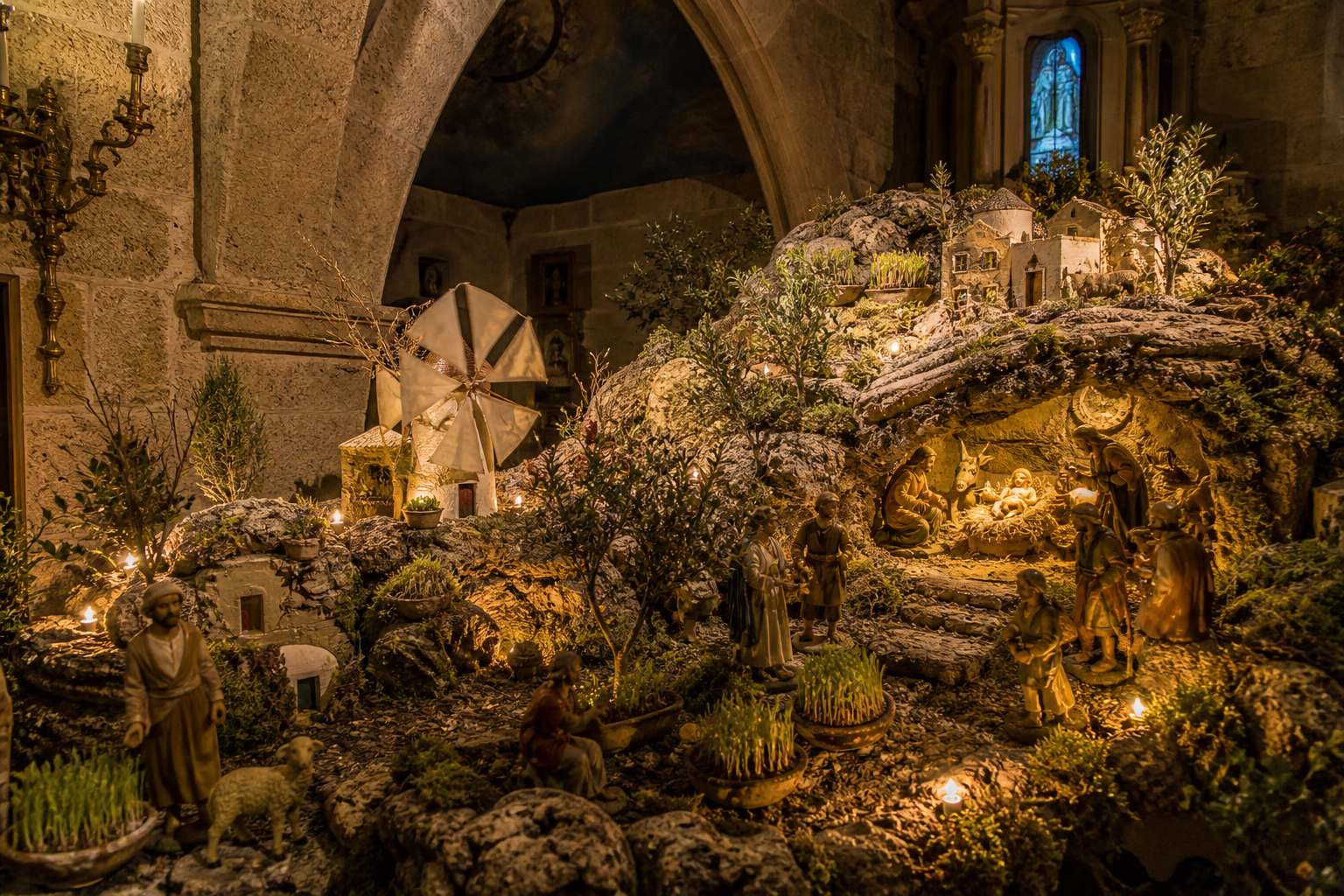
Christmas in Malta is quieter and more church-centred than the lights-and-markets season most visitors expect. The big traditions are the nativity crib (presepju), a Midnight Mass where a child gives the sermon, a hot chestnut drink on Christmas Eve, and little dishes of pale sprouted seeds around the crib. This guide explains each one, in simple words, and tells you where a visitor can see it. For dates of markets and lights, use our Christmas in Malta events guide.
The Christmas crib (presepju)
If you only learn one Maltese Christmas tradition, make it the crib. Most churches have one, and many families set one up at home.
Where cribs came from
Cribs reached Malta in the early 17th century, brought from Italy by noblemen. Several local sources say the first Maltese crib was set up by Dominican friars in Rabat. A popular story says that people were not sure about these new displays at first, and some even used the figures as firewood. That story is told widely, but treat it as local tradition rather than proven history.
What makes a Maltese crib different
Maltese cribs often show a village landscape, with rocky hills, caves, small windmills and ruined buildings, instead of a simple stable. Figures (pasturi) are made by local craftspeople from clay or wax. Some cribs are small and sweet, others fill a whole room.
Where to see cribs as a visitor
- Parish churches in almost every town and village. Walk in quietly and respect services.
- The Friends of the Crib Society holds a December exhibition of around 100 cribs in Valletta. Dates and place change, so check before you go.
- The Inquisitor’s Palace in Vittoriosa has a permanent crib display in its ethnography museum.
- In Gozo, a large crib is listed at Il-Hagar museum in Victoria from 1 December 2026 to 10 January 2027. See our Christmas in Gozo guide.
Live nativity: Bethlehem in Ghajnsielem
In Gozo, volunteers in Ghajnsielem recreate a whole village of Bethlehem in the fields at Ta’ Passi. It is listed to open from 12 December 2026 into early January 2027, and entry has been free in past years. Opening days change each year, so check the Ghajnsielem Local Council before travelling. It pairs well with a Gozo day trip from Malta.
Midnight Mass and the children’s sermon
On Christmas Eve many families have a big dinner and then go to Midnight Mass. The most unusual part is the priedka tat-tfal, the children’s sermon. A young child, usually around seven to ten years old, goes to the pulpit and tells the Nativity story in place of the priest. It is said to have started in 1883 in the parish of Luqa.
Some parishes also hold a Christmas Eve procession with a statue of the infant Jesus, and children dress as shepherds. Practice differs from town to town, so ask locally which parish is doing what.
Visiting a service politely
Midnight Mass is a real religious service and churches can be full. Arrive early, dress modestly, keep your phone away and do not photograph during the ceremony. If you are staying in Valletta, the churches there are easy to reach on foot (see our Valletta guide).
Gulbiena: sprouted seeds around the crib
Look closely at a crib and you may see small pots of pale, thin shoots. This is gulbiena, usually grown from seeds such as wheat or vetch. They are soaked, kept in a dark cupboard or corner and watered, so they grow tall and white or pale yellow. They are then placed around the crib and the baby Jesus. Sources disagree on exactly when to start (from late November to the first week of December), and nobody is sure where the custom began.
Christmas food and drink
Food is simple and seasonal. For more Maltese dishes all year round, see our Maltese food guide.
Imbuljuta tal-qastan
This is a hot drink made from chestnuts and cocoa or chocolate, flavoured with citrus peel and often cloves. It is traditionally served on Christmas Eve, often after Midnight Mass.
Qaghaq tal-ghasel
These are ring-shaped pastries filled with a sweet, sticky honey or treacle-style filling. You will find them in bakeries and at Christmas markets. Read our Christmas markets guide for where to find them.
Dates and holidays to know
In 2026, 8 December (Immaculate Conception) falls on a Tuesday, 13 December (Republic Day) on a Sunday and Christmas Day on a Friday. Public holidays mean many shops and offices close, and bus services may change. See our Malta public holidays page and check what is on in Malta this week for weather and sea conditions. Prices and times change, check the official site or parish before you go.
A simple plan for a traditions-focused visit
- Early December: visit a crib exhibition and a parish church crib.
- Mid December: go to Gozo for the live Bethlehem village and the Victoria cribs.
- Christmas Eve: attend Midnight Mass respectfully, and try imbuljuta afterwards if a parish offers it.
- Christmas week: wander an old town such as Mdina and see how quiet it feels.
FAQ
Is Christmas a big holiday in Malta?
Yes. Malta is a mainly Catholic country, and Christmas Day is a public holiday. Most families celebrate with church services, a family meal and a visit to cribs.
Can tourists attend Midnight Mass?
Yes, anyone can attend, but it is a religious service. Come early, be quiet and respectful, and do not take photos during the ceremony.
What is a presepju?
It is the Maltese word for a nativity crib. Many Maltese cribs show a landscape with hills, caves and windmills, not only a stable.
What is imbuljuta?
It is a hot chestnut and cocoa drink with citrus peel and sometimes cloves, drunk at Christmas, especially on Christmas Eve.
In short
Maltese Christmas is about cribs, church and family more than big shows. Visit a crib, respect Midnight Mass, and try the seasonal food. The details change each year, so check dates locally.
Planning further ahead? Read our New Year’s Eve in Malta guide and our Malta in December guide.