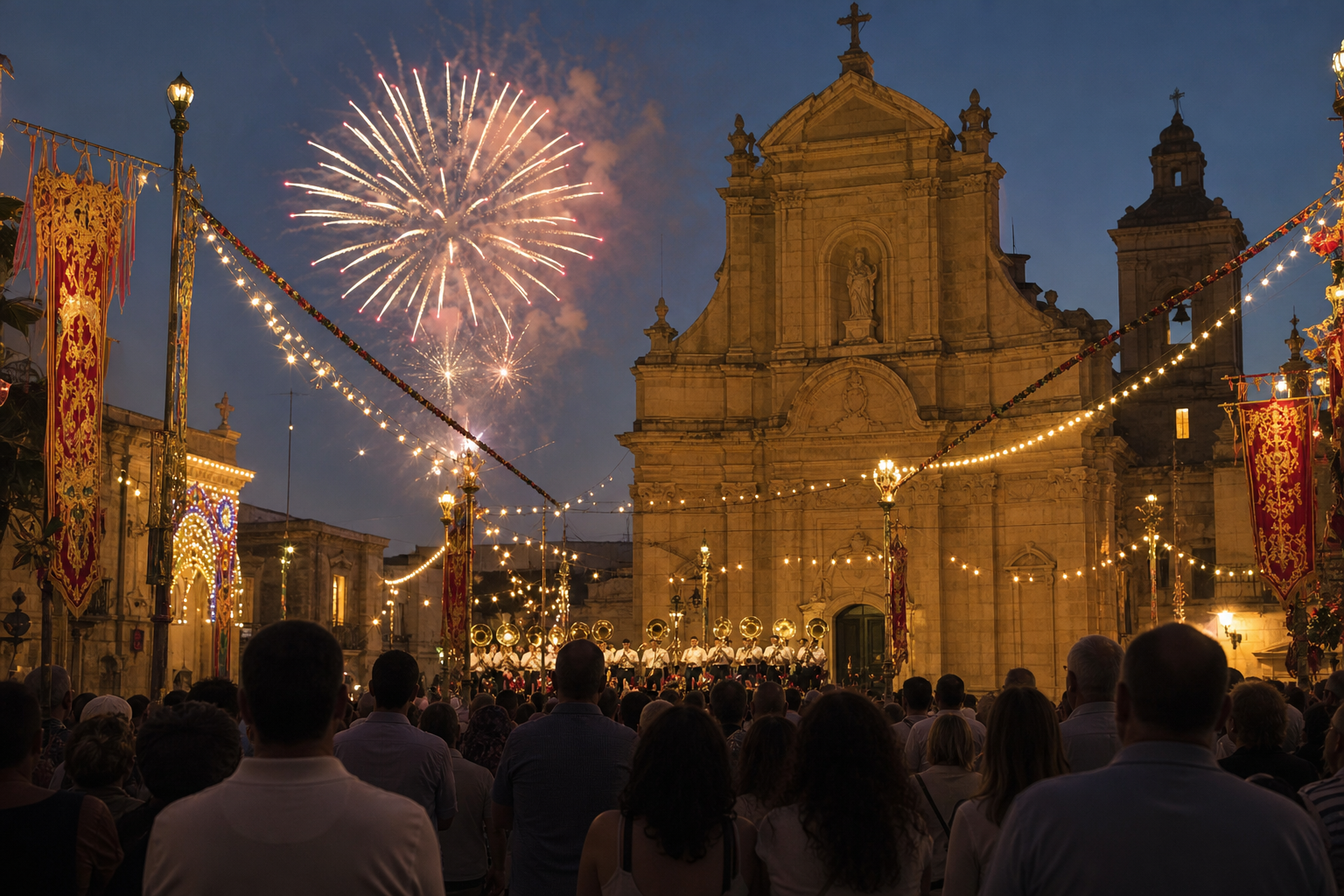
If you hear fireworks on a quiet Wednesday afternoon in Malta, nothing is wrong. Somewhere nearby, a village is celebrating its festa, the annual feast of its patron saint. A festa mixes church services, brass bands, street decorations, fireworks and food stalls, and anyone can join in for free. This guide explains what really happens, when the season runs, what to eat and how to enjoy your first one without being caught off guard by the noise.
What is a Maltese festa?
A festa (the plural is festi, though most visitors say festas) honours the saint to whom a parish church is dedicated. It began as a religious celebration, and the church services are still the backbone of the week. Around them has grown a community party run largely by volunteers. The village band club, the fireworks society and the parish committee spend months preparing: sewing banners, rehearsing marches and building fireworks.
The tradition is valued well beyond Malta. In 2023 UNESCO added the Maltese Village Festa to its Representative List of the Intangible Cultural Heritage of Humanity. UNESCO describes it as a community event of religious origin, prepared by volunteers all year, which ends with a procession in which the saint’s statue is carried through the streets with the clergy, parishioners and marching bands. Every town and village has its own colours, band and local rivals, so no two festas feel exactly the same.
If you want the lighter, story-style version of why Malta sounds like New Year’s Eve all summer, read our piece on why Malta has fireworks all summer.
When is festa season?
The main season runs through the warm months. Visit Malta describes it as a long chain of extended weekends from the end of May through the summer and well into September, with hardly a weekend that passes without some town or village celebrating. Some guides, citing UNESCO, stretch the season from late April to early October, and a few feasts fall outside it altogether.
One thing confuses many visitors: the date of a saint’s day in the church calendar is not always the date of the big village celebration, because many parishes hold their main festa on a summer weekend. A few dates are fixed, though, and are worth knowing:
- 10 February: the Feast of St Paul’s Shipwreck in Valletta, a public holiday that some guides treat as the opening of the festa year.
- 15 August: Santa Marija, the Assumption of Our Lady, celebrated in several parishes at once and a national public holiday.
- 8 September: the Nativity of Our Lady (Il-Bambina), also a public holiday, marked in places such as Mellieħa, Naxxar and Senglea.
- 8 December: the Immaculate Conception, another public holiday. Bormla (Cospicua) celebrates around this date, so there is even a festa to catch in winter.
You can check the full list of days off in our Malta public holidays guide.
How a festa works
The exact programme differs from parish to parish, but most follow the same rhythm. A festa usually lasts from three days to a week or more, and the busiest evenings come at the end.
The build-up
Days before the main event, the village changes. Banners, festoons and papier-mache statues on wooden columns line the main streets, and residents hang lit festoons from balconies and rooftops in the colours of their saint. Houses often get a fresh coat of paint. Evening church services, band club nights and smaller marches get things going, and you will hear the first fireworks long before you see any crowd.
The eve of the feast
The night before the feast day (lejlet il-festa) is usually the loudest and most crowded. This is when you will normally find the big band march and the main fireworks display. If you can only go to one evening, many locals will tell you to pick the eve: the fireworks peak then, while the procession belongs to the feast day itself.
The feast day
The day often starts with a lively morning march, followed by High Mass. In the evening the statue leaves the church and is carried shoulder-high through the decorated streets. Bells ring, bands play and, in many places, confetti and streamers are thrown from balconies. When the statue returns to the church, the festa is formally over, and the village goes quiet.
Fireworks, bands and the famous noise
Three things define the sound of a festa.
- Fireworks. Expect aerial shells at night and spinning ground fireworks, known locally as ġiġifogu. Many displays are produced by local volunteer societies, and neighbouring villages quietly compete to put on the better show.
- Petards. The loud daytime bangs are called murtali. They are made for sound, not colour, so you may hear thunder-like booms under a clear blue sky. They announce that the feast is near.
- Brass bands. Most parishes have a band club (każin) that leads the marches and plays during the procession. The marches are lively and loud, and the club bar is often the social centre of the village.
The noise can start early in the morning and continue late at night. If you are sensitive to loud sounds, or travelling with babies or pets, check the parish programme and avoid booking a room right next to the church square on festa weekends.
What to eat at a festa
Food stalls fill the streets around the church. The classic treat is qubbajt, Maltese nougat sold from decorated carts, and the other staple is imqaret, deep-fried pastries filled with dates. You will also find grilled snacks and other street food, and band club bars sell drinks. Bring cash, as many small stalls prefer it. For more to try during your trip, see our Maltese food guide.
Which festa should you choose?
With so many to pick from, it helps to decide what you want most.
- The biggest celebration: Santa Marija on 15 August. Mosta offers a grand setting under its Rotunda dome, while Mqabba and Qrendi are known for their fireworks on the eve, 14 August. Our guide to Santa Marija covers all the villages involved.
- A calmer experience: choose a smaller village, or a parish such as Attard, where you get the same bands, procession and fireworks with a smaller crowd.
- A festa by the sea: coastal localities such as St Julian’s hold their feasts in late summer, which pairs well with a beach day.
- Something different: Gozo, covered below.
Festas in Gozo
Gozo has its own cycle of feasts, with the full programme of band marches, processions and fireworks at a more relaxed scale. Villages such as Nadur, Xagħra and Victoria are good places to start. If you are planning a trip across, our guide to things to do in Gozo will help you build a day around a festa evening.
How to find dates and programmes
There is no single national festa programme, because each parish organises its own. These sources help:
- The Visit Malta events calendar and the feast calendar published by the Archdiocese of Malta, which list dates and localities.
- The parish, band club or local council pages, which usually post the detailed programme (Programm tal-Festa) a week or two before the feast.
- Our own Malta This Week page, which lists what is on over the next seven days along with the weather.
At the time of writing, 2027 dates have not been widely published yet, so confirm the date with the parish nearer the time. Dates can move, and times change from year to year.
Practical tips for visitors
- Arrive early. Parking near the village core disappears fast and streets are often closed. Park on the edge and walk in.
- Plan your way home. Taxi rides can be detoured around marches, and late at night it is often easiest to walk ten or fifteen minutes to a main road before calling a ride. Our Malta bus guide explains the daytime options.
- Keep your distance from the fireworks. Stay in the square or along the route, not close to where displays are launched, especially with children.
- Respect the religious side. A festa is a parish celebration, not a theme park. Stand quietly when the statue passes and dress modestly near the church.
- Bring earplugs and water. Both are useful, especially for children and on hot summer nights.
- Go on the eve if you want fireworks, and on the feast day if you want the procession.
Frequently asked questions
Are festas free to attend?
Yes. The streets, marches, processions and fireworks are open to everyone. You only pay for food, drinks and any souvenirs.
Why are there fireworks during the day?
Daytime bangs are petards, which are designed for noise rather than colour. They announce the celebration and can be heard across a whole town in bright sunshine.
Can I see a festa in winter?
Yes. The Feast of St Paul’s Shipwreck is on 10 February in Valletta, and the Immaculate Conception on 8 December is celebrated in places such as Bormla. Some smaller feasts also fall outside the main summer season.
Are festas suitable for children?
Many families attend, and some parishes even hold a children’s festa with a smaller statue. The main concern is noise, so bring ear protection and leave before the loudest fireworks if your child is sensitive.
How long does a festa last?
It varies by parish, from about three days to a week or more. The eve and the feast day are the busiest.
In short
A Maltese festa is part church service, part street party and part friendly rivalry between villages. It is loud, crowded and free, and it is one of the most authentic things you can do in summer. Pick a village, check the programme with the parish, arrive early and go with an open mind.
Dates, times and road arrangements change, so check the parish or official sources before you go.
Planning further ahead? See our month-by-month guide to the best time to visit Malta and browse the full Malta events calendar.