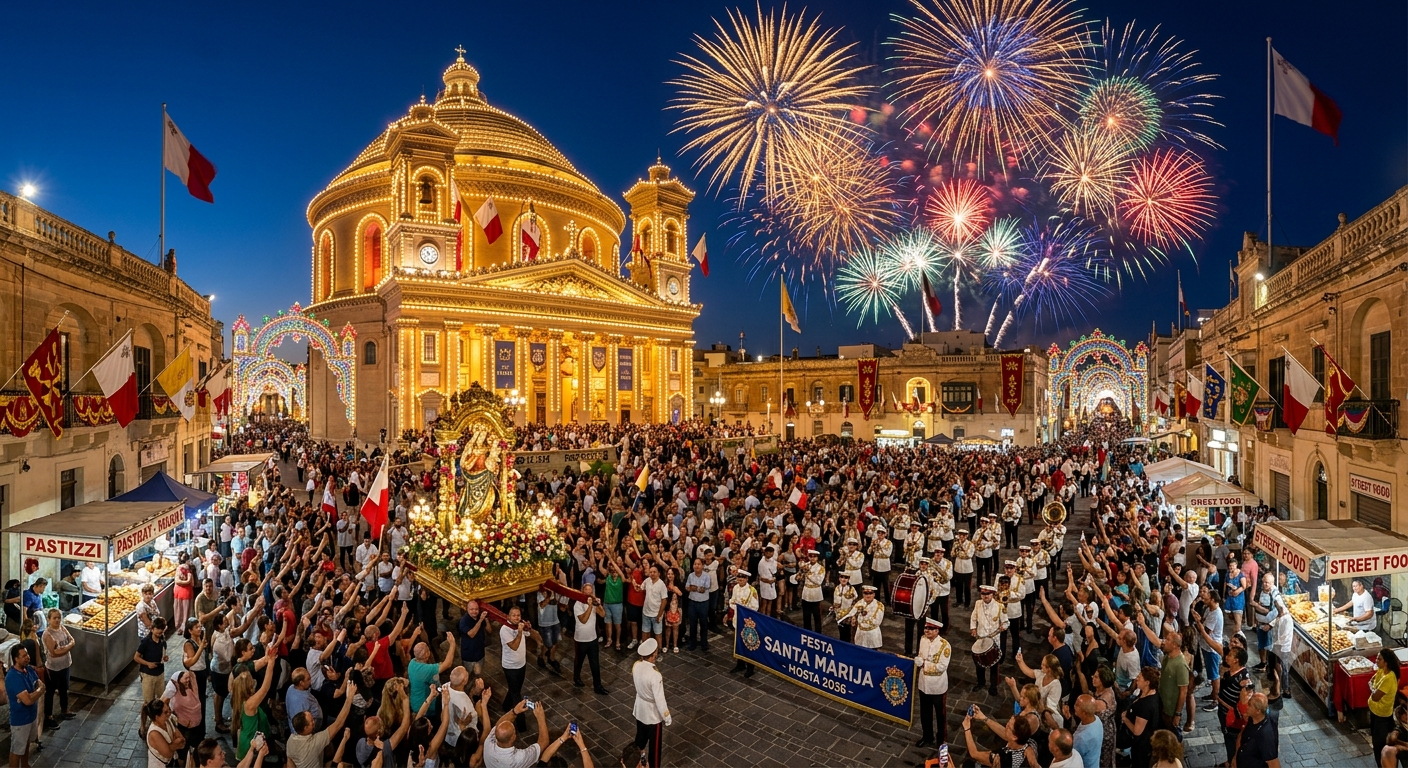
If you only experience one Maltese festa in your lifetime, most locals will tell you it should be Santa Marija. Celebrated on 15th August every year, it is not just another village feast, it is the single biggest celebration on the entire festa calendar, and there is nothing else on the island quite like it. Here is why it stands apart, and everything you need to know if you want to experience it in 2026.
What Makes Santa Marija So Unique
Most Maltese festas belong to one town. Santa Marija belongs to seven, all at once.
On 15th August 2026, the Feast of the Assumption of Our Lady is celebrated simultaneously in Mosta, Mqabba, Qrendi, Attard, Gudja, Għaxaq and Victoria in Gozo. No other date on the calendar sees this many villages hold their main patron feast on the exact same day, which is what makes Santa Marija the true peak of the Maltese summer. It is also a national public holiday, so businesses close, offices empty out, and the whole country effectively downs tools to celebrate. That combination, a religious feast day, a national holiday and seven simultaneous festas, is what separates Santa Marija from every other feast in Malta.
There is also a layer of history that gives the day extra weight. The 15th of August 1942 is remembered as the day the Santa Marija Convoy, known locally as Il-Konvoj ta’ Santa Marija, limped into the Grand Harbour during the darkest days of the Second World War. The tanker SS Ohio and the surviving supply ships arrived battered but intact, saving Malta from starvation during the siege. For many Maltese families, the feast day carries this double meaning, celebrating both a religious event and a moment of national survival, which is why Santa Marija resonates on a deeper level than most other festas.
Festas in Malta as a whole were recognised by UNESCO in 2023 as part of the world’s Intangible Cultural Heritage, and Santa Marija, as the largest and most widely celebrated of them all, is very much the centrepiece of that recognition.
The Seven Villages, Each With Its Own Personality
What makes Santa Marija worth exploring beyond a single evening is that each of the seven villages puts its own spin on the same feast, so the experience changes completely depending on where you go.
Mosta, the grand stage Mosta is the village most people associate with Santa Marija, largely because of the Rotunda, one of the largest unsupported church domes in Europe. On feast night the dome is lit up and becomes the backdrop for the procession, and the sheer scale of the square combined with the size of the crowd makes this the go-to choice for anyone attending a Santa Marija festa for the first time. The Rotunda also has its own dramatic wartime story: in April 1942 a bomb pierced the dome during Mass and failed to detonate, and a replica of it is still on display inside the church today.
Mqabba, the fireworks capital If fireworks are the reason you are going, Mqabba is where you need to be. The village is home to the St Mary’s Fireworks Factory, whose pyrotechnics section has previously been crowned world champions, and their main display is fired from an elevated steel structure that changes design every year, known as the Tower of Light. The headline show takes place on the eve of the feast, 14th August, synchronised to music and closing with the mesmerising spinning ground fireworks known locally as irdieden, a distinctly Maltese pyrotechnic art form. Arrive early, since the crowds along the village bypass grow large well before the display begins.
Qrendi, the fierce neighbour Right next door to Mqabba, Qrendi has built its own formidable reputation for pyrotechnics, and the friendly but intense rivalry between the two villages is part of what makes the southern sky so busy on the night of 14th August. Qrendi’s celebrations stretch out over several weeks, from late July into late August, giving the parish one of the longest festa programmes on the island, all building toward the main fireworks spectacle known locally by names like Conquest of Darkness, a carefully choreographed sequence of music-synchronised pyrotechnics followed by ground fireworks along the village bypass.
Gudja, the historic statue Gudja’s parish church, completed in 1666, is the only church in Malta with three bell towers, and the village holds the record for the oldest titular statue of the Assumption still in use, carved from solid wood in 1807. The procession here feels distinctly steeped in history, with sacred music performances building up in the days before the main event.
Attard, the quieter option Attard offers a more understated version of Santa Marija, with the same core ingredients of bands, processions and fireworks, but generally a smaller crowd, making it a good option if you want to experience the feast without the density of Mosta or the fireworks crowds of Mqabba and Qrendi.
Għaxaq, the village that goes all out on decorations Għaxaq’s Santa Marija celebrations have documented roots stretching back centuries, and the village is particularly known for the effort put into its street decorations, transforming the town for the occasion.
Victoria, Gozo’s contribution Over in Gozo, the cathedral at the Citadel becomes the focal point for Victoria’s Santa Marija celebrations, with traditional horse races along Republic Street and an agricultural fair adding a different flavour to proceedings compared to the festas on the main island. Concerts by local brass bands round out the programme.
What a Santa Marija Feast Day Actually Looks Like
Regardless of which village you choose, the structure of the day follows a familiar rhythm. Build up events run through the week beforehand, with smaller marches and church celebrations from midweek onward. The night before the feast, 14th August, is typically when the biggest fireworks displays take place, especially in the south. The feast day itself, 15th August, begins with a High Mass, often celebrated by the Archbishop in Mosta, followed later in the evening by the main procession, with the titular statue carried through streets lined with decorations, accompanied by brass bands playing traditional festa marches.
Because 15th August is a public holiday, many Maltese families treat the earlier part of the day differently altogether. It is common to head to the beach in the morning for what locals call a xalata, a relaxed beach outing with friends and family, before getting ready for a pre-booked lunch or dinner and then heading to the evening festivities. It is one of the few festas that blends a beach day culture with the evening’s religious and musical celebrations.
Why Santa Marija Stands Out From Every Other Festa
Put simply, no other date on Malta’s festa calendar combines this many elements at once: seven parishes celebrating simultaneously, a national holiday that empties the streets of everyday business, some of the most technically impressive fireworks displays in the country, a genuine friendly rivalry between neighbouring villages competing to outdo each other, and a wartime history that gives the date real emotional weight for Maltese people. Other big festas, such as St Cajetan in Ħamrun or the dual celebrations of St George and St Sebastian in Qormi, are excellent in their own right, but none of them replicate the sheer scale and simultaneity of Santa Marija.
Tips for Visiting Santa Marija 2026
- Decide what you want most before choosing a village. Mqabba or Qrendi on 14th August for the best fireworks, Mosta on 15th August for the grandest procession and biggest crowd, Gudja or Attard for a calmer, more local experience.
- Arrive well ahead of time. Getting to Mqabba or Qrendi an hour or more before the fireworks begin is the difference between a good view and standing at the back of a packed crowd.
- Expect heavy traffic and parking difficulties around all seven villages on the day, particularly near Mqabba and Qrendi given their proximity to the airport. Parking on the outskirts and walking in is usually the better option.
- Book accommodation and restaurants well in advance if you plan to be near any of these villages around mid-August, since this is one of the busiest weekends of the entire Maltese summer.
- If you want to experience more than one village, plan your route carefully, since roads around each of the seven locations get busy and slow moving as the evening progresses.
Santa Marija is not just Malta’s biggest festa, it is the day that captures everything the island’s summer festa season is about: faith, history, rivalry, spectacle and community, all happening across seven villages at once. If you are in Malta on 15th August 2026, it is genuinely one celebration worth building your whole day around.