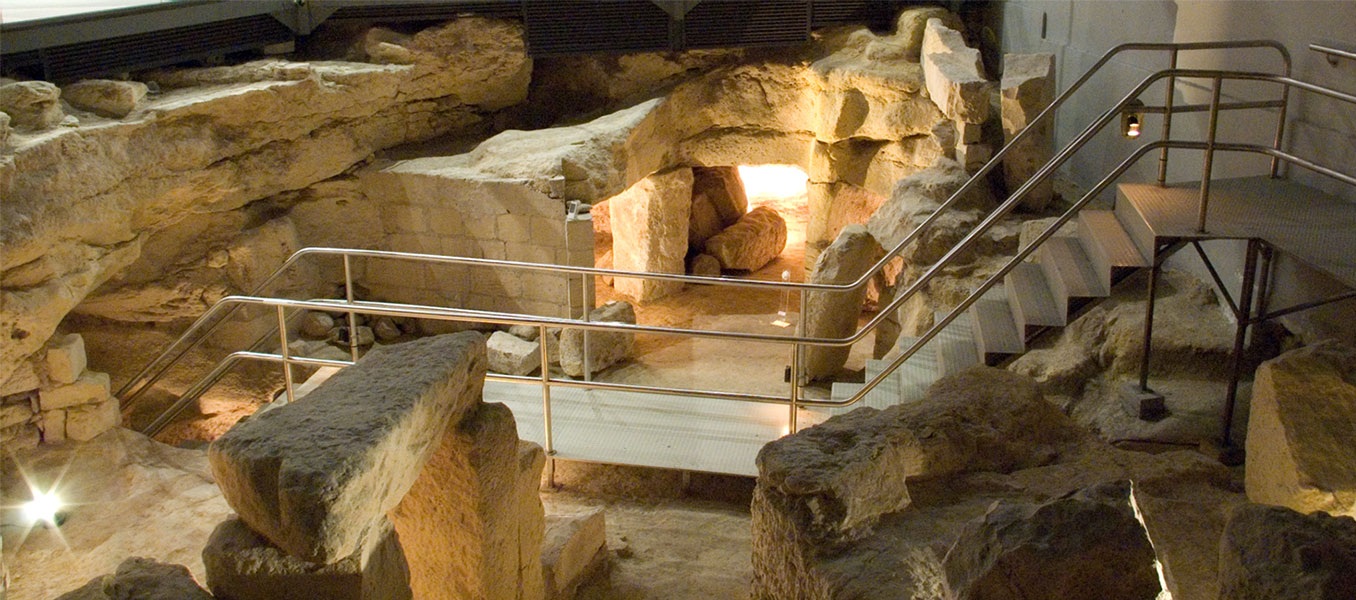
There is nothing else like it anywhere in the world. Underneath an ordinary residential street in Paola, roughly 500 square metres of chambers, halls and passages have been cut into globigerina limestone, three levels deep. Not built. Cut, with stone tools and antler picks, by people who had no metal of any kind.
The Ħal Saflieni Hypogeum is the only known prehistoric underground temple on Earth. It is also the hardest ticket in Malta, with a maximum of 80 visitors admitted per day in groups of ten.
This guide covers what is actually down there, how it was found, and the practical side of getting in: prices, booking, the last minute system, and two rules in the small print that get people turned away at the door.
What is down there
Heritage Malta describes the complex as in use between 4000 BC and 1500 BC, while UNESCO’s record describes the prehistoric cemetery phases as spanning roughly 4000 to 2500 BC. Either way, the builders kept going deeper as space ran out above them. The deepest room sits 10.6 metres below road level, with four side niches carved into it.
The middle level is where it stops being impressive and becomes strange. Those chambers were finished to imitate the above ground megalithic temples, with false doorways, pillars and lintels cut directly out of the living rock. Structures that serve no function underground, copied anyway, by people who evidently thought it mattered. Several surfaces still carry red ochre spirals and honeycomb patterns.
One chamber, usually called the Oracle Room, has notable acoustic properties. A low voice directed into a niche carries through the surrounding spaces. There is a great deal written online about what this was for, most of it invented. The honest position is that the effect is real and the intention behind it is unknown.
Excavation produced pottery, human remains, personal ornaments, small carved animals and larger figurines. Among them was the clay figure known as the Sleeping Lady, who is now on display at the National Museum of Archaeology in Valletta rather than at the site where she was found.
UNESCO records the Hypogeum as inscribed on the World Heritage List in 1980, among Malta’s first entries alongside Ġgantija. Heritage Malta’s current webpage gives 1981, but UNESCO’s own listing and Malta’s official periodic reports both give 1980.
The accident that found it, and damaged it
A stone mason came across the Hypogeum in 1902 while laying foundations for a row of new houses.
By the time anybody reported it, most of those houses were finished and ready to be lived in, and the upper level of the monument had already been damaged beyond repair. The site became public property by the end of 1903, and excavation continued until 1911.
So the Hypogeum survived five thousand years underground and then lost part of itself to a housing development in under a year. That is worth holding onto when you are being told, for the fourth time, that only ten people may go in at once.
Why so few people are allowed in
Heritage Malta allows a maximum of 80 visitors per day, in groups of 10 per tour. That is not crowd control. Carbon dioxide, temperature and humidity all shift with the number of bodies in the chambers, and those shifts damage wall paintings that have survived five thousand years.
The site was closed for several years in the 1990s while a climate control system was installed, and the current limits are what allow it to stay open at all. Which is why there is no priority ticket, no operator with special access, and no way around the queue.
What the visit is like
The visit runs about an hour. It opens with an audiovisual presentation above ground, then takes you underground through the levels with an audio guide, on a set route you stay on throughout. Lighting is kept deliberately low to limit biological growth, with features lighting up as you approach them, so much of the site sits in darkness. Audio guides are available in Maltese, English, German, Italian, Spanish, French and Japanese.
It is worth setting expectations honestly, because reactions to this place vary more than almost anything else in Malta. Some visitors come out calling it the best thing they did on the islands. Others find it smaller and darker than the photographs suggested. Knowing in advance that this is somewhere you go to feel the age of something, rather than to look at a spectacle, changes the hour considerably. The silence does most of the work.
Photography and filming are prohibited throughout, for conservation reasons. Nearly every Hypogeum image in circulation is an official one.
Two rules that get people turned away
These are in Heritage Malta’s terms and conditions, and they are easy to miss.
Closed comfortable shoes are compulsory. Visitors wearing high heels, sandals or flip flops will not be admitted. The terms are blunt about this. Humidity inside is very high and some areas are genuinely slippery, which is also why there are handrails and why you are told to use them. On a warm Malta day this is the single easiest way to lose a €35 ticket, so carry proper shoes even if the rest of your plans call for sandals.
Be on site 15 minutes before your tour time. Tours start strictly on time, and failing to be there can mean entry refusal with no refund.
One more thing worth knowing before you book. The Hypogeum is an enclosed underground space, and Heritage Malta’s own terms warn that anyone susceptible to claustrophobia may find it uncomfortable.
Ticket prices
| Ticket | Price |
|---|---|
| Adults (18+) | €35.00 |
| Youths (12-17) | €20.00 |
| Senior citizens (60+) | €20.00 |
| Children (6-11) | €15.00 |
| Infants (1-5) | Not admitted |
| Last minute tickets | €50.00 |
Prices as currently listed by Heritage Malta. Their terms note that prices can change without prior notice, so check before you budget around them.
That line about infants catches families out. Children under six cannot enter at all, whatever ticket you hold, so if you are travelling with a toddler one adult will be waiting outside.
Where to buy, and who actually sells them
Regular tickets are sold through the Heritage Malta online store and also in person at any Heritage Malta site. That second option is worth remembering. If you are visiting Fort St Elmo or the National Museum of Archaeology on your first day anyway, you can ask about Hypogeum availability while you are standing there.
Heritage Malta is the official seller, and their store is where the real inventory sits. Plenty of operators package the Hypogeum into tours at considerably higher prices, so if you find tickets anywhere else, check carefully what you are actually paying for and whose cancellation terms apply.
On refunds, the position is more nuanced than most guides suggest. Tickets cannot be resold or transferred by you, and arriving late can mean refusal of entry with no refund. However, if you genuinely cannot attend, Heritage Malta operates a resale service: email them at least five days before your visit and they will offer your ticket for sale, withholding a 20% administration fee from the original price. If it sells, the refund is processed in the first week of the following month.
How far ahead you need to book
Heritage Malta’s own advice is simply that the site is highly popular and you should book early. They do not publish seasonal lead times, so what follows is our own estimate based on how availability tends to move rather than official guidance.
For July, August and September, give yourself two to three months. School holiday weeks go first. For April, May, June and October, six to eight weeks is usually comfortable. Between November and March you can often get away with three to four weeks, and slots sometimes sit available closer in than that. Winter tends to be the easiest time to see Malta’s hardest site.
If your dates show as sold out, keep looking anyway. Cancellations go back into the system without warning, which is why checking repeatedly over a week tends to work better than one attempt and a shrug.
One sequencing tip that saves a lot of frustration. The usual approach is to book flights and accommodation first and fill in activities later. For Malta, turn that around. Fix your dates, book the Hypogeum, then build everything else around the tour time you got. The rest of the island can be rearranged. This cannot.
Note also that the Hypogeum is closed on 24, 25 and 31 December, on 1 January, and on Good Friday.
Last minute tickets, and exactly where to get them
Heritage Malta releases a small number of last minute tickets, and this is the part most guides leave vague. The details are what make the difference between getting in and wasting a morning.
They cost €50, and they can only be bought the day before your visit, on a first come first served basis.
Before 12:00 noon they are sold at two places only: Fort St Elmo in Valletta, and the Gozo Museum of Archaeology in Victoria. After 12:00 noon they are also available at the National Museum of Archaeology in Valletta, the Domvs Romana in Rabat, and at the Hypogeum itself in Paola.
One person can buy a maximum of four tickets. Families larger than four can buy more, but every family member needs identification.
How this plays out depends on the season. In summer, more people turn up than there are tickets, so arriving early matters. In winter the queue is often short enough that you walk up and get one without any drama at all.
Treat it as a backup rather than a plan. If the Hypogeum is the reason you are coming to Malta, book it properly and pay €35 instead of €50.
The discount most visitors never claim
Both regular and last minute Hypogeum tickets qualify for 50% off admission to the Ħal Tarxien Prehistoric Complex, provided you buy the Tarxien ticket at the entrance rather than online. Show your Hypogeum ticket when you pay. Tarxien is a few minutes away on foot, built during the same prehistoric temple culture, and it holds the finest carved spirals and animal reliefs in Malta.
You also get 15% off the official Hypogeum guidebook at the onsite shop. Since photography is banned inside, that guidebook is the only way you are taking any images home with you, which is something a lot of visitors work out somewhere on the drive back.
Pairing the two sites in one morning is the obvious move, and a half price ticket makes it an easy one.
Facilities and accessibility
There are lockers, a gift shop, indoor and outdoor seating, accessible toilets and nappy changing facilities on site. The visitor centre is accessible, but the archaeological site itself is not wheelchair accessible, which is unavoidable given that the whole thing is a Neolithic staircase cut into rock. Heritage Malta publishes a detailed access statement worth reading before booking if this applies to you.
Getting there
The address is Triq iċ-Ċimiterju, Raħal Ġdid (Paola), and the site telephone number is 21805019.
Paola is a working residential town a short drive from Valletta and the Grand Harbour. The nearest bus stop is about two minutes away on foot, and public transport is much simpler than driving since there is no large visitor car park. Because of where it sits, the Hypogeum pairs naturally with Tarxien, which is minutes away, and with a half day in the Three Cities.
If you cannot get a ticket
Heritage Malta publishes a virtual tour of the Hypogeum, which is worth watching either as a substitute or as preparation before you go.
Beyond that, Malta’s prehistoric sites do not begin and end here, and none of the following require advance booking. The Ħal Tarxien Prehistoric Complex is minutes away and comes from the same temple culture, with extraordinary carved spirals and animal reliefs. Ħaġar Qim and Mnajdra sit on the southern cliffs above the sea, and Mnajdra is aligned so that equinox sunrise passes through its main doorway. Ġgantija on Gozo dates to around 3600 BC, built with blocks weighing up to fifty tonnes, and ranks among the oldest free standing stone structures anywhere.
And if what you really wanted was to see what came out of the Hypogeum, the National Museum of Archaeology in Valletta is where the Sleeping Lady and the rest of the finds are kept.
Frequently asked questions
What is the Ħal Saflieni Hypogeum? A prehistoric underground complex of chambers and passages cut three levels into limestone in Paola, Malta. It is the only known prehistoric underground temple in the world and a UNESCO World Heritage Site.
How old is the Hypogeum? Heritage Malta gives its period of use as 4000 BC to 1500 BC. UNESCO describes the prehistoric cemetery phases as roughly 4000 to 2500 BC.
How much are Hypogeum tickets? €35 for adults, €20 for youths aged 12 to 17 and seniors over 60, €15 for children aged 6 to 11. Last minute tickets cost €50. Children under six are not admitted.
How far in advance should I book? Heritage Malta does not publish seasonal lead times. Based on how availability moves, allow two to three months for summer, six to eight weeks for spring and autumn, and three to four weeks in winter.
Can you visit the Hypogeum without booking? Not on the day. The only option without an advance booking is a €50 last minute ticket, bought the day before at a designated Heritage Malta site.
Where do I buy last minute tickets? Fort St Elmo or the Gozo Museum of Archaeology before 12:00. After 12:00, also the National Museum of Archaeology, the Domvs Romana and the Hypogeum itself.
What should I wear? Closed comfortable shoes. High heels, sandals and flip flops are not admitted, and some areas inside are slippery.
What time should I arrive? Fifteen minutes before your booked tour. Tours start strictly on time and latecomers may be refused entry without a refund.
Can I get a refund if I cannot attend? Heritage Malta offers to resell your ticket if you email them at least five days before your visit. A 20% administration fee is withheld, and the refund is processed only if the ticket sells.
How many people visit per day? A maximum of 80, in groups of 10 per tour.
Can I take photos inside? No. Photography and filming are prohibited throughout the site.
How long does the visit take? About an hour, including the audiovisual presentation above ground.
Is it suitable if I am claustrophobic? Heritage Malta warns that the site is an enclosed space and may be uncomfortable for anyone susceptible to claustrophobia.
Where is the Sleeping Lady? At the National Museum of Archaeology in Valletta, not at the Hypogeum.
Plan your visit
Site: Ħal Saflieni Hypogeum, Triq iċ-Ċimiterju, Raħal Ġdid (Paola) Phone: 21805019 Booking: Heritage Malta, online or in person at any Heritage Malta site Daily capacity: 80 visitors, 10 per tour Arrive: 15 minutes before your tour Footwear: Closed shoes only, no sandals or flip flops Duration: About 1 hour Closed: 24, 25 and 31 December, 1 January, Good Friday Nearby: Ħal Tarxien Prehistoric Complex, the Three Cities, Valletta Easiest season for tickets: November to March Do not forget: Your ticket gets you 50% off Tarxien admission at the door
The Ħal Saflieni Hypogeum is one of three UNESCO World Heritage Sites in Malta. Read our full guide to UNESCO Sites in Malta.