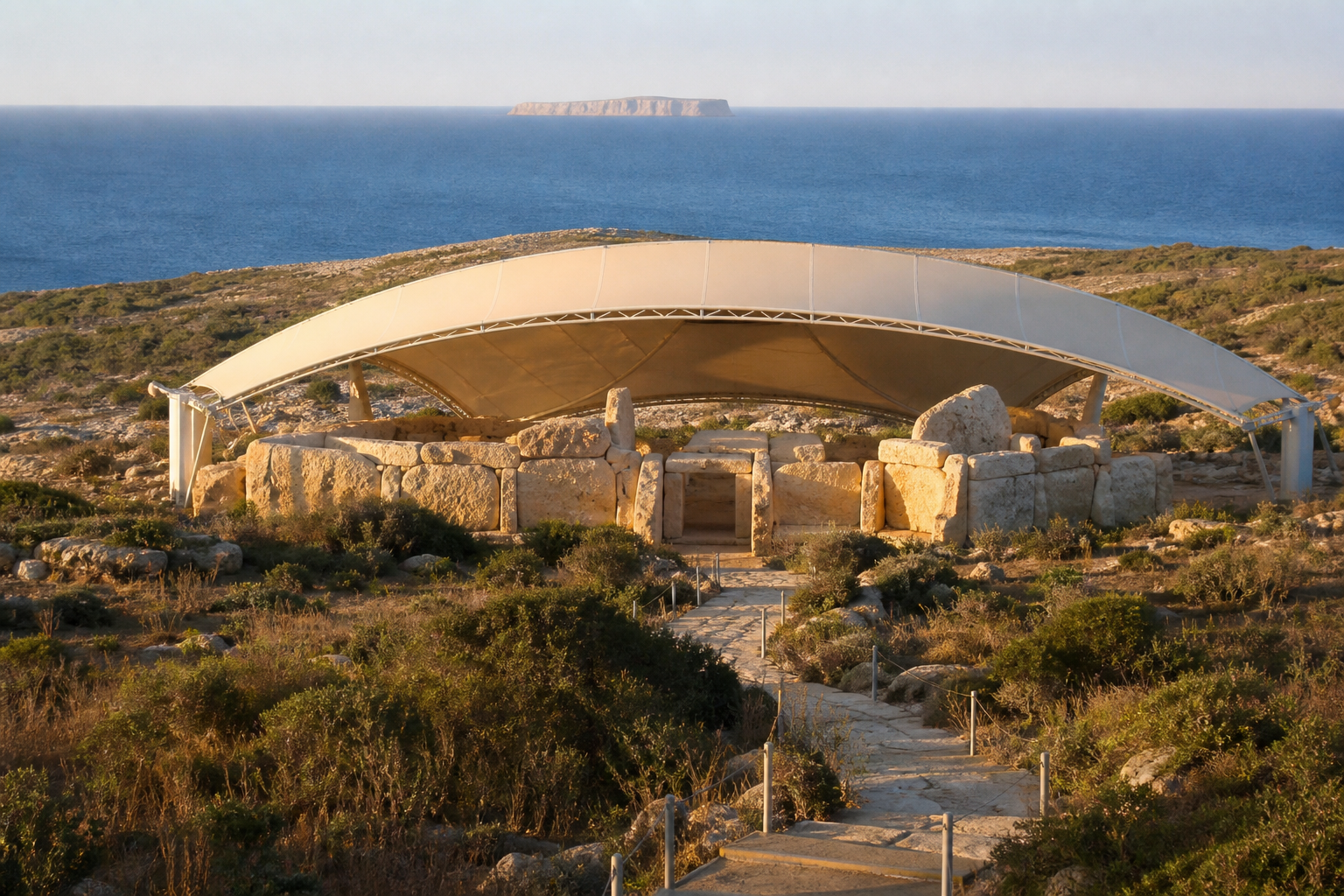
There are temples you visit for the stones, and temples you visit for the setting. Ħaġar Qim and Mnajdra give you both. Two prehistoric temple sites, more than five thousand years old, sitting on the wild southern edge of Malta with nothing in front of them but the sea and the small rocky islet of Filfla on the horizon.
They are just 500 metres apart, share one ticket and one visitor centre, and together make the best introduction to Malta’s temple builders you can get above ground. This guide covers what makes each site different, the famous solar alignment at Mnajdra, ticket prices and how to plan your visit.
Two temples, one archaeological park
Ħaġar Qim and Mnajdra sit inside a protected archaeological park near the village of Qrendi, on the south-west coast of Malta. Both date from the same great temple building period, roughly 3600 to 3200 BC, and both are part of the UNESCO World Heritage listing known as the Megalithic Temples of Malta.
Your visit starts at the visitor centre, which has a small exhibition explaining who built the temples and why the area matters. From there, a short path leads to Ħaġar Qim on the hilltop, and a second, longer path runs downhill towards the sea to Mnajdra.
Since 2008, both sites have been covered by large protective shelters. They look strange in photographs, a bit like giant white tents, but they are there for a good reason. The temples were only excavated in the 1800s, and since then wind, rain and sun have been wearing the stone away at a rate archaeologists could actually measure. The shelters slow that damage down. Once you’re standing underneath, you stop noticing them.
Ħaġar Qim: the temple on the hill
Ħaġar Qim means something like “standing stones” in Maltese, and the name is well earned. The outer wall is built from huge slabs of soft globigerina limestone, the same honey-coloured stone you see all over Malta, and some of them are enormous. One of the upright slabs is often described as the largest stone used in any Maltese temple, around seven metres long.
Unlike most Maltese temples, which follow a neat clover-leaf plan, Ħaġar Qim feels more like a complex that grew over time. Rooms open into other rooms, there are extra entrances, and in places you can see where the builders changed their minds. Look out for the decorated altar blocks with drilled pitting, and the “porthole” doorways cut through a single slab of stone.
Some of Malta’s most famous prehistoric finds came from here, including several of the rounded stone figures often called the “fat ladies” of Malta. They’re now kept safely at the National Museum of Archaeology in Valletta, which is worth visiting before or after the temples.
Mnajdra: the temple that tracks the sun
Walk down the path from Ħaġar Qim and the view opens up completely: cliffs, sea, Filfla, and below you, tucked into a hollow just above the coast, Mnajdra.
Mnajdra is actually three temples side by side, built at different times. The lower temple is the one everyone talks about, because of how carefully it was lined up with the sun.
At sunrise on the spring and autumn equinoxes, around 20 to 21 March and 22 to 23 September, sunlight passes straight through the main doorway of the lower temple and lights up the central passage. At the summer and winter solstices, the first light falls instead on the edges of decorated stone slabs on either side of the inner doorway. It’s hard to imagine this was an accident. The people who built Mnajdra were clearly watching the sun across the year, very likely to keep track of the farming calendar.
Heritage Malta sometimes organises special early morning openings around the equinoxes so visitors can see the effect. Keep an eye on their events page if your trip falls around those dates.
Mnajdra is also simply the more beautiful of the two. The stonework is finer, the setting is wilder, and with the sea right behind it, it’s the place where most visitors take their best photos.
Ticket prices
One ticket covers both Ħaġar Qim and Mnajdra, as well as the visitor centre.
| Ticket | Price |
|---|---|
| Adults (18+) | €10.00 |
| Youths (12-17) | €7.50 |
| Senior citizens (60+) | €7.50 |
| Concessions and students | €7.50 |
| Children (6-11) | €5.50 |
| Infants (1-5) | Free |
| Heritage Malta members and Passport holders | Free |
Prices can change, so check the official Ħaġar Qim and Mnajdra page on the Heritage Malta website before you go. Keep your ticket after visiting Ħaġar Qim, because you’ll need to show it again at the entrance to Mnajdra.
The site is also included in the Heritage Malta Multisite Pass. If you’re planning to visit several museums and temples, our complete guide to Heritage Malta museums and sites explains whether the pass is worth it for you.
Opening hours
The park is open daily, with longer hours in summer and shorter hours in winter, and last admission is usually 30 minutes before closing. Since times change with the seasons, always check the current hours on the Heritage Malta website before setting off. Like all Heritage Malta sites, it’s closed on 24, 25 and 31 December, 1 January and Good Friday.
How long you need
Plan on around one and a half to two hours. That gives you time for the visitor centre exhibition, Ħaġar Qim, the walk down to Mnajdra and back, and a few minutes just sitting and looking at the view, which is honestly part of the experience.
Accessibility
According to Heritage Malta, the visitor centre and Ħaġar Qim are accessible, but Mnajdra is not. The path down to Mnajdra is sloped and uneven in places, and the walk back up is steeper than it looks on the way down.
How to get there
By car: the park is about 15 km from Valletta, near Qrendi, with a car park at the entrance. It’s the easiest option if you want to combine the temples with other stops on the south coast.
By bus: public buses run to the site from Valletta and other parts of Malta. Check the current route and timetable on the Malta Public Transport website or app before you travel, as services in this rural area are less frequent.
Address: Triq Ħaġar Qim, Qrendi.
Make a morning of it on the south coast
Ħaġar Qim and Mnajdra sit in one of the most scenic corners of Malta, so it’s worth building a half day around them:
- Blue Grotto: just down the road in Wied iż-Żurrieq. Take a boat trip into the sea caves in the morning, when the light makes the water glow. Read our Blue Grotto guide.
- The temples: visit Ħaġar Qim and Mnajdra afterwards, when the morning crowds start to thin.
- Ħamrija Tower and the Misqa Tanks: look out for the old coastal watchtower near Mnajdra and the ancient rock-cut water reservoirs on the plateau above.
- Għar Lapsi: finish with a swim at this rocky inlet a short drive west. Our Għar Lapsi guide has the details.
- Dingli Cliffs: or stay for sunset at Dingli Cliffs, Malta’s highest point.
Tips before you go
- Bring water and a hat. The path between the two temples is fully exposed, and the south coast gets very hot in summer.
- Wear proper shoes. The walk to Mnajdra is downhill on the way there and uphill on the way back.
- Go early or late. Tour groups tend to arrive mid-morning. The late afternoon light is beautiful, but check the last admission time.
- See the finds too. Combine your visit with the National Museum of Archaeology in Valletta, where the statues and objects found here are displayed.
- Visit Ġgantija as well. If you’re heading to Gozo, our Ġgantija Temples guide covers Malta’s other great temple site.
Frequently asked questions
How old are Ħaġar Qim and Mnajdra? Both date from roughly 3600 to 3200 BC, making them older than Stonehenge and the pyramids of Egypt.
Does one ticket cover both temples? Yes. Your ticket includes Ħaġar Qim, Mnajdra and the visitor centre.
How far apart are they? About 500 metres, connected by a footpath.
Why are the temples covered? Protective shelters were built in 2008 to slow down damage from sun, wind and rain.
When can you see the sunrise alignment at Mnajdra? At the spring and autumn equinoxes, around 20 to 21 March and 22 to 23 September, when sunlight shines through the main doorway of the lower temple.
Is it included in the Heritage Malta Multisite Pass? Yes.
Is it suitable for wheelchairs? The visitor centre and Ħaġar Qim are accessible, Mnajdra is not.
Plan your visit
Site: Ħaġar Qim and Mnajdra Archaeological Park, Triq Ħaġar Qim, Qrendi Phone: 21424231 Managed by: Heritage Malta Ticket includes: Ħaġar Qim, Mnajdra and the visitor centre Duration: 1.5 to 2 hours Booking: Online through the Heritage Malta store or at the visitor centre Closed: 24, 25 and 31 December, 1 January, Good Friday Nearby: Blue Grotto, Għar Lapsi, Dingli Cliffs Best time: Early morning, late afternoon, or sunrise at the equinoxes
Beautiful Malta is an independent travel guide and is not affiliated with Heritage Malta. Always check opening hours and prices on the official Heritage Malta website before visiting.