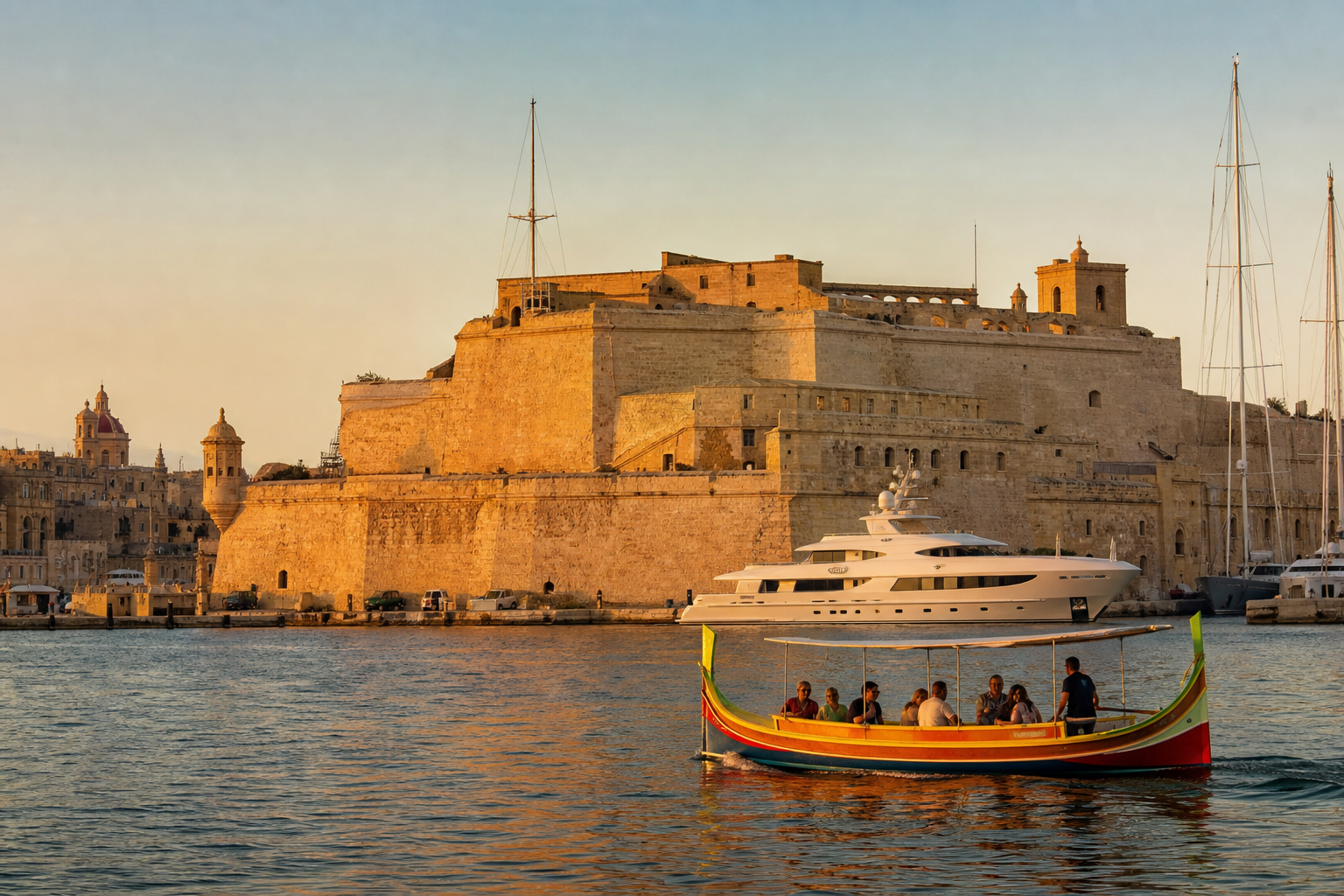
If Fort St Elmo is where the Great Siege of 1565 began, Fort St Angelo is where it was won. From the tip of Birgu, this fortress has watched over the Grand Harbour for centuries, and for much of that time, whoever held it held Malta.
Heritage Malta’s own description puts it well: no other fortress has been as closely tied to Malta’s destiny. Today it’s open to visitors, with restored ramparts, immersive exhibitions, huge cannons and some of the best views in the country. This guide covers its long story, what to see inside, tickets and how to get there.
Much older than it looks
Fort St Angelo stands on a rocky point that has been fortified for a very long time. Long before the Knights arrived, a medieval castle known as the Castrum Maris, the “castle by the sea”, stood here to protect the harbour and the little town that grew up around it.
When the Knights of St John arrived in Malta in 1530, they chose Birgu as their first home and made this old castle their headquarters. They rebuilt and strengthened it, turning it into the fortress whose shape you see today.
The Great Siege of 1565
In May 1565, a massive Ottoman fleet arrived off Malta. Grand Master Jean de Valette and his Knights, supported by Maltese soldiers and townspeople, had far fewer men. The Ottoman plan was to take Fort St Elmo first, then turn on Birgu and Senglea.
Fort St Elmo held out for around a month before falling, and that delay changed everything. Through the long, brutal summer that followed, Fort St Angelo was the heart of the defence. De Valette directed the fighting from here, and the fort’s guns covered the harbour and the walls of Birgu and Senglea as the Ottomans attacked again and again.
In September, a relief force finally arrived from Sicily and the exhausted Ottoman army withdrew. The victory made the Knights famous across Europe, and Birgu was renamed Città Vittoriosa, the “victorious city”. It’s still known as Vittoriosa today. Within months, the Knights began building a brand new fortified capital across the harbour: Valletta.
For the other half of this story, read our guide to Fort St Elmo and the National War Museum.
From the Knights to the Royal Navy
After the Knights left Malta, the British took over the fort, and for much of the 20th century it served the Royal Navy, which even treated it as a “ship” on land under the name HMS St Angelo. During the Second World War, as Malta was bombed relentlessly, the fort is reported to have taken dozens of direct hits and still kept going.
In 1998, part of the upper fort was leased to the Sovereign Military Order of Malta, the modern-day successor of the Knights, bringing the Order back to the very place where it had once ruled. Following an agreement with Heritage Malta, visitors can now explore this upper area too.
What you’ll see
- The ramparts and bastions. Walk the walls with Valletta directly across the water, Senglea beside you and the whole Grand Harbour spread out below. On a clear day, this is one of the finest views in Malta.
- The exhibitions. Through traditional and immersive displays, the fort tells its story from the medieval castle through the Great Siege and the British period.
- The artillery. Heritage Malta describes its gun collection as staggering, and they’re not exaggerating. Seeing the size of these cannons up close helps you imagine what the harbour sounded like in battle.
- The upper fort. The Magistral Palace, the Keep and the Chapel of St Anne, which is one of the oldest parts of the fort.
Ticket prices
| Ticket | Price |
|---|---|
| Adults (18+) | €10.00 |
| Youths (12-17) | €6.00 |
| Senior citizens (60+) | €6.00 |
| Concessions and students | €6.00 |
| Children (6-11) | €4.00 |
| Infants (1-5) | Free |
| Heritage Malta members and Passport holders | Free |
Prices can change, so check the official Fort St Angelo page on the Heritage Malta website before your visit. Fort St Angelo is also included in the Heritage Malta Multisite Pass, which can save you money if you’re visiting several sites. We break down the numbers in our guide to whether the Heritage Malta Multisite Pass is worth it.
How long you need
Heritage Malta recommends around two hours. That’s enough to walk the ramparts, see the exhibitions and the upper fort, and stop for a drink with a view.
Facilities and accessibility
There’s a museum shop selling souvenirs, light snacks and drinks, and restrooms around the site. For visitors with limited mobility, Heritage Malta says electric vehicles are available to help wheelchair users across the areas it manages. Expect some slopes and uneven historic surfaces, as with any old fortress.
Opening hours
The fort is open daily, with seasonal changes to opening times. Check the current hours on the Heritage Malta website before you go. Like all Heritage Malta sites, it’s closed on 24, 25 and 31 December, 1 January and Good Friday.
How to get there
By ferry from Valletta (the best way): the Three Cities ferry crosses the Grand Harbour from the Valletta waterfront below the Upper Barrakka Gardens in just a few minutes, and the views of the fort as you approach are worth the trip alone. From the Birgu landing, it’s a short walk along the waterfront to the fort entrance.
By bus: take a bus to Birgu and walk down through the old town to the waterfront. It’s around a 10 minute walk.
Address: Xatt l-Assedju l-Kbir 1565, Birgu.
Make a day of it in Birgu
- Morning: ferry from Valletta, then Fort St Angelo while it’s cooler.
- Lunch: one of the restaurants along the Birgu waterfront, facing the yachts.
- Afternoon: the Inquisitor’s Palace, another Heritage Malta site in the heart of Birgu, then wander the narrow streets of the old town.
- Evening: cross to Senglea and watch the sunset over Valletta from the Gardjola Gardens.
Our Three Cities guide covers Birgu, Senglea and Cospicua in more detail. And if you’re visiting in early October, don’t miss Birgu by Candlelight, when the whole town glows under thousands of candles.
Tips before you go
- Bring water and a hat. There’s very little shade on the ramparts.
- Visit Fort St Elmo too. The two forts face each other across the harbour and together tell the full story of the Great Siege.
- Go late in the day for photos. The afternoon light on Valletta’s bastions is beautiful from the upper fort, but check the last admission time.
- Wear comfortable shoes. You’ll be climbing ramps and stairs.
Frequently asked questions
Why is Fort St Angelo important? It was the headquarters of the Knights of St John during the Great Siege of 1565, the battle that saved Malta from Ottoman conquest.
How much is the ticket? €10 for adults, €6 for youths, seniors and students, €4 for children aged 6 to 11, and free for infants.
Can you visit the upper part of the fort? Yes. Following an agreement with the Sovereign Military Order of Malta, the Magistral Palace, the Keep and the Chapel of St Anne are open to visitors.
How long do you need? Around two hours.
Is it included in the Heritage Malta Multisite Pass? Yes.
What’s the best way to get there? The ferry from Valletta to the Three Cities, followed by a short walk along the Birgu waterfront.
Plan your visit
Site: Fort St Angelo, Xatt l-Assedju l-Kbir 1565, Birgu Phone: 25401800 Managed by: Heritage Malta Duration: About 2 hours Highlights: Ramparts, artillery, Magistral Palace, Chapel of St Anne, Grand Harbour views Booking: Online through the Heritage Malta store or at the entrance Closed: 24, 25 and 31 December, 1 January, Good Friday Nearby: Inquisitor’s Palace, Birgu waterfront, Senglea
Beautiful Malta is an independent travel guide and is not affiliated with Heritage Malta. Always check opening hours and prices on the official Heritage Malta website before visiting.