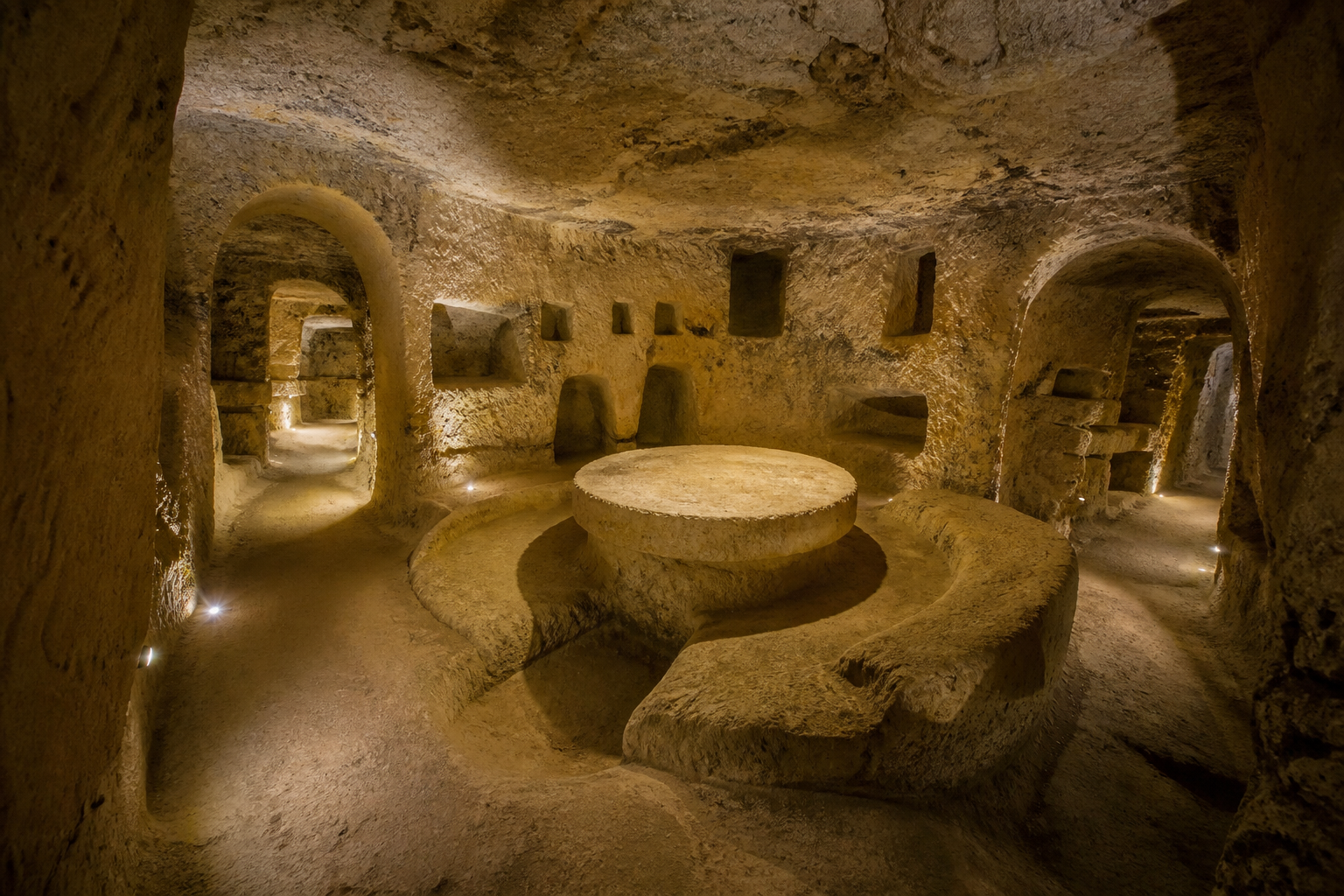
Most people come to Rabat on their way to Mdina, walk past it in ten minutes and never realise what’s under their feet. Beneath the ordinary streets of this busy town lies one of the largest underground cemeteries of Roman Malta, and just outside Mdina’s walls sit the remains of a wealthy Roman townhouse with some of the finest mosaics in the Mediterranean.
St Paul’s Catacombs and the Domvs Romana are both run by Heritage Malta, sit about ten minutes’ walk apart, and together tell the story of Roman Malta better than anywhere else on the island. This guide covers both, with tickets, timings and how to fit them into a day with Mdina.
Why Rabat is full of Roman history
To understand these sites, you need one fact. In Roman times, Mdina and Rabat were a single city called Melite, roughly three times the size of the walled Mdina you see today. Our Mdina guide explains how the city later shrank behind smaller walls and how Rabat grew from the part left outside.
Roman law didn’t allow the dead to be buried inside a city. So the people of Melite dug their tombs just beyond the edge of town, into the soft limestone, creating a vast network of underground burial places. Many of those tombs now lie under the streets of modern Rabat, which is why the town has so many catacombs.
St Paul’s Catacombs
St Paul’s Catacombs are the largest and best known of these underground cemeteries. They were used from around the 3rd century AD, by pagans, Jews and Christians alike, and the site is considered one of the most important early Christian sites in Malta. In 2026, St Paul’s Catacombs became the first site in Malta to be awarded the European Heritage Label, recognising their importance for Europe’s shared history.
The name comes from the tradition that St Paul stayed in this area after his shipwreck on Malta, but the catacombs themselves were built centuries later. They were cleared and studied by archaeologist Antonio Annetto Caruana in 1894, and since then they’ve become one of Rabat’s main attractions.
What you’ll see underground
The site is made up of a main complex and a number of smaller hypogea, or underground tombs, spread across the area. As you go down the steps, the passages branch off into chambers lined with tombs of different shapes and sizes, from simple graves cut into the floor to elaborate canopied tombs for wealthier families.
The highlight is the agape tables. These are round tables carved straight out of the rock, with a sloping bench around them. Families would gather here to share a meal in memory of the person they’d lost, a tradition that was common across the Roman world but rarely survives so clearly. Standing next to one, you suddenly see the catacombs not just as a cemetery, but as a place where people came to remember.
The visitor centre
Start at the visitor centre at the entrance. It explains how the catacombs were used, who was buried there and how archaeologists have studied them, and it makes the walk underground far more meaningful.
Good to know before you go down
- Low ceilings and narrow passages. Some parts are tight. If you’re claustrophobic, you may prefer to stick to the larger chambers.
- Lots of steps. The visitor centre is accessible, but much of the underground area is not suitable for wheelchairs.
- Cool underground. It’s noticeably cooler below ground, which is welcome in summer.
- Good shoes. The floors are uneven, original rock.
The Domvs Romana
A short walk away, just outside Mdina’s walls, the Domvs Romana takes you back to the city above ground. “Domus” is the Latin word for a house, and this was the home of a wealthy Roman family in Melite.
The remains were discovered in 1881, and a museum was built over them soon after, making it one of the oldest museum buildings in Malta. Inside, you’ll walk around the original floors of the house and see objects found during excavations, including statues, pottery and everyday items that show how comfortably the island’s Roman elite lived.
The mosaics
The real treasures are the mosaic floors. Made from thousands of tiny coloured stones, they’re among the finest and oldest Roman mosaics found anywhere in the Mediterranean. The most famous shows two birds drinking from a bowl, so finely made that from a step back it almost looks painted. Take your time here, because the detail rewards a closer look.
There’s another layer of history too. Centuries after the house fell into ruin, the site was used as a Muslim cemetery during the medieval period, and the museum explains this later chapter of the site’s story as well.
Tickets
St Paul’s Catacombs and the Domvs Romana each have their own ticket, and both are included in the Heritage Malta Multisite Pass. Heritage Malta also offers combo tickets that group sites in the same area, so you can see the catacombs, the Domvs Romana and the National Museum of Natural History in Mdina on one ticket.
Ticket prices are updated from time to time, so check the current prices on the official Heritage Malta website before you go. If you’re planning to visit several sites during your trip, our guide to the Heritage Malta Multisite Pass helps you work out whether the pass will save you money.
Opening hours
Both sites are usually open daily, with seasonal changes to opening times and last admission around 30 minutes before closing. Like all Heritage Malta sites, they’re closed on 24, 25 and 31 December, 1 January and Good Friday. Always check the current times on the Heritage Malta website before visiting.
How long you need
- St Paul’s Catacombs: around one to one and a half hours, including the visitor centre.
- Domvs Romana: around 45 minutes to an hour.
Add Mdina and a coffee break, and you have a very comfortable half day.
How to get there
By bus: routes 51, 52 and 53 run from Valletta to Rabat and Mdina, taking around 30 to 40 minutes depending on traffic. Check the Malta Public Transport website or app for current timetables.
On foot: from Mdina’s main gate, the Domvs Romana is just a few minutes’ walk, and St Paul’s Catacombs are around ten minutes further into Rabat along St Paul’s Street and St Agatha Street.
By car: parking in Rabat can be tight. The car parks near Mdina’s entrance are often the easiest option, and everything else is within walking distance.
Nearby, but run separately
Rabat has a few more underground sites that are worth knowing about, but they are not run by Heritage Malta and need separate tickets:
- St Paul’s Grotto and the Wignacourt Museum: the cave where tradition says St Paul stayed, with a museum, more catacombs and wartime shelters beneath.
- St Agatha’s Catacombs: another catacomb complex with a crypt decorated with medieval frescoes.
A half day in Rabat and Mdina
- Morning: St Paul’s Catacombs, while it’s quiet and cool underground.
- Late morning: walk to the Domvs Romana for the mosaics.
- Lunch: grab some pastizzi from a Rabat bakery, a local favourite.
- Afternoon: cross into Mdina, visit the cathedral and the Natural History Museum, and end with cake on the bastions.
- Sunset: drive ten minutes to Dingli Cliffs for the views.
Frequently asked questions
Are St Paul’s Catacombs worth visiting? Yes. They’re one of the most important early Christian sites in Malta, the first Maltese site with the European Heritage Label, and very different from anything else on the island.
Did St Paul really stay in the catacombs? No. The catacombs were built centuries after St Paul’s time. The name comes from the tradition linking St Paul to this area of Rabat.
What are agape tables? Round tables carved from the rock where families shared a meal in memory of the dead.
Is the Domvs Romana the same as St Paul’s Catacombs? No. They’re two separate Heritage Malta sites about ten minutes’ walk apart, each with its own ticket.
Are they included in the Heritage Malta Multisite Pass? Yes, both are included.
Is it suitable for children? Older children usually love exploring the catacombs. Younger kids may find the narrow, dim passages a bit much, so judge by your family.
Can I visit with a wheelchair? The visitor centres are accessible, but much of the underground catacombs are not.
Plan your visit
Sites: St Paul’s Catacombs (St Agatha Street, Rabat) and the Domvs Romana (Rabat, just outside Mdina) Managed by: Heritage Malta Duration: Catacombs 1 to 1.5 hours, Domvs Romana up to 1 hour Tickets: Separate tickets, combo tickets and the Multisite Pass available Closed: 24, 25 and 31 December, 1 January, Good Friday Nearby: Mdina, National Museum of Natural History, St Paul’s Grotto, Dingli Cliffs Best time: Morning
Beautiful Malta is an independent travel guide and is not affiliated with Heritage Malta. Always check opening hours and prices on the official Heritage Malta website before visiting.